SRINAGAR: In a major milestone for rail connectivity in Jammu and Kashmir, the Vande Bharat Express service has been formally extended to Jammu, enabling for the first time a direct train link between Jammu and Srinagar. The upgraded service, now operating with 20 coaches instead of eight, will allow nearly 2,800 passengers to travel daily between the two regions.
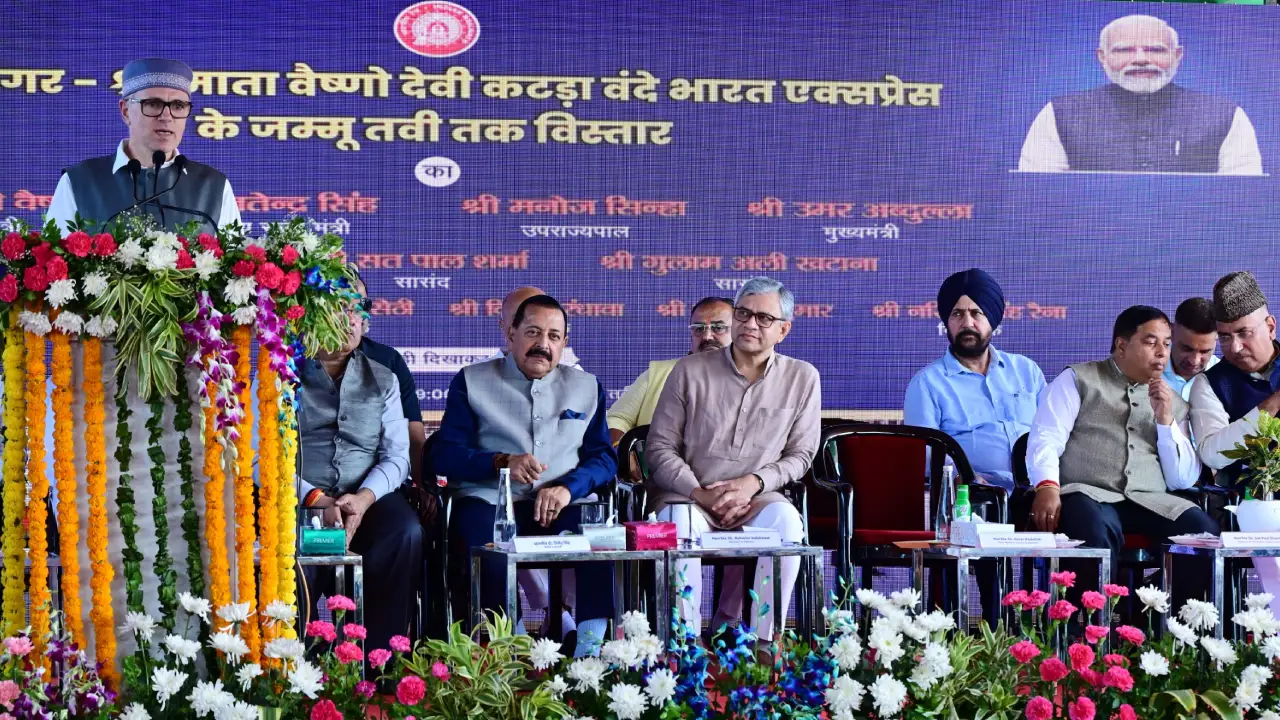
The train was flagged off by Union Railway Minister Ashwini Vaishnaw in the presence of Jammu and Kashmir Chief Minister Omar Abdullah, Union Minister of State Jitendra Singh, Members of Parliament, and senior railway and government officials at Jammu Railway Station.
Describing the development as “historic,” the Chief Minister said the extension marks a long-awaited breakthrough in connectivity and signals the beginning of a transformative phase in the region’s infrastructure and economic growth.
Officials said the train’s capacity has been expanded from around 500 passengers in an 8-coach configuration to nearly 1,400 passengers per trip with 20 coaches. With two such services now operating, the corridor can handle close to 2,800 passengers daily, significantly easing travel between Jammu and Srinagar.
Railway Minister Vaishnaw said the service has recorded 100 per cent occupancy since its launch, with over 5.5 lakh passengers already travelling on the route, an indication of strong public demand and acceptance.
The direct rail link eliminates dependence on road travel along the Jammu–Srinagar highway, offering a faster, more reliable and all-weather alternative. The Vande Bharat trains deployed on the route are specially engineered to operate in extreme conditions, including temperatures as low as minus 10°C, with advanced systems designed for high-altitude terrain.
Calling the service a “lifeline,” Vaishnaw said it will significantly promote tourism, facilitate pilgrimage travel, and strengthen the regional economy. Onboard services have also been localised, with Dogri and Kashmiri cuisines introduced for passengers.
Beyond passenger travel, the rail corridor is emerging as a key logistics backbone for Jammu and Kashmir. Authorities said the line is already enabling efficient transportation of essential goods such as cement, steel, automobiles, and food supplies into the Valley.
At the same time, outbound logistics have improved considerably, with horticultural produce, including apples, cherries, milk and other perishables, being transported to markets across the country. Railway officials said more than 2 crore kilograms of apples have already been moved via rail, reducing costs and transit time for growers and traders.
Chief Minister Omar Abdullah noted that automobiles are now being transported directly to Srinagar by rail, marking a major logistical shift. He added that improved connectivity is opening new economic opportunities for farmers, traders and local industries.
The Railway Ministry said further capacity enhancement works are in progress, including doubling of the Qazigund–Baramulla railway line, installation of automatic signalling systems, and construction of additional crossing stations to streamline operations.
New rail projects such as the Poonch–Rajouri link and the Uri–Baramulla extension are also in planning and DPR stages. Additionally, Jammu Tawi Railway Station is undergoing redevelopment with modern infrastructure and expanded platforms.
The Minister also highlighted parallel infrastructure upgrades, including improvements in the Jalandhar–Jammu rail corridor and road projects such as the Delhi–Ambala four-laning initiative.
In a forward-looking proposal, the Chief Minister urged the Railway Ministry to establish an inland dry port in Jammu and Kashmir. He said the facility would enable customs clearance within the region, simplifying export processes and boosting trade competitiveness.
With the Amarnath Yatra approaching, Railways has assured special arrangements for pilgrims. The extended service is also expected to benefit Mata Vaishno Devi pilgrims by improving last-mile connectivity and easing travel congestion during peak seasons.
Passengers onboard the inaugural run described the journey as “historic” and “comfortable,” with many highlighting the reliability and reduced travel uncertainty compared to road transport.
The extension of the Vande Bharat Express to Jammu completes a crucial segment of the Udhampur-Srinagar-Baramulla Rail Link (USBRL), bringing the Kashmir Valley closer to the national rail network.
“This is the day we had been waiting for years. A dream has finally been realised,” Chief Minister Omar Abdullah said, adding that the rail link has made Jammu and Kashmir “more connected than ever before.”