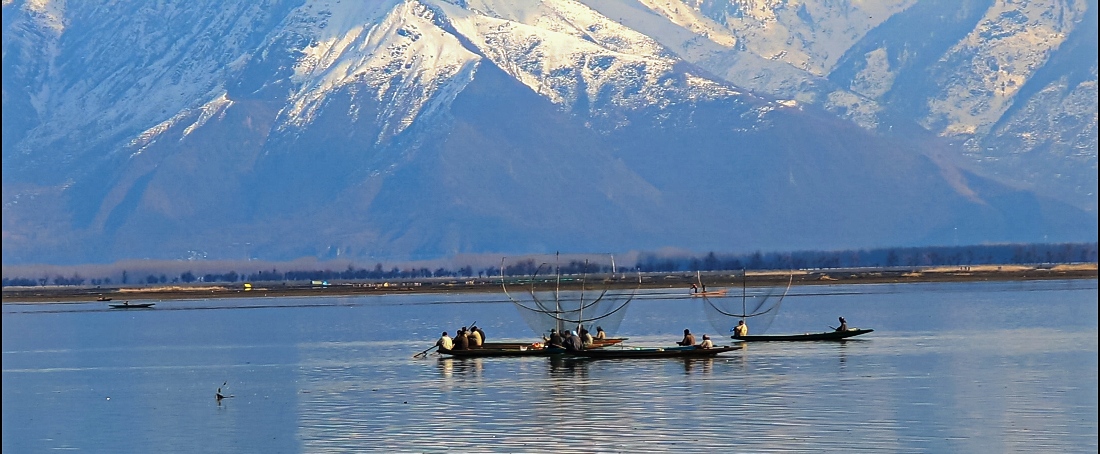
SRINAGAR: In a landmark development for the Wular Lake community, four Members of the Legislative Assembly (MLAs) visited the fishing area of Zurmunz Wular on November 10, 2024 to engage directly with the fisherfolk and address long-standing concerns impacting their livelihoods and the lake’s environment. The visit, organised by dedicated community leaders, marked a significant step in fostering collaborative efforts to protect Wular Lake’s ecosystem and support the local fishing community.
The visit included MLAs Nizam-u-din Bhat (Bandipora), Hilal Akbar Lone (Sonawari), Irshad Ahmad Kar (Sopore), and Irfan Hafeez Lone (Wagoora – Kreeri). These lawmakers joined Ghulam Hassan Bhat, President of the Wular Fisherfolk Union, along with community leaders Naseer Ahmed Dar, Bashir Ahmed, and Farooq Ahmed Dar, who coordinated the event. Environmentalist Dr Shaikh Ghulam Rasool, known for his work in climate justice, also attended the gathering.
Opening the event, Ghulam Hassan Bhat welcomed the MLAs, recognising the visit as a crucial milestone in advocating for the fisherfolk’s rights. Leading the discussions, Naseer Ahmed Dar outlined the community’s challenges, emphasising the need for solutions that prioritise sustainable practices and the rights of local residents.
Dr Shaikh Ghulam Rasool, in his keynote address, highlighted the fisherfolk’s fundamental rights to access resources such as fish and water chestnuts, also calling for fair tax policies. He expressed serious concerns over environmental and pollution issues affecting Wular Lake and the impact on local livelihoods, questioning the allocation of funds meant for lake conservation.
Dr Shaikh also acknowledged the contributions of Omar Abdullah, whose legislative initiatives in his earlierterm as Chief Minister, including the Right to Information Act of 2009 and the Public Service Guarantee Act of 2012, empowered the community and bolstered transparency. “With continued support, we are hopeful that solutions to the urgent issues faced by Wular’s fisherfolk can be achieved,” he said.
The MLAs voiced a shared commitment to supporting the fishing community while addressing the urgent need to conserve Wular Lake. The representatives pledged to work on securing access to essential resources for the community, advocating for their rights to harvest water chestnuts, fish, and use the lake’s resources sustainably. The MLAs agreed that this approach would protect the community’s independence and ensure its resilience.
Each legislator addressed specific priorities for the community. Nizam-u-din Bhat pledged to pursue policy measures to guarantee land rights and essential resources for the fisherfolk.
Hilal Akbar Lone called for urgent reforms that acknowledge the community’s traditional claims to Wular’s resources, demanding greater transparency and accountability from the Wular Conservation and Management Authority (WUCMA).
Irshad Ahmad Kar focused on the need for WUCMA to responsibly utilise funds, ensuring that conservation efforts benefit both the lake’s ecosystem and the fishing community.
Irfan Hafeez Lone emphasised his dedication to sustainable development, promoting nature-based tourism, and integrating local knowledge into conservation projects.
In his previous role on the District Development Council, Lone secured housing land for 40 fisherfolk families, giving them stability near their primary livelihood source.
The event brought into sharp focus the environmental losses suffered by Wular Lake in recent years. According to fisheries data, Wular once supported 63 species of fish, but only 13 remain today, with nine now classified as rare. Iconic species, including the Euro-Asian Otter and various bird species, have disappeared. The lotus stem, a key part of the lake’s ecosystem, was lost following the 2014 floods. The lake’s area has also shrunk significantly, from 269 to 149 square kilometres, impacting water quality and reducing fish stocks.
This landmark visit underscored the importance of a cooperative approach between policymakers and the fishing community to safeguard Wular Lake’s environment and ensure sustainable livelihoods. The Wular Fisherfolk Union expressed deep gratitude to the MLAs and dignitaries who participated, welcoming their commitment to supporting both the ecosystem and the people who depend on it for generations to come.