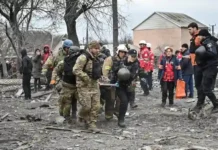
SRINAGAR: The death toll from devastating flash floods in Nepal has risen to 675, while nearly 2,500 people remain missing as rescuers continue searching through mud, debris and damaged infrastructure in some of the worst-hit parts of the country.
Authorities have stepped up rescue and relief operations in the aftermath of Wednesday’s disaster, which swept through communities along the Nepal-China border after a massive collapse of ice, rock and debris in the Himalayan region unleashed torrents of water downstream.
Nepal’s disaster authorities reported 675 deaths and 2,498 people missing. More than 7,500 people have been rescued so far, according to the latest figures.
Across the border in China’s Tibet region, authorities have reported 16 deaths and 546 people missing, taking the combined number of missing people in Nepal and Tibet to more than 3,000.
The scale of the disaster has left entire settlements buried beneath mud and debris, while roads, bridges and hydropower installations have been destroyed. Rescue teams have struggled to reach several remote areas because of damaged roads, unstable terrain and continuing bad weather.
The floods began after a high-altitude collapse sent enormous quantities of ice, rock and debris into the river system near the Nepal-Tibet border. The surge entered the Lhende Khola before moving into the Bhote Koshi and Trishuli river systems, sending floodwaters through several districts in central Nepal. Al Jazeera reported that the Trishuli River rose by as much as nine metres within about 30 minutes during the disaster.
The event was initially linked to a possible earthquake, but subsequent analysis indicated that the seismic signal was generated by the massive landslide itself. Scientists have also pointed to the growing instability of high-altitude glaciers and mountain slopes as a wider concern in a warming Himalayan region.
Rescue Efforts Complicated By Terrain
More than 14,000 rescue personnel have been deployed in Nepal, with helicopters being used to reach communities cut off by collapsed roads and bridges.
In several areas, rescuers have been forced to work through thick layers of mud and massive boulders deposited by the floodwaters. Poor weather has periodically interrupted helicopter operations, further slowing efforts to reach stranded residents.
One of the most difficult operations is taking place at hydropower projects along the affected river corridor, where workers are believed to have been trapped inside tunnels filled with mud.
Specialist teams from India and China have joined Nepalese authorities in efforts to locate and rescue those trapped. AP reported that more than 100 people were believed to be stranded at hydropower sites, with rescuers working to clear mud and establish access to the tunnels.
Fresh Flood Threat
Rescue operations were also complicated by the formation of a new lake near the site of the Himalayan collapse, raising fears that a sudden release of water could trigger another destructive surge.
Those fears led authorities to temporarily suspend some rescue operations. The situation later improved as the lake began shrinking. Reuters reported that satellite monitoring showed the lake had reduced significantly, although authorities continued to monitor the area for further hazards.
Al Jazeera reported that rescue teams resumed operations after the immediate threat from the newly formed lake eased, but authorities remained on alert for further flooding.
Families Search For Missing Relatives
As the rescue operation continues, families across Nepal are desperately searching for relatives who disappeared in the floods.
Hospitals and relief centres have become gathering points for people looking for information. Families have posted photographs and details of missing relatives on walls and noticeboards while officials work to identify bodies recovered from the disaster zone.
The humanitarian crisis extends beyond Nepalese citizens. Hundreds of foreign nationals are among those reported missing, including Indians, Americans and people from several other countries.
The disaster has also affected pilgrims and tourists travelling through the Himalayan border region. AP reported that around 90 Americans were among those unaccounted for, while Indian nationals are also among the missing.
India, China Provide Assistance
India has sent relief supplies and specialised rescue assistance to Nepal, while China has deployed rescue personnel and equipment on its side of the border.
Nepal has also sought international assistance for specialised tunnel rescue, survivor-detection technology and forensic identification of bodies.
Reuters reported that Nepal could require between $4 billion and $5 billion for reconstruction, a figure equivalent to nearly a tenth of the country’s economy. The floods have severely damaged roads, bridges, settlements and hydropower infrastructure, threatening major economic losses.
China has also announced emergency financial assistance and additional support for relief operations. Reuters reported that Beijing has allocated 220 million yuan, or about $32.7 million, for relief efforts.
The immediate focus, however, remains on finding survivors and accounting for those still missing.
With thousands still unaccounted for and large parts of the affected region difficult to access, rescuers are racing against time as families wait for news of loved ones and Nepal begins confronting the enormous task of recovery and reconstruction.