by Asad Mirza
SRINAGAR: Suhail Anjum’s much-awaited book has been released, sparking considerable interest among those passionate about Urdu journalism and its history. A senior journalist and a towering figure in Urdu journalism, Suhail Anjum has carved out a niche over his 35-year career, during which he has been associated with leading Urdu publications, including Weekly Blitz, Weekly Akbar-e Nau, and Weekly Hamara Qadam. From 1995 to 2008, he served as Sub Editor for the historic Urdu newspaper Qaumi Awaz, and since 2002, he has been the India Correspondent for the Urdu service of the Voice of America.
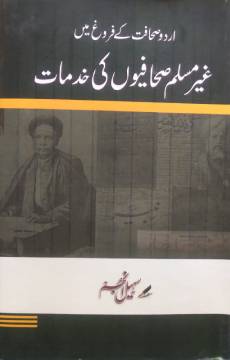
Suhail Anjum has authored over 40 books spanning multiple genres, with 12 of these focusing on various facets of Urdu journalism. His latest work, however, stands out as it delves into the often-overlooked contributions of non-Muslim journalists—Hindu, Sikh, and Christian—in shaping and promoting Urdu journalism in India. This book challenges the prevailing misconception that Urdu is exclusively the language of Indian Muslims, a stereotype perpetuated by successive governments. This mischaracterisation has often led to Urdu’s promotion being dismissed as an appeasement tactic, further fuelling political and social divides.
Through painstaking research, Suhail Anjum sheds light on the invaluable contributions of lesser-known Hindu journalists to the growth of Urdu journalism. His book features detailed pen sketches of 54 influential figures, including luminaries such as Harihar Dutt, Sada Sukh Lal, Kuldip Nayar, Vijay Kumar Chopra, Shanti Ranjan Bhattacharya, Fikr Taunsavi, GD Chandan, and Jamna Das Akhtar. Their work, spanning generations, underscores the rich pluralistic heritage of Urdu and its role as a cultural bridge across communities.
However, one omission from the list has raised eyebrows: Munshi Premchand. Widely regarded as one of India’s greatest authors, Premchand (1880–1936) began his literary career in Urdu before transitioning to Hindi. Despite continuing to write in Urdu until his death, Premchand’s absence from this compilation is puzzling. It may be attributed to his greater renown as a novelist and short story writer rather than as a journalist.
This book is essential reading for those who champion the idea of Ganga-Jamuni Tehzeeb—the syncretic culture of North India—as it establishes that Hindu journalists from regions as diverse as Uttar Pradesh, Bihar, Punjab, and Bengal played pivotal roles in the development and promotion of Urdu. By demonstrating that Urdu transcends religious boundaries, the book makes a compelling case for recognising the language as a shared cultural heritage rather than a marker of any single community.
The history of Urdu journalism cannot be fully appreciated without acknowledging the contributions of Hindu journalists, starting with the publication of the first Urdu newspaper, Jam-e Jahan Numa, by Harihar Dutt in 1822. Suhail Anjum’s meticulous scholarship honours this legacy, offering a fresh perspective on Urdu’s inclusive and diverse journey.
The book’s translation into English and Hindi would be a valuable step, broadening its reach and enabling more readers to appreciate the intricate tapestry of Urdu’s history and its role in India’s cultural ethos.
The 368-page book was published by Nomani Care Foundation, Lucknow.