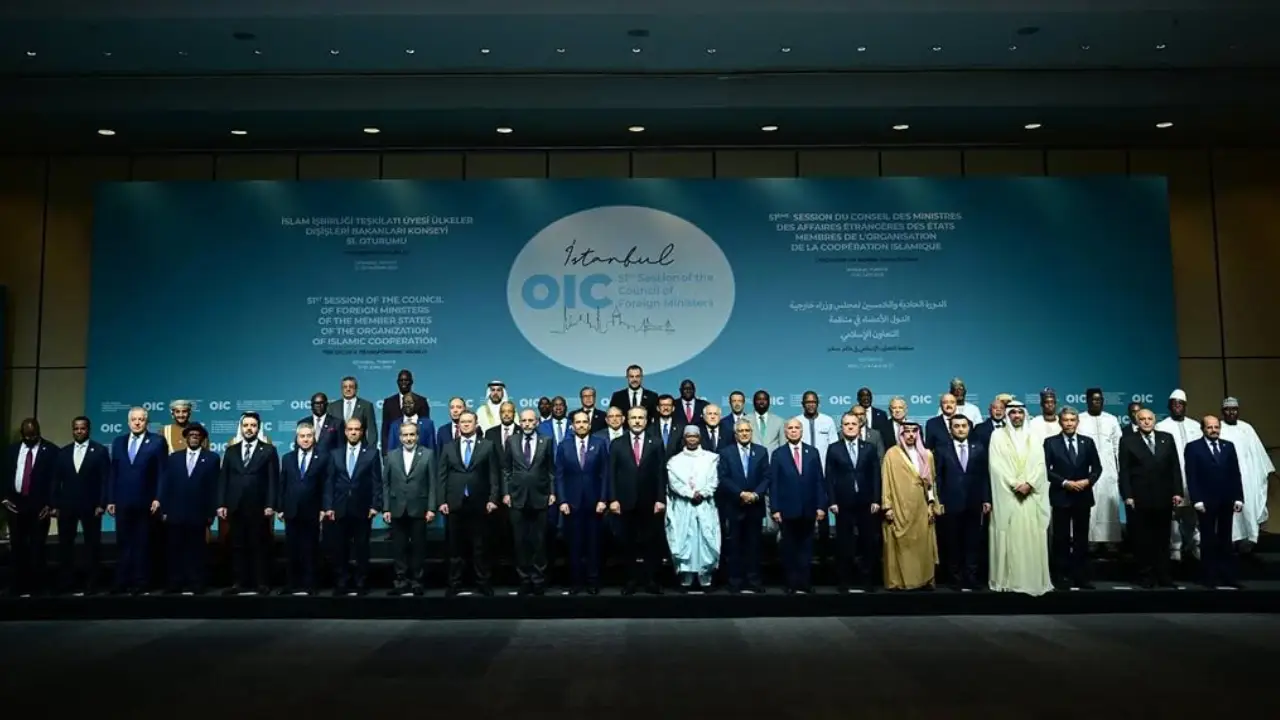
SRINAGAR: The 51st session of the Council of Foreign Ministers of the Organisation of Islamic Cooperation (OIC) opened in Istanbul on June 21, 2025, with a unified and forceful denunciation of Israeli military aggression across the region and an urgent call for international accountability, de-escalation, and coordinated humanitarian action. The session, convened under the theme The OIC in a Transforming World, drew unprecedented participation, with over 1,000 delegates from OIC member states and international organisations, making it one of the most widely attended in its history.
Saudi Foreign Minister Prince Faisal bin Farhan, speaking at the opening session, reaffirmed the Kingdom’s unwavering support for the Palestinian cause, calling for an immediate end to the war in Gaza and a return to diplomacy. Condemning the Israeli airstrikes on Iranian targets as a blatant violation of international law and a threat to regional security, he warned that continued provocations could destabilise the entire Middle East. He stressed Saudi Arabia’s commitment to the establishment of an independent Palestinian state along the 1967 borders with East Jerusalem as its capital, and reiterated support for a peaceful resolution in Yemen, where the Kingdom continues to back efforts to restore peace and security.
Bangladesh’s Foreign Affairs Adviser, Md Touhid Hossain, delivered one of the strongest calls for international legal action, urging the global community to hold Israel accountable for what he described as “unlawful and aggressive” military attacks. Citing violations of the UN Charter and Iranian sovereignty, Hossain called on OIC states to adopt a united and vocal stance in demanding justice through the International Court of Justice and the International Criminal Court. He also linked the Gaza crisis to wider issues confronting the Muslim world, including the Rohingya genocide and the need to combat Islamophobia globally. Expressing appreciation for the OIC’s inclusion of the Rohingya issue in its ten-year strategic programme, he urged deeper institutional reform and stronger implementation mechanisms within the organisation.
Turkish President Recep Tayyip Erdoğan, in a wide-ranging keynote address, warned of the emergence of a “new Sykes-Picot order” in the Middle East, where national borders are redrawn through force and bloodshed. Comparing the humanitarian disaster in Gaza to Nazi concentration camps, Erdoğan said over two million Palestinians were being subjected to unbearable siege conditions. He cited the deaths of more than 55,000 Palestinians, most of them women and children, and called Israel’s campaign in Gaza, Lebanon, Syria, and Iran a form of “state terrorism.” Expressing strong support for Iran’s right to self-defence, Erdoğan also offered his condolences to the Iranian victims of recent Israeli attacks and said Türkiye stood in solidarity with the Iranian people.
In a closed-door session requested by Iran, the OIC foreign ministers held a special consultation to deliberate on Israel’s recent cross-border attacks. Iranian Foreign Minister Abbas Araghchi met with Erdoğan on the sidelines of the conference, where both leaders discussed the need for urgent de-escalation. Türkiye offered to serve as a diplomatic conduit between Tehran and Washington, and Erdoğan emphasised the necessity of launching technical and high-level talks to prevent further deterioration in the region.
The humanitarian catastrophe in Gaza remained at the centre of the summit’s proceedings. UNRWA Commissioner-General Philippe Lazzarini warned that the situation had reached a breaking point, with over two million people facing starvation and the agency’s operational viability under threat due to severe funding shortages. Lazzarini appealed directly to OIC member states for political and financial support, stating that the lives and futures of millions of Palestinian refugees “are in your hands.” He highlighted the deadly pattern of Israeli attacks on food distribution sites and condemned the current aid delivery model, the Gaza Humanitarian Foundation, as both ineffective and lethal.
In addition to the core agenda of Gaza and Iran, the summit addressed broader challenges facing the Islamic world. Erdoğan used the occasion to welcome Syria’s return to the OIC and underscored the need to support its reintegration into the international system. Stressing the importance of protecting Syria’s territorial integrity and national unity, he pledged Türkiye’s multidimensional support for its reconstruction and stabilisation. He also made a strong plea for Muslim unity, warning that internal divisions were weakening the OIC’s ability to respond to crises. “Regardless of sect or ethnicity,” Erdoğan said, “all Muslims share the same qibla and destiny.”
The summit also took up the issue of Islamophobia, with UN Alliance of Civilisations High Representative Miguel Angel Moratinos warning that the phenomenon had grown into a global threat, amplified by social media platforms and digital algorithms. He argued that Islamophobia was not merely prejudice but a violation of human rights and social cohesion, and urged collective efforts to combat hate speech and discrimination online.
In assuming the rotating presidency of the Council, Türkiye signalled a more assertive and proactive OIC leadership. Erdoğan said that the Muslim world must rise as an independent pole in the emerging multipolar global order, capable of influencing international outcomes through unity and wisdom. He called for the OIC to become a more effective development platform, and reaffirmed support for UNRWA, welcoming the planned opening of its new representation office in Ankara.
As the summit concluded, there was a strong consensus among member states on the need for coordinated diplomatic, legal, and humanitarian strategies to respond to Israel’s ongoing military operations, prevent further escalation with Iran, and restore regional stability. Whether the unity on display in Istanbul can be sustained in the face of global inertia remains uncertain, but the 51st session has underscored that the Islamic world is no longer content to remain a bystander in a region descending into chaos.