SRINAGR: A day after chairing a Cabinet meeting in Pahalgam, Jammu and Kashmir Chief Minister Omar Abdullah on Wednesday led a high-level review session in the ski resort of Gulmarg, reaffirming his government’s commitment to reopening the Union Territory for tourism in the aftermath of the April 22 Pahalgam terror attack.
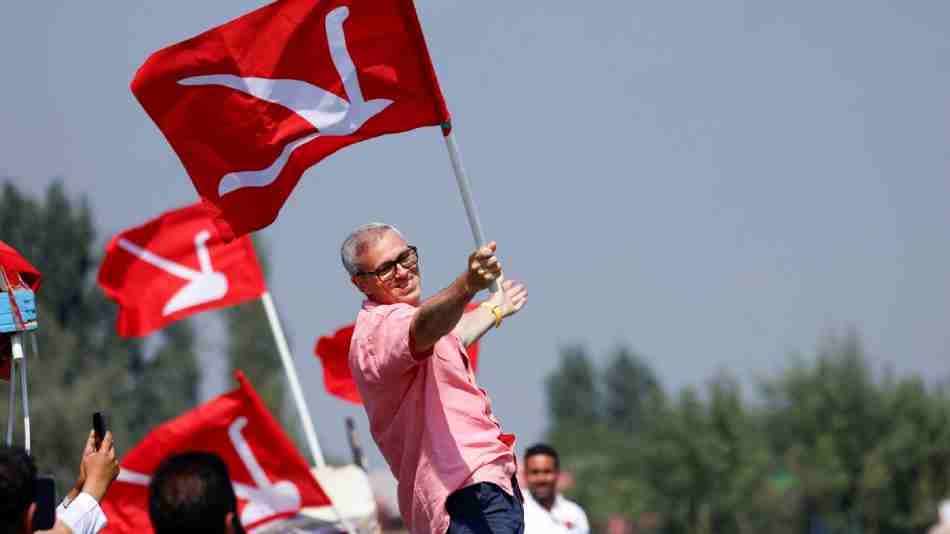
The twin engagements at Kashmir’s premier tourist destinations are being seen as a strong message to both domestic and international audiences that the region is recovering. After riding the iconic Gulmarg Gondola up to Kongdoori, Omar said, “A message should go from here that we are opening Jammu and Kashmir for tourism again.”
In a pointed appeal, Omar called on the Centre to step in and halt the ongoing ‘boycott Kashmir’ campaign, saying it was unjust to punish the people of the Valley who had unequivocally condemned the Pahalgam attack.
“Even after condemning this, if we are still seen as being responsible, what can we do?” Omar asked. “The people of Kashmir did not carry out the attack; they did not drive out the tourists. In fact, they spontaneously came out and said, ‘not in our name’. No political, social, or religious leader can claim credit for this. If even after such condemnation, we are boycotted, it will dissuade people from speaking out in the future.”
The Pahalgam attack left 25 tourists and a local ponywallah dead, prompting a Valley-wide closure of picnic spots and travel advisories that disrupted the tourism season. Since then, a cloud of uncertainty has hung over the industry, a key driver of Kashmir’s economy.
Omar, who is pushing hard to reboot tourism, said that his administration is actively reviewing restrictions on public access to parks and picnic spots. “We were forced to close destinations like Dudh Pathri, Drung, and certain parts of Gulmarg and Pahalgam. But if we want tourism to revive, we must slowly review and ease these decisions,” he said.
To restore normalcy and confidence, Omar has directed the Education Department to organise school picnics to these destinations. “We must first start with our own children. Let the school buses roll back into Gulmarg and Pahalgam. Let our children laugh and play in these valleys again — only then will the message of peace travel beyond.”
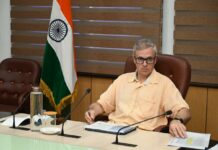
At the meeting in Gulmarg, which was attended by senior civil and police officials, Omar reviewed departmental performances and briefed the administration on his tourism revival agenda. He revealed that during the recent NITI Aayog meeting, he had appealed to the Centre to conduct meetings of parliamentary consultative committees and public sector undertakings in Jammu and Kashmir to boost confidence.
“Some Union ministers responded positively,” he said, indicating that there may be movement on this front soon.
Omar also addressed the perception of friction between his elected government and the Raj Bhawan. On Tuesday, he had referred to the LG administration as the “third unelected government” alongside the Centre and his own. Clarifying on Wednesday, he said, “You only require a thaw if there was a freeze. I have not alleged any freeze. What I’m saying is that we need to coordinate better. Security is the LG’s domain. I can attract tourists, provide them facilities, but ensuring their safety lies with the lieutenant governor and the Centre.”
He reiterated the need for the three power centres — the elected government, Raj Bhawan, and the Centre — to work in tandem to prevent another tragedy like Pahalgam.
Omar also reaffirmed his party’s stand on the restoration of Jammu and Kashmir’s statehood. “Let me say clearly, the conversation on statehood has not stopped. If you read the formal speech circulated at the NITI Aayog meeting, there is a categorical mention of it. I may have chosen not to raise it in the special Assembly session, but the issue remains alive and urgent.”
The Chief Minister’s twin outreach — first in Pahalgam, then in Gulmarg — underscores the gravity of the challenge Kashmir faces after the April 22 attack. But it also reveals a roadmap built around community involvement, Centre-State coordination, and sustained public engagement.
As the Valley enters its critical summer season — traditionally the busiest time for tourism — all eyes will be on whether this political and administrative push can overcome fear and hostility and bring back the lost crowds.