SRINAGAR: A tenuous ceasefire between Pakistan and Afghanistan unravelled on Friday as both countries exchanged airstrikes and accusations of ceasefire violations, plunging the border region back into violence just hours after agreeing to extend their 48-hour truce. The escalation has left dozens dead, including civilians, and cast a shadow over planned peace talks in Doha.

According to Tolo News, thousands of Afghan families have been displaced amid Pakistan’s latest airstrikes in the border town of Spin Boldak, with officials describing widespread destruction and a humanitarian crisis. Nematullah Olfat, deputy head of the Kandahar Department of Refugees and Repatriation, said that “the Pakistani side carried out brutal bombings in densely populated areas of Spin Boldak. As a result, 20,000 families were displaced, and we are working to assist them.”
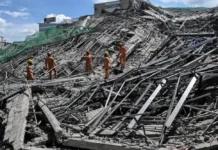
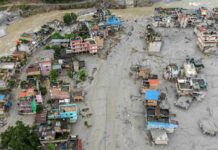
The report said many families have fled to deserts and barren areas lacking basic facilities, while the displaced residents recount homes reduced to rubble, cars and shops burned, and livelihoods lost. Tolo News added that during the bombardment, at least 210 civilians were killed, and 80 houses, 50 shops, and 10 car dealerships were destroyed.
According to Reuters (October 17, 2025), the two neighbours had extended their ceasefire until the conclusion of talks in Doha, with a Pakistani delegation already in Qatar and an Afghan delegation due to arrive a day later. But within hours, fresh hostilities broke out. Afghan police spokesman Mohammadullah Amini Mawia told the US news gatherer, the Associated Press, that Pakistani airstrikes hit the southeastern province of Paktika, including Khanadar village, resulting in civilian casualties. AFP later reported that at least ten people, including two children, were killed.
Pakistan has not commented directly on the strikes but maintains that its recent operations target militant hideouts used by the Tehreek-e-Taliban Pakistan (TTP), which Islamabad accuses of operating from Afghan soil. The AP reported that the Pakistani military had carried out the strikes just hours after a suicide car bomber backed by the TTP attacked a military compound in Mir Ali, North Waziristan, killing several security personnel.
Reuters both cited Pakistani security officials who said seven soldiers were killed when an explosive-laden vehicle rammed into the boundary wall of a military camp. Six militants were reportedly killed in the assault. A faction led by Hafiz Gul Bahadur claimed responsibility for the attack, which triggered intense gunfire near the frontier.
Afghanistan’s Taliban government condemned what it called Pakistan’s “unprovoked aggression.” A senior Taliban official told AFP that Pakistan “broke the ceasefire and bombed three locations in Paktika,” warning that “Afghanistan will retaliate.” Taliban spokesman Zabihullah Mujahid confirmed to Ariana News that Afghan forces had been ordered not to attack unless Pakistan fired first.
Al Jazeera reported that the new round of violence came just as diplomats from both countries were working to extend the ceasefire beyond 48 hours. “Friendly countries are trying to ensure that the ceasefire is extended,” correspondent Kamal Hyder reported from Peshawar, describing the border as “tense” and warning that the situation could “escalate at any moment.”
Meanwhile, Hindustan Times and Reuters reported that among those killed in the Pakistani airstrikes were three Afghan cricketers, Kabeer, Sibghatullah, and Haroon, from Urgun district, who had returned home after a local match. The Afghanistan Cricket Board (ACB) confirmed their deaths and announced the country’s withdrawal from the upcoming Tri-Nation T20I series involving Pakistan and Sri Lanka.
The Associated Press reported that Taliban spokesman Zabihullah Mujahid said a delegation from Kabul was preparing to leave for Qatar, reiterating that Afghanistan did “not seek war with Pakistan or anyone else.” Pakistan’s Foreign Ministry spokesperson Shafqat Ali Khan, however, told reporters that Islamabad wanted Kabul to prevent any attacks from its soil, insisting that Pakistan’s actions were aimed “only at militant hideouts.”
The United Nations Assistance Mission in Afghanistan said 37 civilians were killed and 425 wounded in the week’s cross-border clashes, Al Jazeera reported. Pakistan has not released civilian casualty figures on its side.
Pakistani newspaper Dawn noted that the clashes are the deadliest since 2021, when the Taliban returned to power after the withdrawal of the US and NATO troops. Pakistan’s Defence Minister Khawaja Muhammad Asif accused Kabul of acting as a “proxy of India” and said Islamabad had lost patience after 10,347 terror attacks since 2021 that killed nearly 3,900 civilians and troops. “Wherever the source of terrorism lies, it will have to pay a heavy price,” Asif warned in remarks quoted by News18.
Despite efforts by Qatar and Saudi Arabia to mediate, violence continues to overshadow diplomacy. Both Reuters and AFP reported that the Doha talks were meant to stabilise tensions, but fresh airstrikes and retaliatory warnings have deepened mistrust.
As calm briefly returned to Kabul and Spin Boldak, locals told AFP they feared the fighting could resume at any time. “People have mixed feelings,” one resident said. “They fear the fighting will return, but they still go about their business.”
With both nations trading strikes and accusations, analysts say the ceasefire’s collapse exposes how fragile the peace process remains. As diplomats converge on Doha, the war of words and weapons along the Durand Line threatens to spiral into one of the region’s most serious confrontations since the Taliban’s return to power.