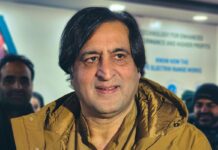
SRINAGAR: In a letter to the Speaker of the Jammu and Kashmir Legislative Assembly, PDP legislator Waheed Ur Rehman Para has demanded the reinstatement of his resolution seeking to designate July 13 as Martyrs’ Day, while sharply criticising what he termed as procedural inconsistencies in the conduct of legislative business during the ongoing budget session.

Para, who represents Pulwama and is one of only three PDP MLAs in the current Assembly, expressed dismay at the exclusion of the Martyrs’ Day resolution from the March 26 bulletin. He argued that July 13, 1931 – when 22 protestors were killed outside Srinagar Central Jail by forces of the Dogra monarchy – marks a foundational moment in Jammu and Kashmir’s political awakening, and its recognition as a public holiday is vital for preserving historical memory.
The holiday was among several scrapped by the lieutenant governor-led administration following the abrogation of Article 370 and the bifurcation of the state into Union territories in August 2019.
“The shift from monarchy to democracy in Jammu and Kashmir came at a price – paid first by the martyrs of July 13, 1931,” Para wrote. “Procedural rules cannot be weaponised to suppress the political significance of this historic event.”
The final phase of the Assembly’s budget session, which resumes Monday after a 12-day recess, will see the tabling of 14 private members’ resolutions, including three seeking restoration of statehood. Para questioned the inclusion of multiple statehood resolutions while his Martyrs’ Day resolution was excluded, despite what he described as broad support among legislators.
Citing the Rules of Procedure, Para pointed out that no resolution raising “substantially the same question” may be moved within one year of an earlier resolution. He argued that the statehood resolutions – similar to one passed in November 2024 alongside a special status resolution – were therefore technically inadmissible until November this year.
The November resolution had urged the Centre to explore a constitutional mechanism for restoring J&K’s special status, though it stopped short of explicitly demanding the reinstatement of Articles 370 and 35A.
Para accused the Assembly Secretariat of allowing redundant and repetitive resolutions – including one on healthcare – at the expense of substantive legislative priorities. He suggested that these resolutions may be “diverting attention from more pressing issues” and diluting the Assembly’s earlier call for the restoration of special status.
“Could this be a conscious attempt to shift the goalpost, divert the discourse away from Article 370 and 35A, and establish a concerning precedent?” Para asked.
He also questioned the balloting process used to determine which resolutions would be tabled, saying it should only apply when the number of admissible resolutions exceeds available slots. Para implied that the inclusion of ineligible or redundant resolutions distorted the outcome of the ballot, possibly to sideline significant matters such as the Martyrs’ Day proposal.
Urging Speaker Abdul Rahim Rather to use his discretionary powers, Para recalled that the special status resolution had been admitted in November 2024 despite not appearing in the order of business. He asked for a similar intervention in the present case, calling for “a reaffirmation of democratic principles over technicalities.”
This is the first budget session of the Jammu and Kashmir Legislative Assembly since the abrogation of Article 370, marking the return of elected representation to the region after a six-year hiatus. The session, which began on March 3, includes 21 sittings in total, with the final leg scheduled from April 7 to April 9.