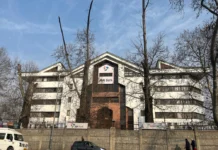
SRINAGAR: The Jammu Kashmir Government’s decision to spend Rs 82.45 crore on repairs and renovation of around 5,000 flats and community halls in migrant camps has triggered concern among members of the Kashmiri migrant community, who say decades of deterioration cannot be addressed through routine plastering, painting and other cosmetic works and that the structural safety of the buildings must be established first.
The government has announced major renovation works across migrant camps, covering more than 200 building blocks and around 5,000 flats and community halls. The tender finalisation process is reportedly in its final stages.
But members of the displaced Kashmiri Pandit community have questioned whether the sanctioned amount will be adequate to deal with the actual condition of the buildings, with some residents reporting peeling exterior plaster, water seepage and leaking roofs.
They have also called for a comprehensive engineering assessment before repair contracts are executed.
“You cannot cure cancer with a bandage; it requires chemotherapy or surgery,” advocate Vishva Ranjan Pandita said, describing the scale of intervention he believes is required.
Pandita said the works could involve slab repairs, plastering, renovation of kitchens and bathrooms and other civil works, arguing that the condition of some buildings warranted an assessment beyond routine maintenance.
Social activist Vinod Khera said the condition of the reinforcement steel visible in some buildings was particularly concerning.
“In several buildings, exposed and heavily rusted reinforcement iron is already visible. Before spending money on plaster, paint, flooring or other superficial repairs, the structural integrity of these buildings must be scientifically assessed,” he said.
Khera said that if buildings were found to be unsafe, they should be reconstructed or subjected to major structural rehabilitation rather than receiving another layer of plaster.
Kashmiri Pandit activist Naveen Bhat also called for a formal engineering survey to determine the extent of deterioration and the actual financial requirement.
“The government needs to assess the actual requirement through a proper engineering survey and provide adequate funds accordingly,” Bhat said. “The objective must be to provide displaced families with safe and dignified housing, not merely make deteriorating buildings look presentable.”
Bhat said the government should address the underlying structural problems if it intended to provide a permanent solution to displaced Kashmiri Pandits.
The government, meanwhile, has said that the buildings will undergo a structural audit.
Relief and Rehabilitation Commissioner, JK, Dr Arvind Karwani, stressed the need for a structural audit of all migrant-camp buildings and directed the Public Works Department (Roads & Buildings) to undertake repair and renovation works on a priority basis in consultation with residents and camp commandants.
The decision was taken during a review meeting on essential services in migrant camps, ongoing development works and proposed maintenance and repair works for the current financial year.
The government said major renovation works covering more than 200 building blocks and approximately 5,000 flats and community halls would be taken up shortly.
The scale of the task is particularly evident at Jagti Township, one of the largest migrant settlements in Jammu.
The township has 4,242 two-room flats spread across 24 buildings, providing accommodation to around 5,600 migrant families.
Residents have reported deterioration in parts of the housing stock, including peeling external plaster and water seepage affecting interior walls. During the monsoon, they said, leaking roofs can result in water entering the buildings and accumulating inside.
The government has said repairs will be prioritised after consultation with residents and camp authorities.
The government’s review also covered basic services in the camps.
The Relief and Rehabilitation Commissioner directed the Jal Shakti Department to ensure uninterrupted drinking-water supply and ordered adequate deployment of tankers wherever shortages occur.
Officials said both short- and long-term measures were being pursued. For Jagti Township, a major water-supply augmentation project is being conceived at a tentative cost of Rs 10 crore.
Dr Karwani also stressed frequent testing of water quality to ensure safe drinking water.
Sewage management is another component of the government’s proposed infrastructure intervention.
The Urban Environmental Engineering Department informed the meeting that sewage treatment plants with an estimated cost of Rs 11.5 crore had been finalised for migrant camps at Nagrota, Muthi-Buta Nagar and Purkhoo.
The plants are to be developed on the model of the sewage treatment plant already functioning at Jagti Township, with work expected to begin shortly.
The Public Works Department is also preparing a comprehensive project covering internal roads and lanes, parks and the facelift of migrant schools, health dispensaries and the Sub-District Hospital at Jagti.
The review also covered the delivery of social-sector schemes to migrant beneficiaries.
Officials said nearly 2,600 families had availed themselves of various government benefits following the digitisation and integration of migrant ration cards with the national database.
The meeting was attended by senior officials from the Relief Organisation and several departments, including Jal Shakti, PWD (R&B), Jammu Power Development Corporation, Urban Environmental Engineering, Health, School Education, Garden & Parks, Jammu Municipal Corporation, Labour & Employment, Skill Development and Rural Development.
Tehsildars and camp commandants from the respective areas also participated.
For the migrant community, however, the immediate concern remains the physical condition of the housing itself.
While the government has announced a Rs 82.45-crore repair programme and ordered a structural audit, residents and activists want the engineering assessment to determine the nature and scale of the intervention, and, consequently, whether the sanctioned allocation is sufficient.
Their argument is that after decades of deterioration, the objective should not simply be to make ageing migrant housing look renovated, but to establish whether it remains structurally safe for the families living in it