SRINAGAR: In a landmark achievement for animal biotechnology and agricultural innovation, Sher-e-Kashmir University of Agricultural Sciences and Technology of Kashmir (SKUAST-K) has formally licensed its indigenous, patented probiotic technology, a genetically modified Lactobacillus plantarum NC8 construct, to Kolkata-based Invati Creations Private Limited. The breakthrough probiotic, developed as a poultry feed additive, will be commercialised nationwide under the brand name Salnil.
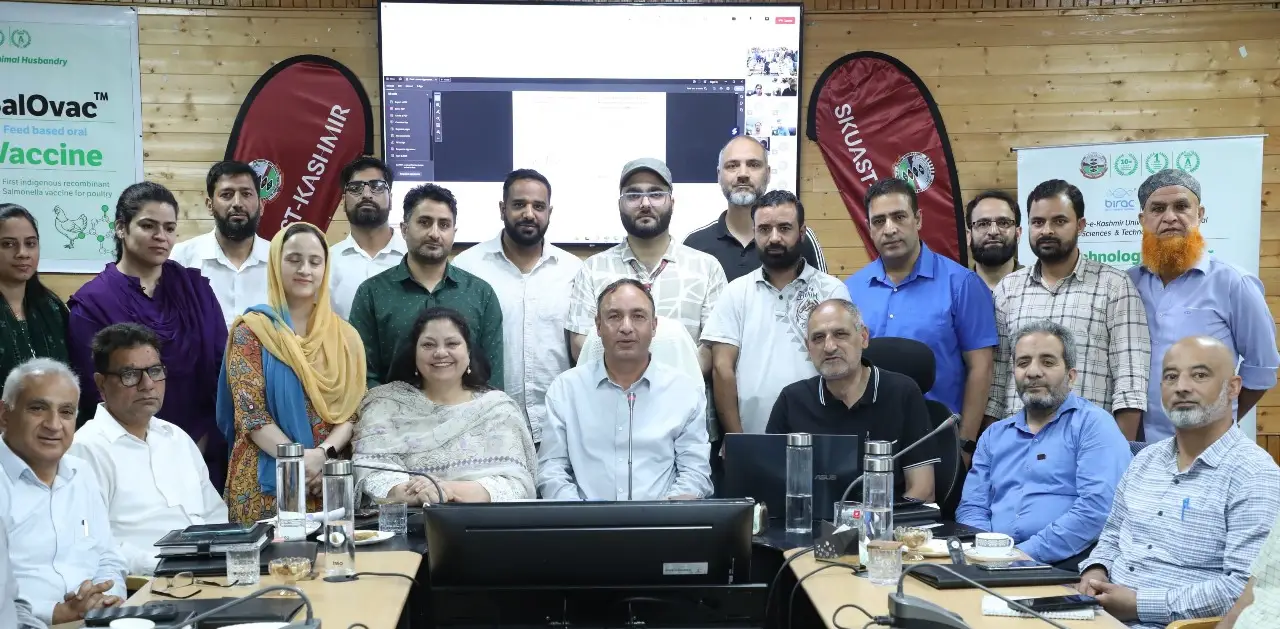
The ‘Technology License Agreement Signing Ceremony’ took place virtually, a first-of-its-kind digital signing hosted by SKUAST-K. The Vice-Chancellor of SKUAST-K, Prof Nazir Ahmad Ganai; Dr Jitendra Kumar, Managing Director of BIRAC; and Mukesh Agarwal, CEO of Invati Creations, jointly signed the agreement in a symbolic step that cements academia-industry collaboration.
Speaking at the ceremony, Prof Ganai described the development as a “great day” for the university and a validation of its commitment to translating research into public benefit. “While many universities develop technologies, very few succeed in transferring them to industry for large-scale application. This partnership changes that,” he said. He also thanked the Department of Biotechnology (DBT) and BIRAC for their consistent support, noting SKUAST-K’s lead among India’s 75 State Agricultural Universities in innovation, with 85 patents and 75 startups to its name.
Dr Vinita Jindal, DGM and Head of Intellectual Property and Technology Management at BIRAC, welcomed the development, emphasising how such strategic transfers boost economic growth and translate research into real-world solutions.
Mukesh Agarwal of Invati Creations expressed pride in partnering with SKUAST-K, stating that the agreement marks a long-term collaboration to transform poultry nutrition in India. The 20-year licensing deal will leverage Invati’s expertise in nanotechnology bioscience to produce Salnil on a national scale.
The scientific foundation for the technology was presented by Prof Syed Mudasir Andrabi, Head of Animal Biotechnology at SKUAST-K, who led the multi-year research. He described the 7–8 year development of the construct as an intensive journey, crediting his PhD scholar Dr Junaid Nazir for his critical role. Prof Andrabi said the probiotic was designed to improve poultry gut health, enhance nutrient absorption, and reduce disease vulnerability — offering a healthier, more sustainable alternative to conventional antibiotic-based feeds.
The event also featured remarks from Prof Haroon R Naik, Director of Research at SKUAST-K, who underlined the probiotic’s value for the food and livestock industries. Dr Jitendra Kumar of BIRAC reaffirmed the Council’s role in bridging the divide between research and industry, accelerating innovation pipelines in agriculture and biotechnology.
The probiotic, with an Indian patent secured and global IP filings underway, promises to set new standards in sustainable poultry production. Beyond its scientific novelty, Salnil is expected to improve food safety, reduce dependency on antibiotics in animal feed, and promote environmental and economic sustainability in Indian agriculture.
This technology transfer, stakeholders said, signals the beginning of a new chapter in India’s agri-biotech journey, where homegrown research can drive national innovation and global competitiveness.