SRINAGAR: Amid rising concerns about the performance of government schools in Jammu and Kashmir despite substantial funding, Chief Secretary Atal Dulloo on Saturday chaired a high-level review of the School Education Department, stressing that the quality of education must reflect the scale of public investment, pegged at over Rs 11,000 crore for the 2025–26 financial year.
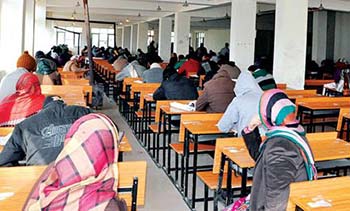
With a staggering annual spend of nearly Rs 1 lakh per student in government schools — well above the national average — Dulloo said the focus must now shift to outcomes, starting with teacher accountability and efficient use of classroom time. He pointedly remarked that no amount of infrastructure or technology would yield results unless teachers demonstrate commitment and creativity in the classroom.
During the meeting attended by the Secretary, School Education Department, Directors of School Education Kashmir and Jammu, PD Samagra Shiksha, and JKBOSE officials, the Chief Secretary directed stringent monitoring of teacher punctuality. He suggested linking teacher salaries to their attendance, emphasising that habitual tardiness or absenteeism, especially leaving schools for personal work, should not go unchecked. Officials informed that the JK Attendance App, a geo-tagged facial recognition system, is already operational and used by 1.14 lakh school employees.
Dulloo further asked senior officers to conduct regular surprise visits — physical and virtual — particularly in remote schools, to assess both staff presence and the quality of teaching.
The Chief Secretary also reviewed the use of digital and modern classroom infrastructure across the Union Territory. As per department data, J&K now has 1,420 Computer-Aided Learning (CAL) Centres, 2,036 ICT Labs, and 4,272 Smart Classrooms. He instructed the department’s IT wing to create a real-time dashboard to track the daily usage of these facilities.
On vocational education, Dulloo noted that over 1.41 lakh students from Classes 9 to 12 are currently enrolled in 15 trades taught across government schools. He urged regular mentoring of these students and support until they are placed in jobs.
Regarding pre-primary reforms under the Early Childhood Care and Education (ECCE) framework, the Chief Secretary warned against hasty implementation. With pre-primary classes to be launched in 15,550 schools and 13,804 AAYAs/helpers already engaged, he called for a zone-wise feasibility study and appointment of nodal officers to avoid admission-related disruptions. He stressed coordination with the Social Welfare Department in this regard.
The meeting also reviewed progress on the establishment of Kasturba Gandhi Balika Vidyalayas (KGBVs), girls’ hostels, and modernised facilities under centrally sponsored schemes like the PM SHRI. A total of 396 schools in J&K have been selected for PM SHRI upgrades.
Secretary School Education Department, Ram Niwas Sharma, presented an overview of the school education landscape. Jammu and Kashmir has a total of 24,137 schools, of which 18,724 are government-run and 5,413 are private or other institutions. The cumulative student enrolment across all levels stands at 26.17 lakh, including 13.56 lakh in government schools.
The UT is administratively divided into 188 education zones, 97 in Jammu and 91 in Kashmir. According to the 2017 NSO survey, J&K’s literacy rate stands at 77.3 percent.
Officials also informed that the Vidhya Samiksha Kendra (VSK) in Jammu is now fully operational, enabling data-driven decisions and academic interventions. The VSK has launched four educational chatbots to streamline attendance tracking, learning support, field monitoring, and parental engagement.
The meeting concluded with the Chief Secretary reiterating that public education must deliver measurable results, and every rupee spent must translate into meaningful learning outcomes for the children of Jammu and Kashmir.