SRINAGAR: President Donald Trump proposed a controversial and significant shift in US foreign policy on February 1, 2025, suggesting the possibility of relocating over one million Palestinians from Gaza to neighbouring countries. It triggered a global outrage, reports appearing in the global media said.
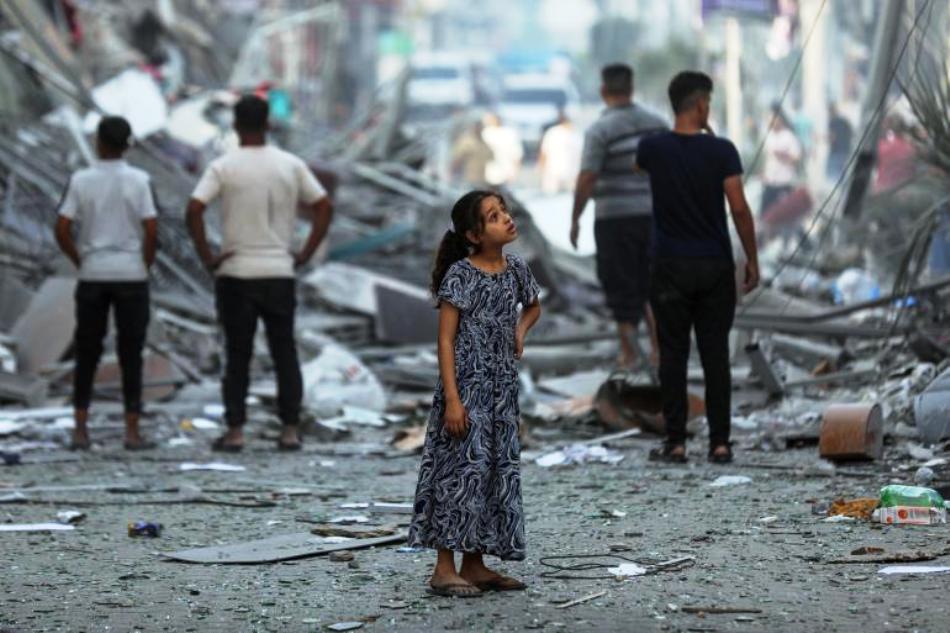
Amal, 7, contemplating her neighbourhood after neighbouring homes were levelled to the ground.
Trump revealed that during a phone call with King Abdullah II of Jordan, he had proposed that the Kingdom take in more Palestinians. “I said to him that I’d love you to take on more because I’m looking at the whole Gaza Strip right now, and it’s a mess, it’s a real mess,” Trump said to reporters aboard Air Force One. The king, however, did not publicly endorse the proposal, which did not feature in the official Jordanian account of the call.
Jordan, already home to 2.39 million Palestinian refugees, according to UN data, rejected the suggestion through a strong statement from its Foreign Minister, Ayman Safadi. “Our refusal of displacement is a steadfast position that will not change,” Safadi declared, reaffirming Jordan’s commitment to a two-state solution and ensuring that Palestinians remain on their land. Egypt, which also borders Gaza, joined Jordan in opposing any forced displacement, reiterating its long-standing stance against such measures.
Trump’s remarks came amid ongoing tensions in Gaza, which has suffered widespread devastation due to the ongoing conflict between Israel and Hamas. The UN reports that airstrikes by Israel have decimated much of Gaza, leaving 90 per cent of its residents displaced.
Trump, who has long advocated for a negotiated settlement to the region’s conflict, suggested that Jordan and Egypt could house displaced people, calling for a “clean up” of the Gaza Strip. He also spoke about the potential for temporary or long-term housing solutions for Palestinians, emphasising the necessity of international cooperation for rebuilding Gaza.
“You’re talking about a million and a half people, and we just clean out that whole thing,” Trump was quoted saying. “I don’t know, something has to happen, but it’s literally a demolition site right now. Almost everything’s demolished, and people are dying there, so I’d rather get involved with some of the Arab nations and build housing in a different location where I think they could maybe live in peace for a change.”
The suggestion drew sharp reactions both regionally and internationally. The Palestinian Authority and major Arab nations, including Egypt, Jordan, Saudi Arabia, and the UAE, issued a joint statement condemning the proposal. They reaffirmed their commitment to the two-state solution, rejecting any efforts to forcibly displace Palestinians. “We will not accept any proposals or solutions” involving relocation, said Hamas leader Sami Abu Zuhri, calling the US suggestion “ridiculous and worthless.”
In response to Trump’s comments, Russian officials emphasised the need for a political solution based on internationally recognized frameworks, advocating for the establishment of a Palestinian state within the 1967 borders. The Russian Foreign Ministry reiterated that Palestinians have the right to live in Gaza as part of their future state.
Meanwhile, at The Hague, a coalition of countries from Africa, Latin America, and other regions formed the Hague Group to coordinate legal, diplomatic, and economic actions against Israel’s violations of international law in Gaza. The group, which includes South Africa, Colombia, and Chile, vowed to take steps to hold Israel accountable, including compliance with International Criminal Court (ICC) orders and preventing arms transfers to Israel.
As the humanitarian crisis in Gaza deepens, the international community continues to grapple with the question of how to resolve the longstanding Israeli-Palestinian conflict. Trump’s controversial proposal has added a new layer of complexity to an already volatile situation. While some Israeli officials support the idea of relocating Palestinians, the proposal has been met with widespread condemnation from Arab nations, Palestinian groups, and many international actors, all of whom stress the importance of a two-state solution as the only viable path to peace.