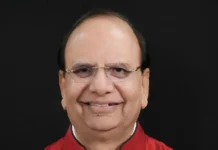
SRINAGAR: Gitanjali Angmo, wife of climate activist Sonam Wangchuk, met her husband in Jodhpur jail on Tuesday for the first time since his detention under the National Security Act (NSA), reports appearing in the media said.
“Met @Wangchuk66 today with @RitamKhare and got the detention order which we will challenge,” Angmo wrote on X, adding that her husband’s “spirit is undaunted,” his “commitment resolute” and his “resilience intact.” She said Wangchuk had conveyed “heartfelt thanks to all for their support and solidarity.”
Angmo’s meeting came two days after Mustafa Haji, legal adviser of the Leh Apex Body, and Wangchuk’s elder brother, Tsetan Dorjey Ley, met the detained activist in Jodhpur jail.
Her visit coincided with a Supreme Court hearing on Monday, where the bench issued notices to the Centre and the Ladakh administration on Angmo’s petition challenging Wangchuk’s detention. Appearing on her behalf, senior advocate Kapil Sibal told the court that the authorities had not served the grounds of detention to Angmo, making it impossible to contest the order.
Sibal also sought permission for Angmo to meet her husband, to which the court replied that no such order could be passed without a formal request. “First, make a request, and if it’s rejected, then approach the court,” the bench told him.
Wangchuk, who had been on a 35-day hunger strike demanding statehood for Ladakh and its inclusion under the Sixth Schedule, was detained following violent clashes in Leh on September 24. During the protest, demonstrators, mostly youth, torched the BJP office, the Leh Hill Council building and several vehicles. Security forces opened fire, leaving four people dead and scores injured.
The administration later described Wangchuk’s actions as “prejudicial to the security of the state time and again.” Following his detention, he was shifted to Jodhpur jail. Earlier, Angmo told The Tribune that she had been unable to reach officials and had not received a copy of the detention order.
As the fallout of the September 24 violence continues to ripple across the Union Territory, Ladakh’s crucial tourism sector has been hit hard. Hoteliers, tour operators and transporters have jointly urged authorities for urgent financial intervention to prevent large-scale business collapse.
In a letter addressed to the chairman of the Union Territory Level Bankers Committee (UTLBC), the All Ladakh Hotel and Guest House Association, All Ladakh Tour Operators Association, Leh Cooperative Taxi Ltd, and unions representing tempo and biker operators said the unrest had compounded an already weak tourist season.
The letter, according to reports, appreciated the Finance Department’s September 19 notification declaring Ladakh as “affected by disturbances” effective April 22, following the Pahalgam terror attack. The classification had enabled the region to access special financial relief measures, including a one-year moratorium extension on loans.
“However, the tragic events of September 24 have once again pushed Ladakh’s tourism and trade sectors into severe financial distress. With the season now effectively over, and most businesses shutting down for winter, the ability of local entrepreneurs and operators to service even basic dues has become impossible,” the letter said.
The associations pointed out that the tourism sector sustains over 70 per cent of the region’s livelihoods, directly or indirectly, and warned of widespread defaults and closures unless urgent measures were taken.
They requested that the moratorium period be made interest-free or that an interest subvention be granted for at least 12 months. The stakeholders also sought mandatory restructuring of all tourism-related loans across sectors—including hotels, guest houses, taxis, transporters, tour operators, and small traders—so that repayment schedules could be revised without penalisation or reclassification as NPAs.
They further urged that borrowers availing of these relief measures be protected from CIBIL score downgrades or NPA classification to safeguard their future access to credit. “We sincerely urge the UTLBC and concerned financial institutions to expedite the formulation and circulation of the final relief package to safeguard both livelihoods and financial stability in the Union Territory,” the letter said.
Meanwhile, political outreach efforts to build support for Ladakh’s statehood movement are expanding beyond the region. A delegation from Ladakh, comprising members of the Kargil Democratic Alliance (KDA) and Socialist Party (India), met Uttar Pradesh Assembly Leader of Opposition Mata Prasad Pandey in Lucknow on Tuesday to seek solidarity for their demands.
Addressing a press conference later at the Press Club in Lucknow, KDA leader Sajjad Kargili said that the people of Ladakh had been peacefully fighting for their constitutional rights for four years and would continue their struggle until their demands were met.
Socialist Party general secretary Sandeep Pandey told reporters that the delegation would meet Samajwadi Party president Akhilesh Yadav on Thursday. Pandey was part of a fact-finding team from the National Alliance of People’s Movements (NAPM) and Hum Bharat Ke Log that had earlier visited Ladakh during Wangchuk’s agitation.
At the press conference, the visiting leaders criticised the government’s crackdown on protesters, the firing that killed four people in Leh on September 24, and the detention of Wangchuk and others. They demanded the immediate release of all detainees, withdrawal of cases filed against protesters, and a judicial probe into the firing incident, which they termed “a matter of national shame,” particularly citing the death of a 1999 Kargil War veteran.
The delegation reiterated its demand for Ladakh’s inclusion in the Sixth Schedule of the Constitution to protect its tribal character, full statehood to restore democratic representation through an elected assembly, and a separate public service commission for local recruitment. It also sought two parliamentary constituencies—Leh and Kargil—given the region’s vast geography and lack of Rajya Sabha representation.
While Wangchuk’s detention has drawn national attention to Ladakh’s unresolved political aspirations, the ongoing unrest and economic distress underline the depth of frustration in India’s northernmost Union Territory. As winter sets in, both the legal and political battles over Ladakh’s future appear far from over.