by Faiqa Masoodi
SRINAGAR: In the fertile paddy belt of South Kashmir, where the rhythm of farming life has long been sustained by gravity-fed water systems, a creeping crisis is threatening the very foundations of rural livelihoods. The Nandi Canal—one of the largest and oldest irrigation canals in the Valley—is witnessing an alarming disruption, pitting downstream farmers against upstream users, and undermining agricultural productivity across vast swathes of Anantnag and Kulgam districts.
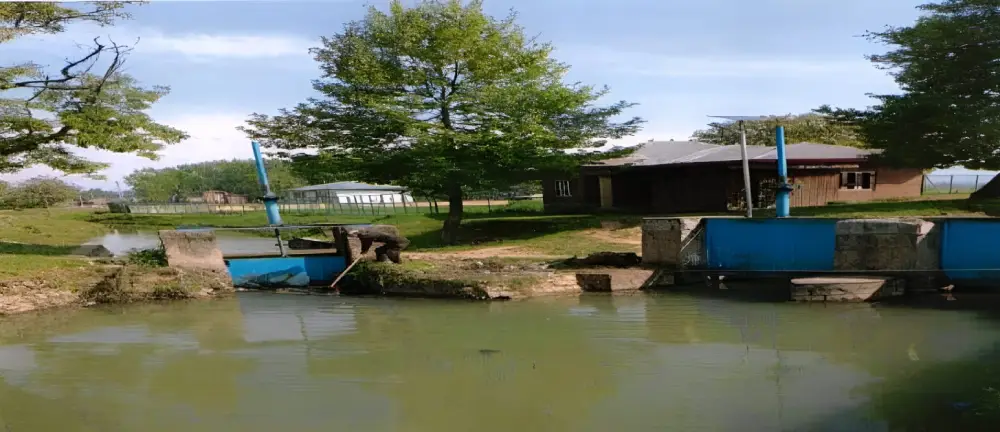
Designed to carry 6.64 cubic metres of water per second (cumecs) from the Veshu River, which is fed by the glacial waters of Aharbal, the Nandi Canal was built to irrigate 2379 hectares of agricultural land in the Anantnag West and Bijbehara constituencies. At 18 kilometres long, with a mild gradient of 1 in 5000, the canal begins its journey at Lassipora just downstream of the confluence of Nallah Vethyethrou and Veshov Nallah—tributaries of the River Jhelum—and ends at Sangam village, splitting midway into the Main Nandi and Dubji branches.
Last week, the government told lawmakers that the gravity canal is “functional and up,” maintaining that it continues to serve its original purpose. However, this official position is at stark odds with ground realities reported by residents and farming communities across the region.
For several weeks now, villages along the lower reaches of the canal have been facing a crippling water shortage. Despite a steady and adequate flow near the canal’s origin at Aharbal, the downstream areas in Bijbehara and Anantnag West are being deprived of their share of irrigation water. Local residents attribute this growing discrepancy to unauthorised diversions along the canal’s course, specifically, the construction of concrete bunds that are completely blocking water passage in favour of certain areas in Kulgam and Shopian.
“Earlier, bunds were made of loose stone. They allowed a little water to pass. Now, with cement and concrete walls, nothing gets through,” said a farmer from Jablipora. “The fields are drying up, and we are watching our crops fail.”
The consequences are devastating. The canal supports over 6,500 families across 24 villages, providing irrigation to more than 2,000 hectares of farmland. Rice, mustard, vegetables, and apple orchards are all being impacted by the shortage. The canal also plays a secondary role in meeting domestic and livestock water needs, particularly vital in areas without alternative infrastructure.
Making matters worse is rampant illegal mining in the Veshu stream, where unchecked extraction of sand and gravel has altered the riverbed, triggered erosion, and reduced water retention. These activities, locals warn, are weakening the structural foundation of the entire canal system and could lead to long-term ecological damage.
“This is no longer just about water theft,” said a grower from Shamsipora. “This is structural vandalism—and the authorities must act.”
Adding to the tension is the dilapidated condition of the canal itself. Built in 1100 AD, the Nandi Canal remains largely earthen, save for occasional cement lining at vulnerable spots. Over time, unchecked seepage, side leakage, and overflows have led to massive water loss and have endangered lives and property in adjoining areas. Wooden outlets—some centuries old—are still in partial use, and many parts of the system remain neglected despite the canal’s historic significance.
The canal splits into two distributaries: the Main Nandi Branch, which serves villages such as Wanpoh, Batengoo, Semthan and Sangam; and the Dubji Branch, which supplies Khudwani, Shamsipora, Subhanpora, Hussanpora and Naynasangam. Both branches are affected by the drop in supply, but tail-end villages are suffering the most.
Farmers are demanding urgent and structural solutions. These include the immediate dismantling of illegal bunds, a complete halt to mining activities in the Veshu, and the sanctioning of a Lift Irrigation Scheme from Lassipora to bolster supply. They have also asked for the installation of drought pumps in water-starved villages like Subhanpora, Shamsipora, Hussanpora, and Jablipora. Most critically, they are seeking a full-scale reconstruction of the canal, modelled on the successful renovation of the Dadi Canal.
The Nandi Canal is more than an irrigation channel—it is a testament to community engineering, a symbol of equitable water-sharing once inspired, as oral history suggests, by the saint Nund Rishi himself. But unless its traditional spirit is restored through immediate technical and policy intervention, it risks becoming a flashpoint for agrarian distress and regional discord.
The fields of Anantnag and Kulgam cannot wait for long. Water, once freely flowing and fairly shared, is fast becoming the source of division.