by Sri Varshith Kumar Reddy E
India’s rising graduate unemployment, weak job absorption, and AI-driven disruption, especially acute in Jammu and Kashmir, signal a structural shift from demographic advantage to growing economic liability

India showcases an impressive expansion in higher education. Gross enrolment in tertiary education has climbed to around 28 per cent, with close to five million graduates entering the labour market every year. The State of Working India 2026 report, released in March 2026 by Azim Premji University, cuts through this veneer and presents a starker reality. Nearly 40 per cent of graduates under the age of 25 are unemployed, while around 20 per cent of graduates aged 25 to 29 remain without work. In absolute terms, the latest Periodic Labour Force Survey (PLFS) microdata for 2022–23, synthesised in the same report, show that 1.1 crore of India’s 6.3 crore graduates aged 20 to 29 were unemployed in 2023.
A more disquieting statistic concerns the composition of unemployment itself. Graduates now constitute roughly 67 per cent of all unemployed youth in the 20–29 age band, almost double their share in 2017 and far above their representation two decades ago. The proportion of unemployed youth with only school-level education has shrunk, while the share with diplomas, degrees, and postgraduate qualifications has swelled. The credential has, in too many instances, become less a passport to opportunity and more a token for a queue that never seems to move.
The Macro Lens
Headline unemployment numbers exude a deceptive tranquillity. The Economic Survey 2025-26 celebrates a decline in the overall unemployment rate from around 6 per cent in 2017-18 to roughly 3.2 per cent in recent PLFS rounds, while Trading Economics data place the seasonally adjusted national unemployment rate at approximately 4.9 per cent in February 2026. This apparent improvement rests heavily on the capacity of the informal economy to absorb workers into low-productivity self-employment, casual labour, and disguised employment in agriculture.
The youth labour market tells a markedly different story. India has roughly 36.7 crore youth between 15 and 29 years of age, of whom about 26.3 crore are out of education and form the active potential workforce. Between 2004–05 and 2022–23, the economy absorbed only about 2.8 million additional graduates annually into employment, even though graduate cohorts entering the labour market were almost twice as large. Only 6.7 per cent of graduates hold permanent salaried positions, and a mere 3.7 per cent occupy white-collar roles embedded in formal contracts with social security.
An unsettling inversion emerges when these numbers are placed side by side. Educational attainment, which ought to reduce the risk of joblessness, now increases the probability of unemployment for the youth cohort relative to those with more modest schooling. The labour market, in effect, punishes aspiration nurtured by the education system itself, converting what should have been human capital gains into pools of frustrated and underutilised talent. India continues to speak in soaring rhetoric about its demographic dividend, even as the demographic window that gives that phrase meaning will begin to narrow after 2030, when the share of the elderly rises and the youth share recedes. The present decade, therefore, represents the last full window in which structural reform can convert potential into realised productivity.
Artificial Intelligence
Into this already fragile equilibrium enters a new destabilising force: the silent restructuring of entry-level labour markets through artificial intelligence. Anthropic’s February 2026 report, Labour Market Impacts of AI: A New Measure and Early Evidence, introduces the concept of “observed exposure”, combining task-level assessments of AI capability with actual usage data from real-world deployments of Claude and similar models. The analysis identifies occupations such as computer programmers, customer service representatives, financial analysts, paralegals, and junior content producers as particularly exposed to generative AI.
At first glance, the findings appear reassuring. Across advanced economies that have seen rapid diffusion of generative AI since late 2022, the report does not detect a broad-based surge in unemployment in these exposed roles. The labour market has not experienced a sudden wave of mass layoffs attributable solely to AI. However, entry-level dynamics tell a more sobering story, especially for a country like India, which channels a large share of its graduates into precisely these occupations.
The report documents a clear tightening in job-finding rates for workers aged roughly 22 to 25 seeking entry into AI-exposed roles. A companion study cited in the report by Brynjolfsson and co-authors finds a 6 to 16 per cent reduction in employment for this cohort in AI-exposed occupations, driven primarily by slower hiring rather than the displacement of existing workers. Senior employees tend to retain their roles and boost productivity using AI tools, while junior positions—once the training ground for fresh graduates – are gradually eliminated from hiring pipelines.
Corporate behaviour in India reflects this shift. Industry surveys and placement trends during the 2025-26 cycle point to a contraction in hiring for traditional entry-level roles in IT services, back-office processing, and standardised analytics—segments that have historically absorbed large numbers of engineering and commerce graduates. Firms increasingly deploy generative AI to handle templated customer interactions, first-level coding and testing, and routine documentation, allowing them to meet output targets with smaller entry-level cohorts. A labour market already strained in its ability to absorb graduates now faces structurally declining demand for the very roles that once served as the first rung of the employment ladder.
Jammu and Kashmir
The national crisis manifests more sharply in Jammu and Kashmir, where structural economic fragility intersects with political transition and a long history of disruption. Official PLFS data presented in February 2026 place the Union Territory’s unemployment rate at 6.7 per cent, nearly double the national average of around 3.5 per cent for the same period. A Mission YUVA baseline survey identifies 4.73 lakh individuals in the 18–60 age group who describe themselves as not working but willing to work, within a surveyed population of 64.8 lakh.
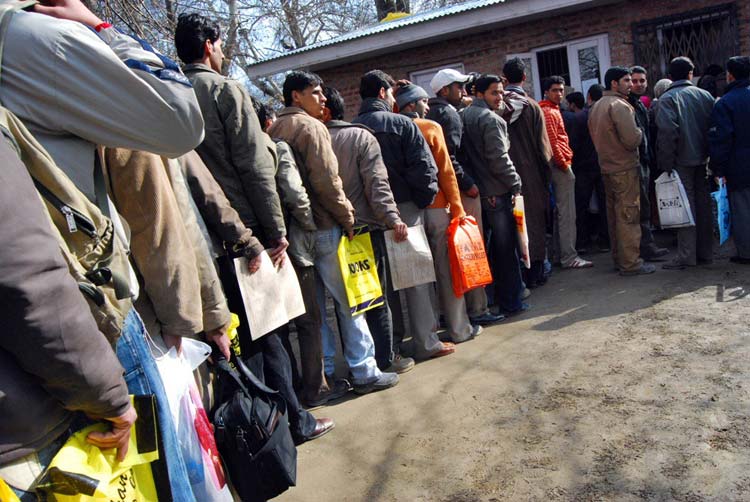
Administrative data further underlines the depth of educated unemployment. As of January 2025, over 3.70 lakh unemployed youth were registered on the Jammu and Kashmir Employment Portal, including 66,628 graduates, 47,114 postgraduates, and 15,396 professional degree holders. This distress coexists with nearly 77,000 sanctioned government posts lying vacant across departments.
Recruitment drives under initiatives such as Mission YUVA, along with commitments to fill one lakh positions, have progressed slowly, with concerns persisting about pace and transparency. On the ground, the social reality is stark. Reports from Srinagar, Baramulla, and Anantnag describe long queues of highly qualified youth competing for a handful of low-paid Class IV government posts—from peons to constables. Many recount a decade-long cycle of coaching, short-term contracts, and unpaid internships, often disrupted by delayed or cancelled examinations.
In such a context, unemployment transcends economic deprivation. It feeds political alienation and, in a region with a fraught history, risks contributing to broader instability.
Diagnosing Structural Failures
Three structural failures recur across the evidence.
First, the composition of growth. India’s post-liberalisation expansion has been led by services, particularly IT, finance, and communications, while labour-intensive manufacturing has not scaled proportionately. This has constrained the creation of jobs suited to the volume of graduates entering the workforce.
Second, the architecture of education and skilling. The system continues to reward volume, more graduates, more certifications, more short-term courses—rather than outcomes. Sustained employment at rising real wages remains peripheral to funding and regulatory frameworks. Curricula in many institutions lag behind technological and sectoral shifts, with insufficient emphasis on applied skills, problem-solving, and client-facing capabilities.
Third, labour market intermediation. Small and medium enterprises remain credit-constrained and risk-averse, limiting their capacity to create graduate-level roles. Public employment exchanges function largely as passive registries rather than active matching platforms. Private placement systems remain concentrated in metropolitan areas, leaving smaller towns underserved. The result is a systemic mismatch: millions of qualified youth and thousands of potential employers fail to connect.
Towards a New Policy Architecture
Addressing these failures requires institutional redesign rather than incremental schemes.
At the national level, four priorities stand out: structured graduate employment compacts linking industry and government incentives to hiring; outcome-based skilling finance tied to sustained employment; curricular redesign aligned with the realities of AI; and a robust digital labour market platform enabling efficient matching of skills and opportunities.
For Jammu and Kashmir, a targeted strategy is essential. This could include a dedicated Graduate Employment Trust to fund structured fellowships across sectors; a transparent, time-bound drive to fill vacant government posts; the development of sector-specific industrial clusters in horticulture, tourism, handicrafts, and renewable energy; and investment in psychosocial and civic infrastructure to support youth engagement and resilience.
A Narrowing Window

The evidence converges on a single conclusion: India stands at a narrowing intersection of demography and technology. The choices made in this decade will determine whether the country converts its youthful population into productive capacity or consigns a generation to underemployment and frustration.
A society that fails to productively engage its educated youth does not remain stable indefinitely. It accumulates discontent, erodes institutional trust, and risks social volatility. The data are clear. The question that remains is whether India’s policy establishment can respond with the urgency and imagination that this moment demands.
(The author is a pracademic working on government policy and public institutions. Views are personal.)