by Sri Varshith Kumar Reddy E
As glaciers retreat, floods intensify, and governance fragments, Jammu and Kashmir must move from emergency response to institutional resolve, and the case for a dedicated Climate Council has never been stronger.
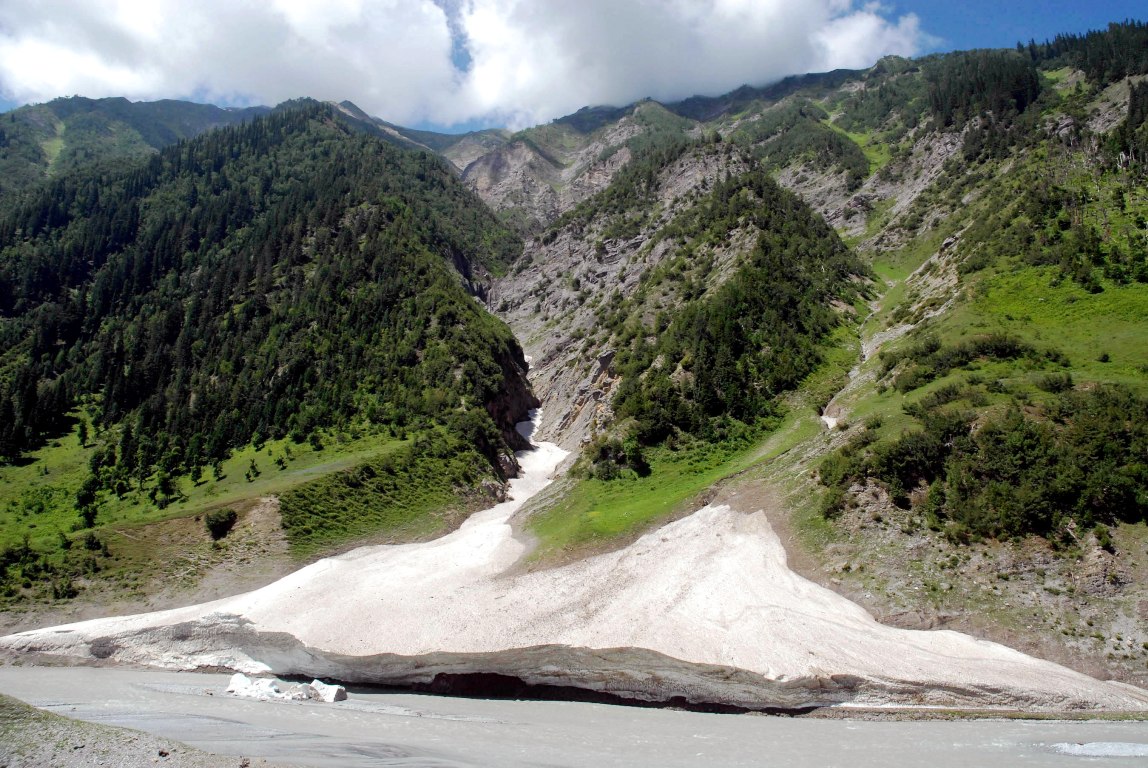
The numbers coming out of Jammu and Kashmir in 2025 and early 2026 are a verdict, and a damning one. In 2025, weather calamities across the Union Territory claimed 199 lives, wiped out over 8,000 homes, destroyed nearly 12,000 livestock and damaged thousands of hectares of crops. In August 2025 alone, unprecedented rains unleashed catastrophic flooding across the region. February 2026 saw Srinagar record its warmest temperatures in a decade. Glacial lakes in the Himalayas are swelling at an accelerating pace, raising the spectre of Glacial Lake Outburst Floods capable of devastating valley communities with little warning. Snowfall has declined sharply, glaciers are shrinking, and the long-term water security of the Indus basin upon which agriculture, horticulture, hydropower and millions of livelihoods depend grows increasingly precarious with each passing season.
This is May 2026. And the question J&K must honestly ask is whether its governance architecture is built for the scale of what is already here.
What J&K Has Today?
The honest answer is the beginnings of awareness, with very little institutional architecture to match. Chief Minister Omar Abdullah, reflecting on 2025’s destruction, publicly acknowledged the need for a dedicated department to study and address climate change, and endorsed the idea of a separate climate budget, a proposal first raised by legislator M Y Tarigami. In March 2026, the J&K government constituted a UT-Level Steering Committee for implementing the Climate Change Action Plan, chaired by the Chief Secretary and drawing members from Jal Shakti, Power Development, Agriculture, Disaster Management, Housing, Health, Forests and Environment departments.
This is a meaningful step, and it would be unfair to minimise it. A steering committee, even a well-constituted one, is a different instrument from a standing institution with resources, statutory authority and a long-term mandate. The Steering Committee exists to oversee an Action Plan. What J&K requires is a body empowered to make, fund and implement the choices that will define the region’s resilience for the next three decades.
The energy picture illustrates the same pattern with ambition that outruns coordinated delivery. J&K’s estimated hydropower potential stands at approximately 18,000 MW, of which only about 24 per cent has been harnessed to date. Chief Minister Abdullah has announced a roadmap to triple installed capacity to around 11,000 MW by 2035, with four major under-construction projects comprising Pakal Dul, Rattle-II, Kiru and Kwar, totalling 3,014 MW expected to come online by 2028.
Solar solarisation under PM Surya Ghar is adding capacity, though progress is well below target with only 16,799 households solarised against a stated target of 83,550. A fresh Hydropower Policy, announced in the 2025-26 Budget, was conspicuously absent from the 2026-27 Budget speech and from the Economic Survey, leaving regulatory clarity for private investors in limbo.
The picture that emerges is of a UT moving in broadly the right direction, across multiple fronts, with no single institution integrating those movements into a coherent climate-resilience strategy. Departments work within their mandates. The system as a whole remains ungoverned.
The Climate Trap J&K Is Walking Into
The problem is structural rather than one of intent. J&K’s political leadership, bureaucracy and civil society increasingly understand what is at stake. Climate change in a mountain UT like J&K is irreducibly cross-sectoral. Glacial retreat affects water availability, which affects hydropower generation, which affects industrial and agricultural productivity, which affects fiscal revenue, which affects the government’s capacity to fund disaster response. A cloudburst damages roads, disrupts supply chains, delays renewable projects and triggers displacement, all in one event. Governance structures built around departmental boundaries are poorly equipped to manage chains of consequence of this kind.
Permafrost melting threatens glacial lake stability and the very foundations of roads, bridges and hydropower infrastructure built across Kashmir’s high altitudes. Infrastructure planning, environmental clearances, disaster risk management and climate science sit in different departments with different reporting lines and different budgetary envelopes. The result is predictable, the one where reactive crisis management with structural resilience perpetually deferred to a plan that is always under preparation and rarely fully funded.
The economic stakes compound this urgency. Apple horticulture, J&K’s most valuable agricultural sector, is already experiencing disruptions with unseasonal snowfall, early warming, erratic blossom cycles that reduce yields and threaten the livelihoods of hundreds of thousands of farming families. Tourism, the other pillar of the economy, depends on predictable seasons: ski resorts need consistent snow, and valley tourism needs monsoons that irrigate rather than inundate. These are central to J&K’s fiscal and social stability, and both are now being reshaped by a changing climate.
The Case for a J&K Climate Council
What J&K requires is a statutory Climate Council with a clear mandate, dedicated resources and the authority to coordinate across departmental lines. The March 2026 Steering Committee is a useful forerunner; it falls short of being a sufficient response. A J&K Climate Council, constituted by statute and reporting to the Chief Minister, should carry a mandate spanning five domains.
First, it should own a rolling, publicly available Climate Resilience Roadmap for J&K, updated every three years, integrating disaster risk reduction, water security, energy transition, land use and livelihood protection into a single strategic document with measurable milestones and named fiscal commitments.
Second, it should govern a dedicated Climate Budget line through ring-fenced allocations for adaptation and resilience investments, covering nature-based solutions for slope stabilisation, catchment restoration and urban drainage, alongside conventional infrastructure.
Third, it should anchor J&K’s engagement with national climate and energy institutions, including the Ministry of Power, MNRE, the National Disaster Management Authority and NITI Aayog, ensuring that the UT’s specific vulnerabilities: its glacial hydrology, its disproportionate exposure to extreme weather, its underutilised renewable potential are represented in national-level decisions.
Fourth, it should provide a standing platform for scientific input, hosting J&K’s universities, the Indian Institute of Remote Sensing, the National Institute of Hydrology and local environmental agencies to translate research into policy. The gap between what glaciologists know about ice-loss trajectories and what planners build into infrastructure design has been costly. It needs closing.
Fifth, it should be the institution that negotiates and tracks climate finance commitments from the Centre, whether through the National Adaptation Fund, green climate instruments or bilateral development partnerships, ensuring that J&K’s unique vulnerability translates into commensurate investment.
Where J&K Must Get To

The destination is clear enough to describe with precision. A J&K in which government plans for a warmer, drier and more volatile climate as the baseline, rather than as a contingency. Where hydropower expansion is designed around hydrological stress rather than historical peak flows. Where apple orchards are being proactively shifted to higher altitudes under a government programme, rather than abandoned by individual farmers acting alone. Where the 83,550 households targeted for solar coverage are actually solarised, giving rural communities energy security that damaged grids cannot interrupt. Where glacier monitoring data is publicly available, regularly updated and directly connected to flood early-warning systems that reach the last village in the last valley.
Getting there requires an institution with the continuity, the authority and the dedicated resources to govern the long arc of J&K’s climate future. A Climate Council, statutory, cross-sectoral and transparently accountable, is the minimum condition for coherent governance in a territory where a warming Himalaya is already rewriting the rules of every season.
The great melt is proceeding on its own schedule. The question is whether J&K’s institutions can move at comparable speed.
(The author is a pracademic working on government policy and public institutions. Ideas are personal.)