SRINAGAR: The Srinagar city woke up to an unusually quiet Monday morning. The familiar rattle of school buses was absent, pyjamas replaced uniforms, and the usual rush of students making their way through the city’s narrow lanes was missing. With the Kashmir Valley reeling under an intense and prolonged heatwave, all government and private schools across the region began an unscheduled 15-day summer vacation starting today, June 23.
The decision to shut schools was formally announced by Jammu and Kashmir Education Minister Sakina Itoo, who said the early closure was necessary due to the “unbearable weather conditions” making it difficult for children to attend classes. “We have decided to commence the summer break earlier than initially planned,” she said.
The government had originally scheduled the vacation from July 1 to July 10, but rising temperatures over the past week forced a rethink. “Keeping student well-being in mind, the summer vacation will now span from June 23,” Itoo confirmed. The minister added that the situation would be reviewed at the end of the holiday period, and if the heatwave continues, an extension would be considered.
Before declaring the vacation, the Education Department had already revised school timings in an attempt to minimise the impact of the heat. Schools within Srinagar municipality limits were directed to function from 8:00 AM to 1:00 PM, while those in surrounding areas operated from 8:30 AM to 1:30 PM.
But as temperatures climbed even further, officials decided that sending children to school was no longer safe. Over the weekend, Srinagar recorded a scorching 34.8°C on Sunday, following Saturday’s peak of 35.5°C — figures well above the city’s normal June temperatures. Surprisingly, the city outpaced Jammu, which recorded a relatively lower 33.0°C.
The unusual pattern extended to other parts of the Valley. According to an independent weather forecaster , Kokernag registered 34.2°C, surpassing its previous second-highest June temperature of 33.8°C noted on June 19, 2025, and June 29, 1999. Its all-time June record remains 34.9°C, set on June 25, 2005.
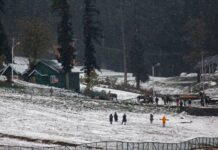
Qazigund touched 35.0°C, its third-highest June temperature on record — only June 26 and 27 of 1988 were hotter, said another meteorologist, Faizan Arif Keng. Kupwara registered 34.5°C, while the usually temperate Pahalgam touched 29.6°C. Gulmarg, known for its cool climate, remained the Valley’s most comfortable spot at 25.7°C.
The India Meteorological Department (IMD) has forecast some relief ahead. For June 23, Srinagar is expected to remain partly cloudy, becoming generally overcast by evening, with highs around 33°C. The next day may bring rain, thunderstorms, or even dust storms, though the temperature is predicted to remain steady.
Even so, the overall pattern is clear. Kashmir is experiencing significantly above-normal June temperatures, a trend that experts say could be linked to larger climate shifts across the Himalayan region.
For now, homes are quiet, students are indoors, and Kashmir’s streets, at least in the mornings, feel a little less hurried.