SRINAGAR: At least 3,192 schools across Jammu and Kashmir have reported less than ten or zero student enrolment since 2022, even as 1,732 schools have been closed or merged since 2019, the government informed the Legislative Assembly, highlighting ongoing efforts to rationalise resources and improve infrastructure in the education sector.
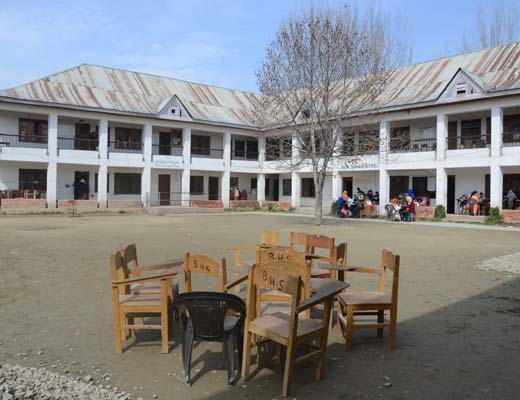
Pic: Bilal Bahadur
Replying to a question by MLA Ranbir Singh Pathania, the School Education Department said that these low-enrolment schools together have 2,518 teachers posted, drawing salaries despite minimal or no student presence. Division-wise data shows that Jammu division accounts for 1,494 such schools with 1,934 teachers, while Kashmir division has 1,698 schools with 584 teachers.
The government said that alongside the issue of low enrolment, gaps in basic infrastructure persist in several schools. As per UDISE data for 2025–26, 2,698 schools lack boys’ toilets, while 57 schools do not have girls’ toilets and 78 lack drinking water facilities. A much larger deficit exists in physical infrastructure, with 9,078 schools without boundary walls and 10,896 schools lacking playgrounds. However, it maintained that no school in the Union Territory lacks facilities for recreational activities.
To address sanitation gaps, the government said construction of 4,481 toilets, including 1,441 for boys, 2,575 for girls and 465 for children with special needs, is currently underway through the Public Works (R and B) Department and the Rural Development Department, with works at various stages of completion.
On expenditure, the government said a total of Rs 13816.66 crore has been incurred on salaries for such schools over the years, even as 1,732 schools have been closed or merged due to low enrolment since 2019, including 1,427 in Jammu division and 305 in Kashmir division.
The department said it is undertaking continuous efforts to rationalise teaching staff and maintain the prescribed pupil-teacher ratio, which currently stands at an average of 1:15 across the Union Territory. Measures include redeployment of surplus teachers to understaffed schools and utilisation of Cluster Resource Coordinators as subject-specific teachers to address shortages in disciplines such as Science, Mathematics and English.
It added that a broader reform strategy is being implemented in line with the National Education Policy, focusing on strengthening infrastructure and improving quality of education. This includes equipping schools with smart classrooms, digital tools and laboratories, expanding access to digital libraries, and promoting sports and holistic development. Sustainability measures such as solar panels, water conservation systems and waste management initiatives are also being introduced in schools.
The government further said that a School Quality Assessment Framework has been put in place to monitor performance indicators across infrastructure, teaching processes and learning outcomes, while efforts are underway to ensure optimal utilisation of public funds and resources in the school education sector.