SRINAGAR: Marking International Women’s Day with a profound discussion on digital addiction, the Amar Singh Club, Srinagar, hosted a thought-provoking session under its Common Interest Conversations initiative. The event, presided over by Tanveer Jehan (IAS), former Commissioner/Secretary, led to the conceptualisation of The Greenhouse Intervention—a community-driven initiative aimed at shielding children from the harmful effects of digital addiction.
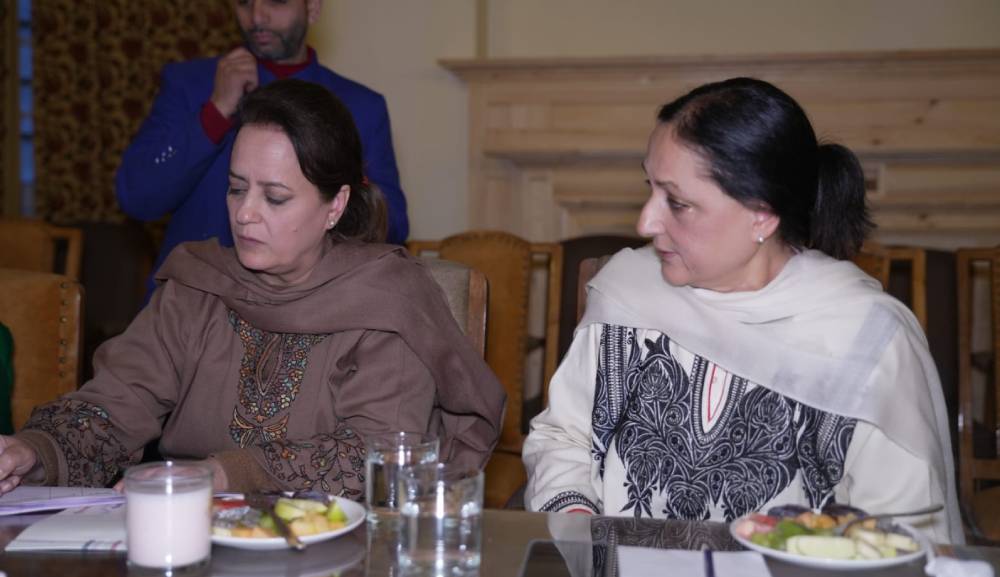
Presided over by former Commissioner/Secretary Tanveer Jehan (IAS), the event saw the participation of several prominent women, including Qurat-ul-Ain, Hawa Bashir, Asiya Murtaza, Shagufta Qazi, and Shahala Ali Sheikh, alongside representatives from the Managing Committee Rauf A Punjabi and Parvez Fazili. Nasir Hamid Khan, Secretary of Amar Singh Club, welcomed the attendees and emphasised the vital role of women as caregivers in shaping young minds.
The discussion highlighted a growing concern—children today are increasingly glued to digital devices, leading to significant developmental, psychological, and social consequences. Experts pointed out that early childhood is a crucial phase for cognitive development, with the pre-frontal cortex and limbic cortex playing key roles in shaping decision-making, emotional regulation, and social interactions. Excessive screen time, particularly for children under six, is impairing brain development, leading to issues such as anger management difficulties, anxiety, depression, attention disorders, cognitive delays, and a moral and social disconnect.
Paediatric experts worldwide recommend no screen time for children under two and extremely limited exposure for those between two and six years of age. However, in reality, children today are excessively dependent on digital devices, primarily due to working parents and the increasing reliance on screens for pacification. The concern extended beyond individual well-being to a broader societal issue—whether Kashmir’s future generations would grow up disengaged, emotionally unstable, and dependent on technology for validation. If unchecked, digital addiction could lead to an unprecedented mental health crisis, intervening a necessity rather than an option.
Recognising this alarming trend, the participants at the session conceptualised ‘The Greenhouse Intervention,’ a community-led initiative designed to provide children with an alternative to excessive screen exposure. The idea revolves around creating supervised spaces, referred to as Greenhouses, where children of different age groups, including infants, toddlers, preschoolers, and adolescents, can interact, play, and learn in a structured, technology-free environment. These spaces would be run exclusively by women, ensuring a nurturing and safe atmosphere for children to engage in meaningful social interactions, cultural and artistic activities, outdoor play, and learning about Kashmiri history, language, and heritage. With proper surveillance and a structured curriculum, these Greenhouses aim to serve as sanctuaries where children can experience real-life challenges, develop resilience, and grow into well-rounded individuals without the crutch of digital dependency.
A significant aspect of the initiative is its feasibility. Participants proposed that existing government infrastructure such as schools, community centres, and other underutilised spaces be repurposed for setting up these Greenhouses. Various government departments, including Education, Health, Sports, Handicrafts, Forests, and Floriculture, could collaborate to provide the necessary logistical and financial backing. The participants agreed to draft a detailed blueprint outlining the framework for a public-private partnership, which will be submitted to the government for consideration.
The discussion was part of the broader initiative The Cashmere Recuperation, which aims to counter digital addiction through structured, science-based community interventions. To further engage the public, a logo and trophy design challenge was announced, with a prize of Rs 25,000 for the best submission.
The session concluded with an overwhelming consensus that urgent action is needed to curb the escalating digital addiction crisis. The participants commended the Amar Singh Club, Srinagar, for its proactive role in addressing pressing societal concerns. The event highlighted the power of community-driven solutions, with women playing a central role in shaping a healthier, more resilient future for Kashmir’s children. The coming weeks will see further refinement of ‘The Greenhouse Intervention’ model, with detailed action plans and government collaboration strategies in the pipeline. As the conversation continues, Kashmir’s society stands at a crucial juncture—whether to allow digital addiction to dictate the future or to reclaim its children through conscious, community-led initiatives.