by Ishfaq Gani Mir
Rising marriage age in Kashmir reflects economic insecurity, rigid social norms, and emotional strain, creating loneliness, demographic shifts, and an unspoken but deepening social crisis
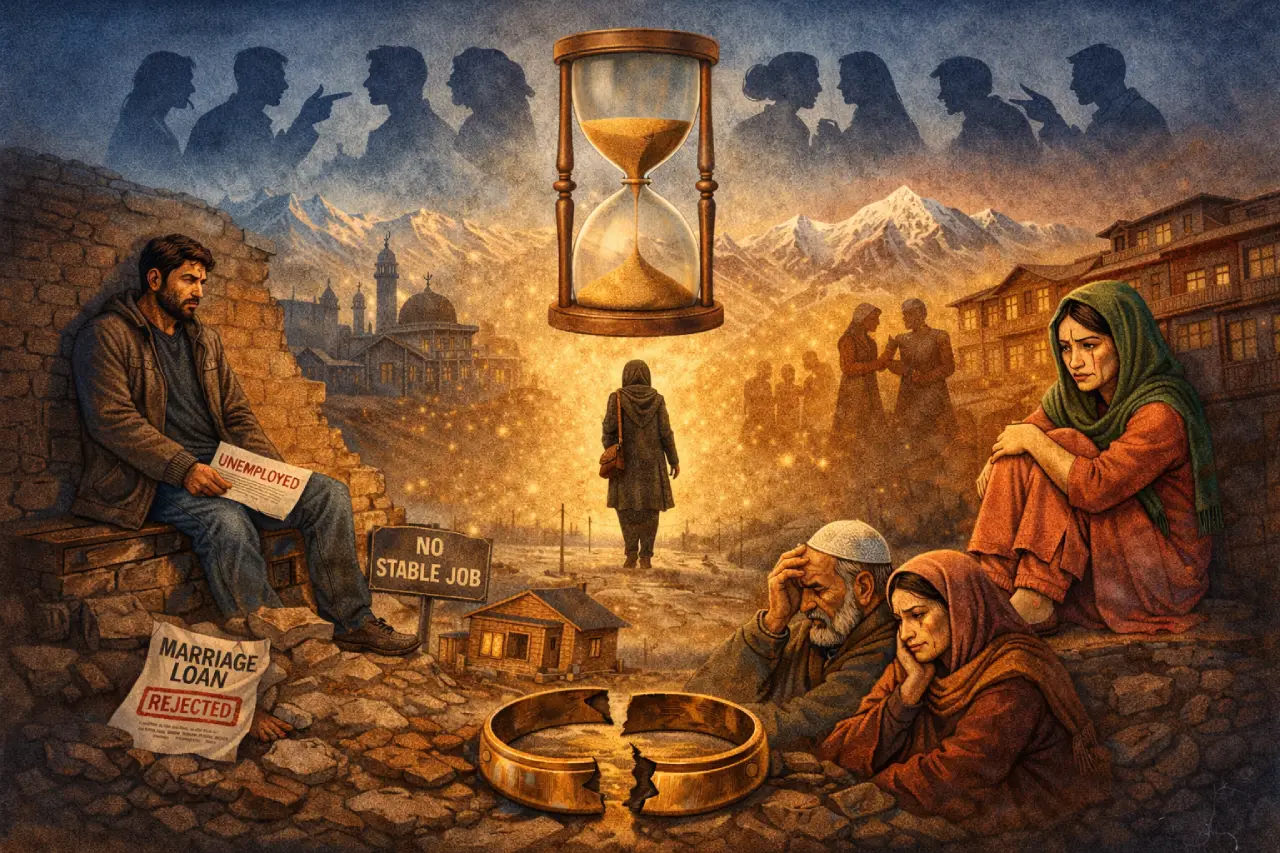
In Kashmiri society, marriage has never been merely a personal milestone; it has traditionally been a social institution woven deeply into family structure, community continuity, and emotional security. Yet, over the past two decades, a silent but profound shift has taken place. The age of marriage, once early, predictable, and socially regulated, has steadily moved upward. Today, late marriages are no longer exceptions; they are becoming the norm.
This transformation raises an uncomfortable but necessary question: are late marriages a sign of progress, or have they emerged as a social curse born out of structural failures?
The average age of marriage for men has crossed 30 in urban areas, while for women it now hovers between 28 and 30. This delay is not merely a lifestyle choice; it reflects deeper socio-economic anxieties. Prolonged education, unemployment, and housing insecurity have collectively postponed the readiness, both real and perceived, for marriage.
Economic Insecurity
At the heart of late marriages in Kashmir lies economic precarity. A generation raised amid conflict has inherited not only trauma but also limited opportunities. Government jobs, once the backbone of middle-class stability, are scarce. The private sector remains weak. Contractual employment and low wages have replaced long-term security.
Marriage in our culture still demands financial readiness: a house, a stable income, and the ability to support extended family expectations. Young men, unable to meet these benchmarks, postpone marriage indefinitely. For women, economic dependence and limited career pathways further complicate the equation.
Late marriage, therefore, is not a rejection of tradition but an involuntary delay caused by economic stagnation.
Social Expectations
Ironically, while society has changed economically, marital expectations remain rigid. The pressure to arrange “ideal” matches, high qualifications, government jobs, fair complexion, flawless reputation, has intensified rather than softened.
Families reject proposals over minor discrepancies, salary gaps, caste nuances, or perceived social status. Matrimonial negotiations have become competitive marketplaces rather than compassionate unions. As a result, many suitable matches are lost to unrealistic benchmarks, pushing individuals further into delayed marriages.
This paradox, modern pressures combined with conservative expectations, creates a social deadlock.
Late marriage in Kashmir is not emotionally neutral. It reveals growing loneliness, anxiety, and social alienation, especially among unmarried women. Society often views unmarried women beyond a certain age with suspicion or pity, while men face silent ridicule masked as concern.
Prolonged singleness also affects mental health. The absence of emotional companionship, coupled with social pressure, leads to depression, reduced self-worth, and sometimes withdrawal from social life. The issue is rarely acknowledged publicly, yet privately, it has become widespread.
Marriage delays are thus not just demographic trends; they are mental-health concerns in disguise.
Demographic Structure
Late marriages have cascading effects. Fertility rates are declining, family sizes are shrinking, and inter-generational bonding is weakening. Parents age without the emotional security of settled children, while children born later face reduced extended family support.
Our traditional joint family system, once a cushion against social stress, is slowly eroding. Late marriages accelerate this fragmentation, reshaping the very fabric of social cohesion.
A crucial question emerges: Do late marriages reflect women’s empowerment? Partially, yes. Increased education and awareness have enabled many women to delay marriage voluntarily. However, empirical realities suggest a more complex picture.
Many women remain unmarried not by choice but due to gendered expectations, limited employment, and societal scrutiny. While men’s late marriages are often justified by career instability, women face blame, stigma, and shrinking marital options with age.
Thus, late marriage in Kashmir is less a symbol of liberation and more a reflection of structural gender imbalance.
Calling late marriages a “curse” may seem harsh, but the term captures the collective frustration of a society unable to adapt. The curse does not lie in marrying late per se, but in a system that delays marriage through unemployment, rigid norms, and emotional neglect—then punishes individuals for the delay.
In societies with strong social security, late marriages coexist with emotional stability. In Kashmir, where institutions are fragile, late marriages often translate into prolonged uncertainty and silent suffering.
Reform, Not Romanticisation
The solution does not lie in moral panic or forced early marriages. It lies in economic revival, realistic social expectations, and emotional openness. Families must prioritise compatibility over status. Society must normalise diverse life paths without stigma.
Marriage should be a source of companionship, not a test of survival.

Late marriages in our society are not merely a demographic shift; they are a mirror reflecting economic hardship, social rigidity, and emotional neglect. Whether they become a curse or a conscious choice depends on how society responds.
If Kashmir learns to reform its expectations while restoring economic dignity, late marriages may cease to be a crisis. Until then, they remain a quiet but growing social wound, unspoken, unresolved, and deeply human.
ہم نے عمریں گزار دیں انتظار میں،
اور وقت ہم سے زندگی لے گیا۔
نہ ضد تھی محبت کی، نہ خوف وعدوں کا،
بس حالات نے ہر رشتہ ٹال دیا۔
(Author is an advocate at the High Court of Jammu, Kashmir and Ladakh. He has masters in political science and history, a Bachelor’s in Education, and LLB and LLM. Ideas are personal.)