SRINAGAR: China has disclosed unprecedented details of what officials are calling the country’s first large-scale space rescue mission, a rapid and tightly coordinated operation that unfolded after the Shenzhou-20 spacecraft was struck by a tiny shard of space debris in early November.
According to the South China Morning Post, the emergency response mobilised thousands of engineers, flight controllers and specialists across multiple agencies, and was executed in barely twenty days — a turnaround far faster than comparable incidents in the United States or Russia.
The crisis began when a particle less than one millimetre wide hit and cracked a window on the Shenzhou-20 return capsule just a day before its three-member crew was scheduled to undock from the Tiangong space station. Jia Shijin, chief designer of the Shenzhou system, told state broadcaster CCTV that striking a spacecraft window was “almost impossible”, yet the triangular mark raised immediate concerns. Astronauts photographed the damage from different angles, and external images were taken using Tiangong’s robotic arm. On the ground, a dozen specialist glass institutes reviewed the evidence and concluded that the crack had penetrated the outer thermal pane.
Simulations and wind-tunnel tests carried out by two major research agencies suggested that if the crack expanded during the intense heat of re-entry, the entire outer pane could detach. That, engineers warned, would expose the inner pressure pane. If that too failed, the cabin could depressurise in an instant. At a high-level meeting on November 8, Chinese space officials ruled that Shenzhou-20 could no longer provide a safe trip home. Two emergency plans were debated. Officials ultimately chose to bring the crew home aboard the already docked Shenzhou-21 spacecraft and then launch a new uncrewed capsule, Shenzhou-22, to replace Tiangong’s lifeboat capability. Ji Qiming, the senior spokesman for China’s Manned Space Agency, said this option offered both speed and operational familiarity.
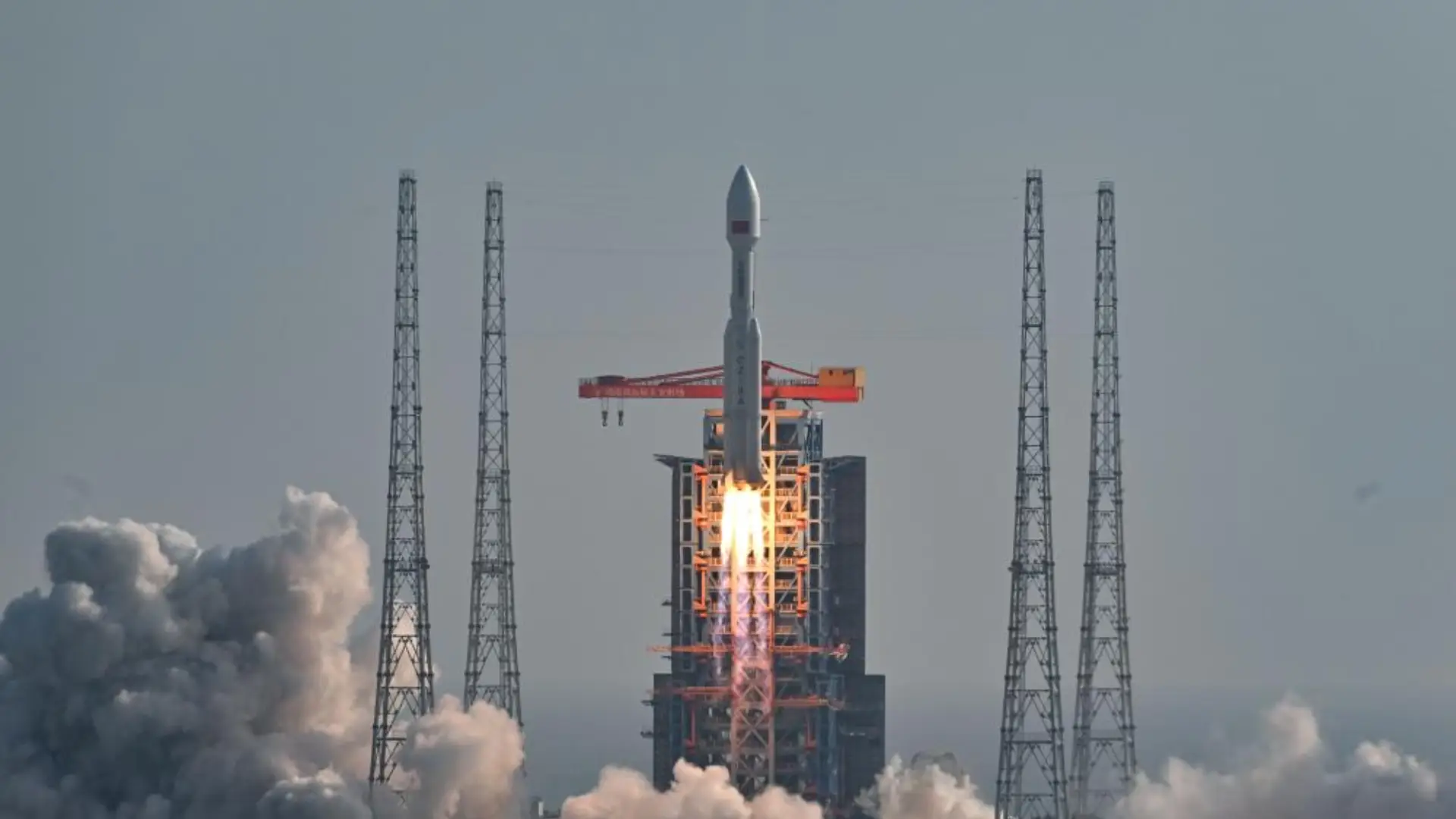
The Shenzhou-20 crew returned safely on November 14, but their departure briefly left the Shenzhou-21 astronauts without an escape craft. That gap was closed when Shenzhou-22 launched on November 25, restoring emergency cover on the station. In the meantime, officials told CCTV that there were adequate supplies aboard Tiangong, though engineers joked that special arrangements had to be made to feed the four research mice that had travelled with Shenzhou-21. China has now decided to return the damaged Shenzhou-20 capsule to Earth without crew for detailed inspection. State news agency Xinhua reported that the re-entry will generate “real-world experimental data” vital for future spacecraft design.
The South China Morning Post noted that China’s twenty-day turnaround compares starkly with earlier international incidents. After a Soviet Soyuz malfunction in 1979, the replacement craft took around two months to reach orbit. A similar coolant leak on a Russian Soyuz docked at the International Space Station in 2022 required more than two months to resolve, and the crew did not return until late 2023. In the United States, two NASA astronauts endured an unplanned nine-month stay in space this year after repeated issues with Boeing’s Starliner spacecraft.
Space.com, drawing on official Chinese statements, reported that the Shenzhou-20 capsule suffered “penetrating cracks” caused by a high-velocity impact. The CMSA concluded that the safest course was to send it back uncrewed to avoid any catastrophic failure during re-entry. The Shenzhou-21 crew will continue their six-month mission aboard Tiangong until relieved by the Shenzhou-23 astronauts in 2026. Meanwhile, China has accelerated its spacecraft production schedule, with Shenzhou-23 now expected two months ahead of its original deadline.
China is also moving to reduce future risks by expanding its space situational awareness networks. The Xingyan, or Star Eye, constellation — reported by the South China Morning Post — will eventually comprise 156 satellites capable of tracking debris, monitoring orbital activity and issuing collision warnings every two hours. This follows the launch of Kaiyun-1, another satellite designed to monitor objects in space.
Experts have long warned that Earth’s orbit is becoming dangerously overcrowded as governments and private companies launch more satellites and spacecraft. The European Space Agency now estimates that over 15,100 tonnes of material are circulating in space, including 1.2 million debris fragments between 1cm and 10cm, and an astonishing 140 million pieces as small as 1mm. Travelling at roughly 7.6 kilometres per second in low orbit, even the tiniest fragments can cause serious damage — as shown when a particle smaller than 1mm pierced the thick glass of the Shenzhou-20 capsule.
Officials say the rescue mission should serve as a reminder of the inherent risks in human spaceflight. “In this work, the job is never truly finished,” Jia Shijin said. “Only by staying alert can we continue succeeding.”