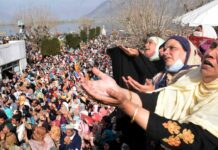
Kashmir’s Festival Mood Mirrors Economic Realities
Across the world, festivals are economic high points. Whether it’s Christmas in the West, Lunar New Year in East Asia, or Eid across the Muslim world, markets flourish. Shops overflow with buyers, vendors multiply, and entire sectors, from retail to transport, ride the wave of seasonal demand. In Kashmir, too, Eid-ul-Azha has traditionally been a time of brisk trade, bustling livestock mandis, and overflowing bazaars. But this year, it feels unusually quiet.
Kashmir, celebrating Eid this Saturday, is seeing a visibly modest festival. The usual pre-Eid market buzz is conspicuously muted. Flea markets have more footfall than traditional shopping belts. Even in Srinagar’s expansive Eidgah, where herders annually converge to sell sacrificial animals, the rush is uninspiring. Sellers speak of falling demand and poor sales. Many have not even recovered what they spent transporting livestock to the Valley.
The reasons are not hard to find. Unemployment remains alarmingly high. With a government downsizing its recruitment, ongoing departmental reorganisations, and few new jobs created, youth are adrift. Agriculture is stagnant, and the service sector has shown no meaningful recovery. A series of layoffs in hospitality, retail, and informal workspaces in recent weeks have only deepened anxiety.
Tourism, expected to be a cushion, has also faltered. The disposable incomes from the hospitality sector always have a cascading impact. The April 22 killing of 26 tourists in Pahalgam shattered hopes of a booming summer season. As tensions escalated, India and Pakistan teetered at the brink of confrontation. The tourist footfall began drying up almost overnight.
Even deeply personal religious journeys have declined. This year, just over 4,100 people from Jammu and Kashmir applied for the Haj pilgrimage, a staggering drop from over 8,000 in 2024, and far below the 35,000 mark seen in 2017. More than 700 applicants withdrew, many citing financial constraints.
The growing economic distress is starkly reflected in welfare statistics. Despite official claims that over a million people have been lifted out of poverty, according to the latest Multidimensional Poverty Index released by Chief Minister Omar Abdullah, the number of people availing free or subsidised rations in 2025 is higher than in 2018. That more people depend on government rations today than before is a telling commentary on the ground reality.
From floods to militancy, from unrest to COVID-19, and the post-Article 370 transitions, Kashmir’s economy has absorbed repeated shocks. It now survives on apples, handicrafts, and a shrinking set of government jobs. This Eid, the modest mood in the markets is not about changing tradition. It is an honest reflection of how fragile the economic foundation beneath the celebration has become.