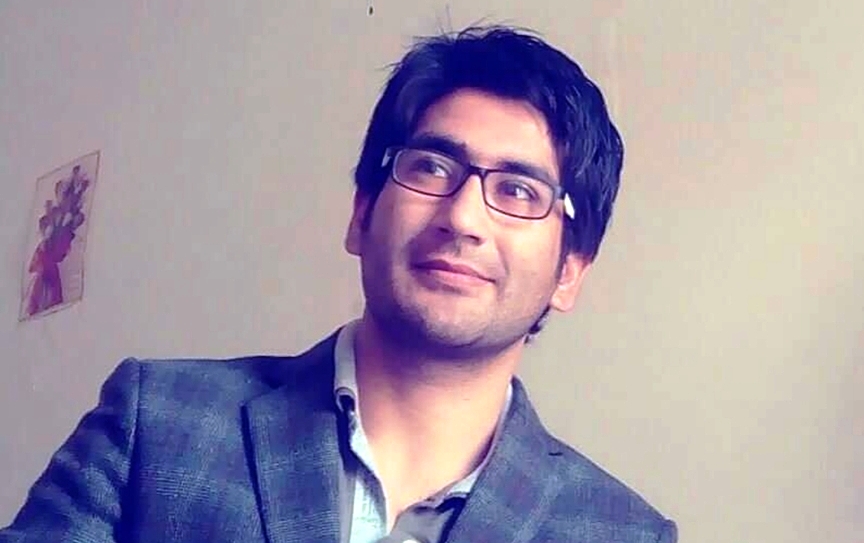
by Dr Ghulam Mohammad Khan
We are living in what may be called, with no small irony, the “Reelocene Epoch” a cultural moment governed by the dominance of the short-form video. The reel, a flickering stimulant, has assumed the role of the prevailing aesthetic of the age, capturing attention spans with unrelenting precision.

As Jean Baudrillard might suggest, the public no longer consumes content; rather, it consumes the spectacle of consumption itself, a fractured, relentless cycle of imagery that neither demands nor delivers anything of substance (Baudrillard, Simulacra and Simulation). Its rule is unchallenged. Lectures, prayers, and even conversation are now subject to reduction, trimmed into palatable, forgettable fragments. In this economy of attention, brevity is not the soul of wit but the end of thought.
As an educator, I routinely warn students about this fragmentation of consciousness. I cite the concerns of the Frankfurt School regarding the industrialisation of culture (Adorno and Horkheimer, Dialectic of Enlightenment). Reels, I explain, weaken analytical thought, replacing reflective engagement with the immediate gratification of the swipe. Yet I find myself complicit, not unlike a priest delivering sermons on restraint while privately indulging.
Lately, I have become captivated by the performative gestures of actors, particularly actresses and influencers, whose mannerisms appear increasingly detached from genuine human expression. They resemble not real people, but symbolic echoes, unsettling spectres of affect. The content they produce carries little meaning. What draws me in is the performance itself. As Roland Barthes noted in Mythologies, the signifier often outpaces the signified. In this case, manner eclipses the message entirely.
What disturbs me most is how these stylised expressions have begun to infiltrate ordinary interaction. There is no existing language to diagnose their absurdity, no framework with which to discredit them as empty displays. Yet when one fumbles with cutlery in a “respectable” hotel, the judgment is immediate. Cultural custodians emerge, armed with their silent codes: inelegant, ignorant, and unrefined. Pierre Bourdieu, in Distinction, might have smiled at the contradiction. The public unquestioningly accepts the exaggerated performances of influencers in daily life, yet still deploys outdated standards of propriety to punish minor social lapses.
The irony is unmistakable.
Through its relentless proliferation of the trivial, the reel has made everyone fluent in the vocabulary of spectacle. Still, the older hierarchies endure. The language of influence is celebrated, no matter how hollow. Meanwhile, the markers of “taste” retain their punitive power. The medium that claims to democratise has only repackaged the old inequities in new, curated forms.
Let us examine, with the precision of a Barthesian semiotician (Mythologies), the spectacle surrounding a particular celebrity, a figure sculpted by the industry of manufactured authenticity. Her attire, more articulate than her expressions, resembled what Baudrillard termed a hyperreal costume (Simulacra and Simulation), a visual command declaring, “Observe, but do not reflect.” Each strand of hair, styled to improbable volume, conformed to the aesthetic logic of the reel, where naturalism is disavowed and visible effort becomes a silent ideal. Within this ecosystem, one does not merely exist; one must enact existence, like a modern Sisyphus condemned to reapply gloss without end.
The video, severely truncated, was not a conduit for meaning but a stage for its simulation. The question posed to her served as ambient filler, incidental to the performance of her lips, the deliberate dilation of pupils, and the calibrated flicker of enamel. Goffman’s The Presentation of Self in Everyday Life seemed to dissolve under the weight of parody. Her movements were not communicative acts but set pieces, rehearsed for the appearance of spontaneity. Each motion of the hand-carried the exactitude of an automaton, the smile arrived on schedule, not as a response but as a conditioned nod to algorithmic demands.
Then came the laughter, so precisely timed it could have emerged from a production manual devised by Fordist engineers (Gramsci, “Americanism and Fordism”). The conversation’s emptiness amplified the absurdity, revealing that in the reel economy, even triviality must shimmer with manufactured delight. Her voice, devoid of weight, echoed what Adorno criticised as the jargon of authenticity, a tonal gloss masking a lack of substance.
What unfolded was not elegance but its simulation, a formulaic replica of charm designed for frictionless consumption. The reel does not document life. It supplants it with a stylised effect, leaving viewers caught between fascination and a faint sense of unease, as though having gorged on sweetness only to reach again for the same.
We are observing, as Walter Benjamin proposed in The Work of Art in the Age of Mechanical Reproduction, the replication of affect itself. The expressions, intonations, and stylings of digital performers, actors, influencers, and YouTubers, now circulate with such intensity that they have become part of popular culture’s basic grammar. These curated voices and exaggerated gestures have shed their status as individual performances. They now operate as social scripts, re-enacted with the conviction of ritual. The younger generation, unknowingly shaped by the algorithm, speaks in borrowed voices, moves in gestures learned through repetition, and feels in patterns that have been rehearsed for them.
What is striking, in a distinctly Bourdieuian sense (Distinction), is how this mimicry tends to remain confined to a particular class, those captivated by the glamour of show business, where each exchange resembles an audition, and every encounter is viewed as material for a potential reel. The same expressions, if heard in a grocery store or a government office, would sound misplaced. Yet within the right echo chamber, they are delivered with reverence. These gestures are not always harmful. Some are innocuous, even appealing. However, when they evolve into exaggerated theatrics, imitations of high society or stylised speech that proclaims a desire to belong, they begin to reflect a deeper cultural affliction.
Zadie Smith has noted that linguistic multiplicity is not inherently problematic (Speaking in Tongues). Yet affectation, in its exaggerated form, betrays not fluency but an unease with the self. A strained accent, a rehearsed laugh, or a borrowed gesture evokes the image of a poorly fitting costume. The difference lies in speaking another language with understanding and performing linguistic tourism, a disjointed impersonation that makes the gap between self and aspiration more obvious. The reel has transformed its viewers into amateur method actors, perpetually rehearsing parts for which they were never selected.
This gives rise to one of the central contradictions of digital culture. The more individuals imitate, the further they move from authenticity. The more they perform, the less they remain present. The reel provides and withholds in equal measure, creating a generation of skilled impersonators who no longer speak with their voices.
What unfolds is a version of the Bakhtinian carnival (Rabelais and His World) translated into digital language, where widened eyes, tilted brows, bared teeth, and stylised exclamations no longer appear as natural reactions but as curated signals. Once harmless or even whimsical, these gestures now form a language of power, controlled by the new aristocracy of the reel. When dominated by influencers, they cease to be playful and become mechanisms of control, where even vulgarity is stylised into a form of distinction. Crudeness, recontextualised by the elite, masquerades as authenticity, reinforcing existing hierarchies.
The irony becomes evident in the classroom. Undergraduate literature students, many of whom struggle with the spelling of Shakespeare or the function of metaphor, can nevertheless reproduce expressions such as ouch, shit, and god damn it with a fluency that echoes Orwell’s Newspeak (1984). These phrases are not acquired through reading or reflective conversation. They arrive through digital repetition, bypassing critical engagement to settle in the mind as instinctive, performative habits.
The grotesque element lies in the class dimension. When members of the reel elite employ such language, they do so with the ease of those who possess cultural capital. Their obscenity signals refinement, a mark of cosmopolitanism that lifts them above provincial norms. When mimicked by outsiders, these same expressions appear strained and artificial. The voice is borrowed. The tone is off. The result is a performance of aspiration, a sacrifice of linguistic heritage in exchange for an imagined sophistication. This leaves a generation that cannot define synecdoche but can pronounce oh my god with the precision of a streaming drama.
In this environment, words are no longer carriers of thought but theatrical devices, props in a globalised display. Language is emptied of meaning and repurposed for performance. The more individuals distance themselves from their native speech, the more they believe they belong to an imagined elite. Ouch is no longer an utterance of discomfort; it becomes a badge of surrender, an act of symbolic erasure. The reel rewards only those who dissolve most completely into its vacant theatre.
We now face what Guy Debord might describe as the society of the spectacle in its most covert form. Its influence is not imposed by coercion or rhetoric but through the slow absorption of aesthetic codes. It resembles Adorno’s culture industry (Dialectic of Enlightenment), which achieves its effect not by commanding submission, but by presenting its logic as natural. Gesture by gesture, word by word, the reel displaces the local. This is not merely mimicry. It is a quiet occupation, where ubiquity replaces persuasion, and where repetition outlasts resistance.
Expressions, as Raymond Williams argues in Marxism and Literature, are never simply personal acts. They represent shared articulations of cultural consciousness. When a generation adopts the vocal fry of American influencers, the gasps of Korean drama characters, or the clipped enunciation of British prestige accents, not for communication, but to simulate charm or allure, they participate in what postcolonial theorists describe as linguistic self-exotification.
Homi Bhabha, in The Location of Culture, might interpret this as mimicry without mastery, where the borrowed voice fails to confer sophistication. It leaves the speaker adrift, neither rooted in the local nor assimilated into the foreign. The result is a kind of ventriloquism, performed in the accent of global effect.
The problem lies not in the cultural exchange itself. Hybridisation has always shaped language. The damage comes from the imbalance embedded in this exchange. In the age of reels, language is reduced to a menu of selectable identities. The privileged now treat accents as fashion, something to adopt or discard as desired. For those on the margins, the process operates in reverse. Their accents are perceived as burdens, reminders of origins best concealed. A cultivated tone becomes a form of camouflage. A native idiom is surrendered in pursuit of approval.
This erosion is not only a question of style. It signals a deeper loss. Each exaggerated inflexion, each synthetic squeal or vocal fry, is not simply awkward. It marks a retreat from heritage. These are not harmless imitations. They resemble farewells. In every overacted syllable lies the silence of a voice once spoken naturally, now traded for something algorithmically valuable.
The algorithm, relentless in its preference for uniformity, offers rewards only to those prepared to discard what makes them distinct. It prizes imitation over origin, and spectacle over meaning. The reel confers attention. In return, it demands erasure. Language becomes currency. Dignity becomes collateral.
(Born and raised in Sonawari (Bandipora) on the shores of Wullar Lake, the author is an Assistant Professor at HKM Degree College Bandipora, Kashmir. Ideas are personal.)