by Humaira Nabi
SRINAGAR: In March 1994, as Pakistan prepared a diplomatic ambush at the United Nations Human Rights Commission (UNHRC), India was forced into one of its tensest foreign policy battles since Independence. The charge: gross human rights violations in Jammu and Kashmir. The stakes: if the resolution passed, it could internationalise the Kashmir dispute for the first time in decades.

This riveting episode, almost forgotten in public memory, is dramatically retold in Abhishek Choudhary’s new biography, The Believer’s Dilemma, the concluding volume in his study of Atal Bihari Vajpayee. Drawing on archival material and fresh interviews, the book casts new light on the improbable roles played by unlikely allies and ideological rivals during one of India’s most precarious moments in global diplomacy.
The resolution, whipped up by Pakistan after a 33-year gap, came at a moment when international attention was turning sharply toward the treatment of Muslims in India following the Babri Masjid demolition. Prime Minister Narasimha Rao needed a face that combined credibility, gravitas, and diplomatic experience. He turned to his greatest critic—Vajpayee.
“There were jokes,” Vajpayee would later say, “that the foxy Rao had entrapped me, so in case Pakistan won, he could blame me.” But Rao had also made a bold and calculated move: in Vajpayee, he sent not just a seasoned statesman but the opposition’s most persuasive public figure. The multi-party delegation also included Finance Minister Manmohan Singh, junior Foreign Minister Salman Khurshid, and, most dramatically, a weepy and fiery Farooq Abdullah, fresh from self-imposed exile in London.
Their mandate was clear: to defeat the resolution, or at the very least, fracture the consensus behind it. Their strategy? To present India as “an innately secular, multi-party democracy” where differing voices, including those from Kashmir, were not just tolerated, but included at the highest level of engagement.
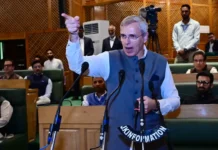
Inside the UN chambers, Farooq’s performance was electric. His eyes welled up, voice cracking, he roared: “Over my dead body—she will come into Kashmir over my dead body, United Nations or no United Nations.” The “she” was Benazir Bhutto, who had compared Delhi’s actions in Kashmir to “the darkest days of the Holocaust.”
“I will defend Kashmir with the last drop of my blood,” he thundered. “You”—the Pak-backed militants—“have turned my beautiful valley into a killing field.”
Backstage, Vajpayee was less impressed. He dubbed Farooq a “langoor”, a baboon, for his theatrics, and refused to sit next to him. The team found a workaround: Vajpayee would speak in the morning, and Farooq would take the afternoon shift.
Despite this diverse display, India was struggling to rally support. A majority of the 53-member UNHRC was expected to abstain, just enough for Pakistan to score a symbolic win. Vajpayee even had a fallback statement prepared, opposing the idea of a UN fact-finding mission in Kashmir, in case the resolution passed.
Then came a dramatic backchannel play. Foreign Minister Dinesh Singh flew to Tehran, where his Chinese counterpart was also present. India pleaded with Iran and China to abstain. Meanwhile, the Hinduja business family, old friends of Vajpayee from his Janata Party days, quietly leaned on their Geneva-based connections, including sending homemade food to Vajpayee’s suite, to sway Iran’s position.
“Miraculously, India was rescued by Iran,” Choudhary writes. Iran’s dissent broke the OIC consensus. Confused and isolated, Pakistan withdrew the resolution. The vote never happened.
Back home, the Indian delegation was received like a victorious cricket team. It was a diplomatic escape, pulled off not just through strategy but through a delicate balancing act of personality, power, and persuasion. It also demonstrated the paradox of Vajpayee himself, a man who railed against the government in Parliament, yet rose above partisanship when India’s global standing was on the line.
This moment, Choudhary argues, reveals the deeper contradictions that shaped Vajpayee’s career. Believer’s Dilemma doesn’t merely chronicle a political life; it maps the evolution of the Sangh Parivar and the rise of the Hindu Right, using Vajpayee’s journey to trace the push and pull between ideological loyalty and national interest. From the Janata Party era to the aftermath of the Babri Masjid, the 2002 Gujarat riots, and his reluctant stance on the Indo-US nuclear deal in 2008, the book explores a leader who never fully escaped the shadow of the RSS, even as he tried to pull the BJP to the centre.
In Geneva, at least, Vajpayee found a way to serve both India and his conscience. And in doing so, he helped prevent Kashmir from becoming a permanent item on the world’s diplomatic agenda.