by Malik Daniyal
Political actors subtly reframe economic data to persuade publics, prioritising narrative control over reality, transparency, and lived economic experience
In most democracies, we witness this political theatre where politicians trade blame over responsibility for the state of the economy. Unfortunately, amid this constant exchange, constructive and meaningful discussion is often drowned out by the noise. The public is left to navigate a contest of rhetorical argumentation where carefully crafted language, performative confidence, and pseudo-intellectualism carry more weight than substantive economic reasoning. In such an environment, power tends to gravitate not towards the most informed but towards the most persuasive.
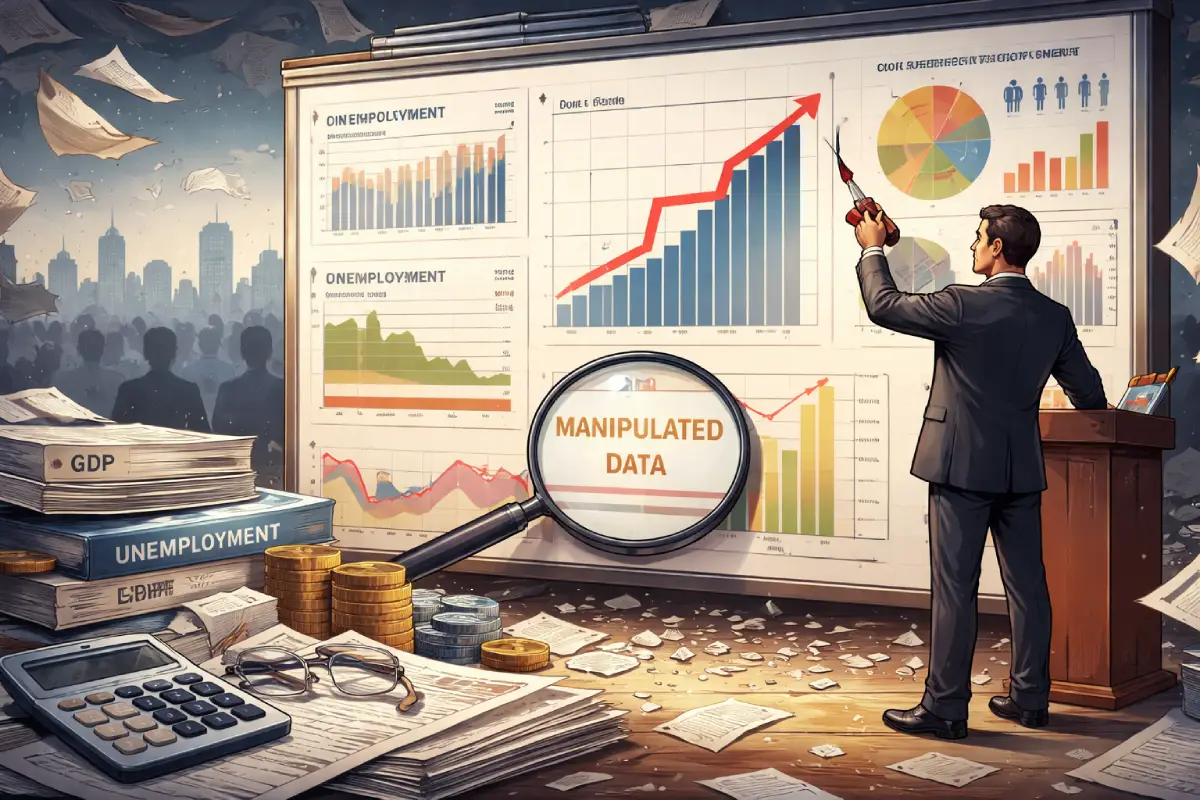
Yet the true danger does not reside only in political speeches or televised debates. It lies in something far more subtle and far more powerful. It is in the strategic framing, selection, interpretation, and occasional distortion of economic data itself. Numbers, which should ideally reflect an objective economic reality, are extracted from complex contexts and repackaged into simplified narratives. By the time they reach the public, they no longer inform; rather, they persuade. The question is not merely whether data is presented, but how it is presented, what is included, and what is left out.
Economic Indicators
Economic indicators such as GDP, GNP, inflation, unemployment rates, poverty ratios, fiscal deficits, and human development indices are originally designed to help policymakers understand the health, direction, and vulnerabilities of an economy. However, these standardised tools become powerful political instruments when filtered through political intent.
Take GDP growth, for example. It is often branded as the ultimate scorecard of government performance. While GDP may reflect the total value of goods and services produced, it does not comment on who benefits, where the growth occurs, or how sustainable that growth is. A government can legitimately report a 6 per cent or 7 per cent growth rate while real wages stagnate, informal employment rises, and inequality deepens. Yet in political discourse, such nuance is rarely conveyed. Instead, the number is deployed as an unquestionable marker of success.
Likewise, unemployment figures can be reshaped through definitional changes. If employment is measured not by the stability or sufficiency of income, but by minimal hours of engagement, then precarious, underpaid, or informal labour can be reclassified as “employment”. A person working two hours a day may be presented as “employed” in official statistics. In this way, joblessness is not resolved, but merely renamed.
Similarly, inflation data can be adjusted through selective baskets of goods. If staple commodities that deeply affect poor households are underrepresented in the consumption basket, then official inflation rates will fail to reflect real-life pressure. While citizens struggle with rising prices of essentials, they are told that “inflation is under control”.
Thus, the manipulation of economics does not always require falsification. More often, it relies on redefinition, exclusion, selective aggregation, and strategic emphasis. It is a science of framing rather than fabrication.
Data Manipulation?
To better understand this dynamic, consider a few hypothetical but realistically possible scenarios.
Imagine a region that records a 5 per cent increase in per capita income over a year. Politically, this figure is celebrated as evidence of rising prosperity. However, a deeper look shows that the increase is primarily concentrated among urban elites involved in real estate or large-scale trade, while rural incomes remain stagnant or even decline. When averaged, the growth seems universal. In reality, the majority of citizens experience deterioration rather than improvement.
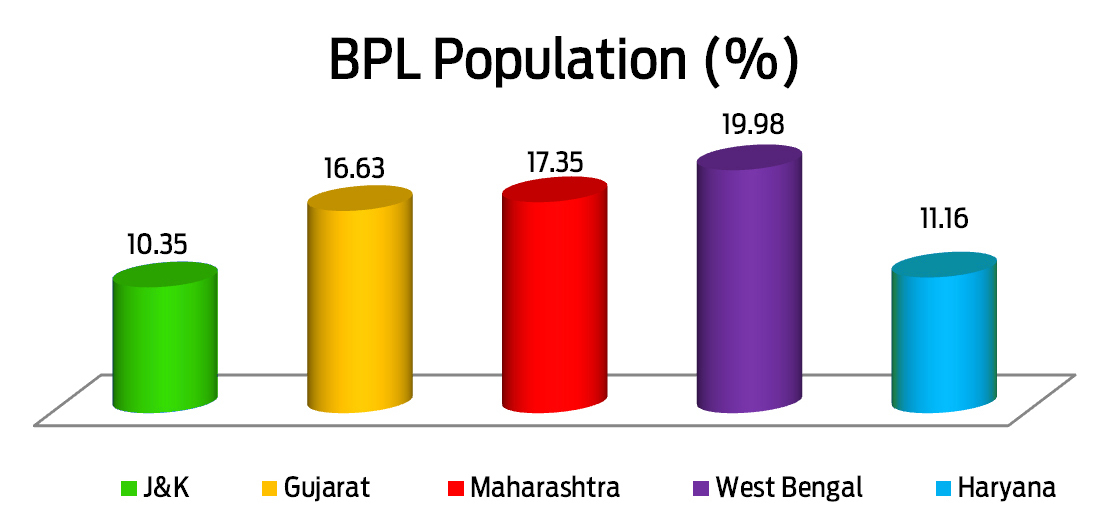
In another scenario, a government announces that poverty has declined by 10 per cent in five years. On paper, this sounds transformative. But the poverty line itself has not been updated to account for inflation, urbanisation, or changing living standards. What is categorised as “above the poverty line” in data no longer guarantees basic human welfare. Poverty did not disappear; rather, the benchmark simply moved away from reality.
Consider also a case where a government highlights an increase in business registrations as proof of economic vibrancy. What is not disclosed is that many of these registrations are inactive firms or shell operations created for compliance benefits or access to subsidies. The data creates the appearance of entrepreneurship without supporting genuine productive activity.
These scenarios illustrate a deeper truth. The numbers do not speak, but they are made to speak. And politicians often become the authors of that voice.
Illusion of Understanding
Modern media structures greatly amplify the relationship between political messaging and economic data. In today’s digital environment, complex data is reduced to simplified headlines, infographics, or sound bites. A tweet or a 30-second news clip replaces a 200-page economic survey. In the attempt to make information accessible, essential complexity disappears.
The public, already distanced from the tools required to critically analyse statistics, becomes vulnerable to narrative dominance. A repeated number, even if weakly supported, gradually assumes the status of truth. This psychological phenomenon, sometimes called the illusion of truth effect, ensures that the more often a statement is repeated, the more believable it becomes, regardless of its accuracy.
Statistical Distortion
The manipulation of economic data does not always announce itself through crude falsification. More often, it operates through technical sophistication. It is silent enough to escape public detection but powerful enough to alter national perception. Modern statistics is as much about construction as it is about calculation. Those who control the framework often control the final narrative.
One of the most effective instruments of distortion is the alteration of the base year used in computing GDP and related indicators. Although such revisions are sometimes justified due to structural changes in the economy, they can also be strategically timed to generate favourable growth patterns. A change in the base year recalibrates the entire economic timeline, creating the appearance of acceleration without any substantial transformation in productive activity.
Sampling structures present another vulnerable entry point. National surveys, labour force data, and household consumption trends are deeply dependent on who is selected, where data is collected, and which populations are left underrepresented. Remote regions, informal workers, seasonal labourers, conflict-affected populations, and women engaged in unpaid labour often exist at the margins of institutional data collection. Their invisibility within datasets becomes statistically institutionalised.
Additionally, selective aggregation, such as combining economically unequal regions into a single average, collapses diversity into uniformity. Huge regional disparities disappear into the national means. A struggling rural economy merges with an expanding urban zone, and the output is presented as moderate but acceptable growth. This false equivalence erases lived hardship behind the mask of arithmetic balance.
Even more decisive is the process of methodological opacity. When statistical procedures are complex but unexplained, numbers gain an aura of authority without accountability. The public is discouraged from questioning figures it does not fully understand, and institutional silence replaces transparency. In such environments, data transforms from a public resource into an elite instrument.
Thus, the manipulation of economic data today rarely violates the rules of mathematics; rather, it redefines the rules of measurement.
Recognising Manipulation
In an era governed by metrics, credibility often rests on quantification. Yet numbers, despite their appearance of neutrality, are deeply embedded within political, institutional, and ideological structures. Recognising distortion does not therefore require mathematical expertise, but perceptual awareness.
One of the clearest indicators of manipulation is the divergence between statistical narratives and lived experience. When reports speak of rising prosperity while households experience declining purchasing power, nutritional insecurity, deteriorating healthcare access, and unemployment, the tension between data and daily life becomes undeniable. Reality, in such cases, is not inaccurate; rather, it is excluded.
Another warning signal is the strategic repetition of selective figures. Governments and political actors often highlight one or two favourable indicators in isolation while neglecting broader datasets. Economic health, however, is multidimensional. A rise in GDP alongside declines in workforce participation, public expenditure on health, educational investment, and female employment does not signify progress. It signifies imbalance.
Furthermore, a consistent pattern of delayed releases, retroactive revisions, and inaccessible microdata should raise concern. Data that cannot be independently examined cannot be trusted. One should recognise that where transparency is absent, confidence must be conditional.
Civil society, independent researchers, academic institutions, and increasingly informed citizens play a powerful role in identifying these discrepancies. The comparison of national statistics with ground studies, NGO reports, university surveys, and international estimates forms an informational ecosystem that resists single-narrative dominance. In many cases, the truth does not survive in official publications, but in comparative observation.
Thus, numerical literacy is no longer an academic privilege. It is a democratic responsibility.
Safeguarding Economic Integrity
For economic data to retain its legitimacy and societal value, strong institutional frameworks must replace political convenience. Ensuring the credibility of statistical systems is not a technical reform alone — it is a democratic imperative.
Foremost among necessary reforms is the absolute independence of national statistical institutions. These bodies must operate with legal and constitutional safeguards that insulate them from political interference. Their leadership should be protected through fixed terms and transparent appointment processes, much like judicial authorities.
Equally necessary is the principle of radical transparency. Every dataset must be accompanied by clearly documented methodologies, sampling structures, timelines, limitations, and revisions. Raw, anonymised microdata should be available for independent analysis. When citizens and scholars can verify conclusions, data regain its legitimacy.
External audits and peer-review mechanisms must also become institutionalised. Universities, research organisations, and international statistical bodies should periodically evaluate national data systems, not as adversaries, but as partners in credibility.

Equally transformative would be the introduction of public data literacy initiatives. When citizens are educated in basic statistical interpretation, manipulation becomes less effective. A numerate society is a resilient society.
Lastly, regions historically marginalised from data narratives must be structurally prioritised. Conflict-affected areas, rural economies, informal sectors, and peripheral regions must be overrepresented rather than ignored in national surveys. Only then can development cease being imagined and begin being real.
These reforms are not radical. They are corrective. They do not weaken governance but protect it from itself.
Economic data is a powerful instrument. In the hands of ethical institutions, it becomes a compass for development. In the hands of political interests, it becomes a mirror that reflects only what is desired, not what is real.
The manipulation of statistics may not always involve lies. Often, it involves silence, omission, reframing, and presentation. It is subtle, systematic, and sophisticated. And it reshapes reality more effectively than any speech.
Until then, we must ask ourselves: in a world governed by numbers, who is really writing the story?
(The author is a final-year economics student at the University of Delhi. Ideas are personal.)