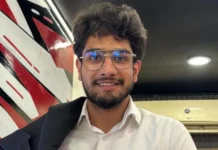
SRINAGAR: In a moment of prestige and international recognition, Dr Shabir Hassan, a leading Kashmir biotechnology researcher and academic from Khalifa University in the United Arab Emirates, was awarded the BRICS International Award 2025 for Excellence in Research and Promoting Education Across Borders and Cultures. The honour was conferred during a landmark ceremony at the World Trade Centre in Moscow, under the aegis of the BRICS Culture Media Forum, in partnership with the Embassy of the Kingdom of Bahrain and the World Peacemaker Alliance.
Held under the theme Cultural Projects as a Tool for Integrating the BRICS Plus Countries, the event was graced by a distinguished gathering of global statesmen, diplomats, cultural icons, and thought leaders. The presence of senior figures, including Dr Ahmed Al-Saati, Bahrain’s Ambassador to Russia, and Andrey Svintsov, Deputy of the Russian Duma, underscored the gravitas of the awards and their growing relevance in today’s fragmented geopolitical landscape.
But amid the glamour and symbolism of the night, it was Dr Hassan’s award, celebrating the power of science and academic diplomacy, that sent a powerful message about the role of intellectual leadership in shaping global peace and understanding, reports appearing in the media said.
Dr Hassan was recognised for his groundbreaking work in biotechnology and for building educational bridges between the UAE and BRICS nations. His collaborative research initiatives have not only advanced the frontiers of biomedical science but have also inspired institutional linkages, academic mobility, and youth engagement across continents.
“In recognition of your exemplary contributions to advancing scientific research and enhancing international academic collaboration,” read the citation. “Your commitment to promoting education across borders and cultures has significantly impacted the global scientific and academic community.”

Dr Shabir Hassan, currently an Assistant Professor of Biology at Khalifa University in the UAE, has charted an extraordinary journey from his roots in Kashmir to leading global institutions such as Harvard Medical School and Brigham and Women’s Hospital in the United States, where he served as an Early Career Investigator and Associate Bioengineer. His research focuses on developing in vitro disease models—especially for cancer and rare genetic disorders—for use in drug discovery and delivery, using advanced tools like 3D bioprinting, smart biomaterials, and mini-optical tomographic imaging systems. During his PhD, he pioneered nano- and micro-materials conjugated with proteins to study protein folding and aggregation, and their photothermal effects for cancer therapy.
Dr Hassan has published over 55 high-impact scientific papers and earned wide recognition for his innovative work, including the development of low-cost mini-microscopes—one of which was named a Hot Paper by the Royal Society of Chemistry—and 3D self-oxygenating artificial tissues for implantation in cases of volumetric tissue loss. His accolades include the Endeavour Award from the Australian Government, mobility grants from the Swiss National Science Foundation, the Excellence in Mentorship Award from Harvard Medical School/BWH, and the Best Oral Presentation Award from TERMIS Asia-Pacific in 2023. A passionate science communicator and mentor, Dr Hassan has delivered talks at international forums including the MIT Museum and currently serves as Associate Editor for Frontiers in Biomaterials Science, having also helped launch the MIT Science Policy Review in 2020.
Speaking after the award ceremony, Dr Hassan expressed gratitude to the organisers and reiterated the role of science as a universal language of peace and cooperation.
“This recognition is not mine alone, it belongs to every student, every researcher, and every institution that believes in collaboration without borders,” Dr Hassan said. “The BRICS International Award serves as a powerful affirmation that scientific excellence and educational outreach can bring communities together and pave the way for a more equitable and informed world.”
A visual tribute accompanying Dr Hassan’s segment featured his notable milestones, from leading biotechnology research clusters to launching academic exchange programmes between the Gulf and BRICS universities. The tribute also highlighted his policy advocacy for equitable access to higher education in emerging economies.
As one of the keynote speakers noted, “Dr Shabir Hassan represents a new generation of global academics who are not only pushing the boundaries of knowledge but are also healing divisions through learning.”
The evening’s atmosphere was further elevated by music, dance, and cultural exchanges, showcasing the diversity and unity of the BRICS Plus community. Delegates from India, Brazil, China, South Africa, Bahrain, Russia, and the UAE joined hands to celebrate the achievements of Dr Hassan and fellow awardee Maestro Igor Evard, who was honoured for his contributions to symphonic music and cultural philosophy.
In his closing remarks, Dr Sergei Dvorianov, Vice President of the BRICS Culture Media Forum, described Dr Hassan and Evard as “living symbols of what this platform stands for — cross-cultural excellence, innovation, and peace.”