In Kashmir’s brief summer, cherries ripen before anywhere else, offering a fleeting glimpse of vast horticultural promise. As climate change and market demands grow, scientists and farmers strive to extend the season, blending tradition with innovation, reports Syed Shadab Ali Gillani
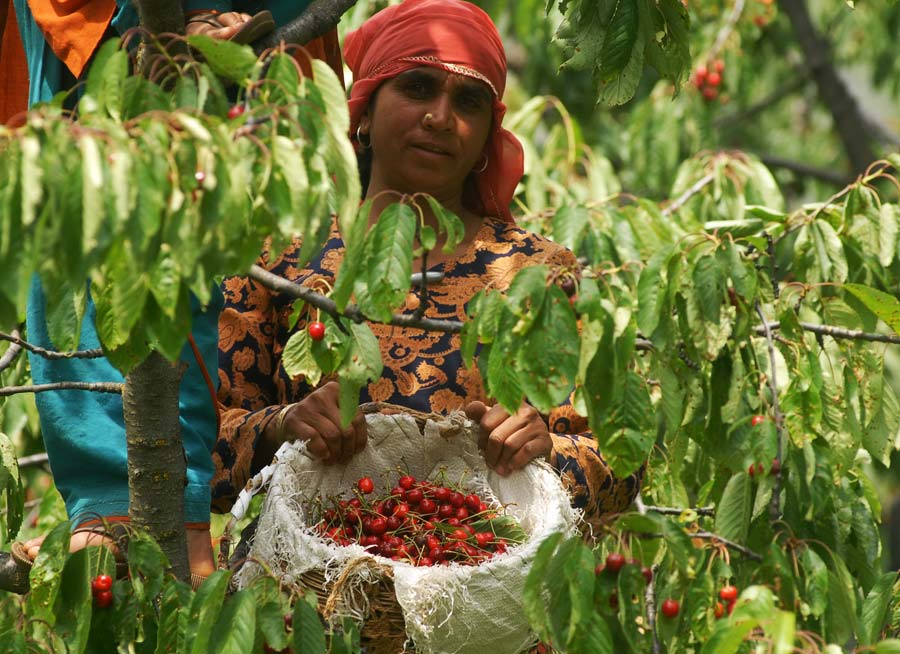
In Gutlibagh, a remote village in Ganderbal, rows of crimson trees swayed gently in the breeze, their branches heavy with ripening cherries. It is amazing to watch growers climbing ladders with practised ease, carefully collecting the season’s first fruit in baskets and buckets.
Located beside the Ganderbal road, Gutlibagh residents work in the orchards early, as men and women move between trees, reaching for firm, unripe cherries. The air filled with the soft sound of cutters, footsteps on damp earth, and the murmurs of seasoned workers.
“This is where the season begins,” a resident said, explaining that cherry and strawberry were the first fruits they harvested. Unlike Cherry, the strawberry is a newcomer in Kashmir’s fruit basket.
Orchard owner Nisar Ahmed, who had farmed the land for years, recalled how Kashmir’s freak weather damaged his crop. “When the flowers bloomed, it rained for days. We lost more than half,” he regretted. He had switched to hybrid farming in 2018 after traditional methods failed. Despite requesting soil testing from the horticulture department, he said, they received no follow-up.
Most of Gutlibagh’s cherry trees were planted by previous generations. Nisar noted that many now preferred hybrids due to their longer shelf life, five to seven days, compared to just one or two for the older varieties. This made them easier to sell.
He picked a cherry and held it out. It was firm, unlike the older ones that would fall apart quickly.
Markets preferred this firmer fruit, but some growers were hesitant. Altaf Hussain Khan, who had been in the cherry trade for a decade, believed the older varieties were tastier and tied to their way of life. “My father and grandfather worked with them. We still do,” he said. His family grew cherries, apples, and walnuts in rotation.
A Daily Supply
Every day, Gutlibagh sends 3,000 to 4,000 cherry boxes to market, mostly to Srinagar. Some went to other Indian cities, and a small number abroad. But there was no storage. Managing refrigerated transport for cherries to reach Mumbai has been a major task for the government. Unlike apples, cherries are to be sold immediately after picking as they lack shelf life.
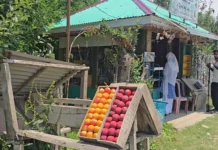
Nisar remembered the roadside stalls that once lined the highway from Wayil Bridge to Sonmarg. When tourism was booming, sellers moved hundreds of boxes from these stalls. “That is gone now,” he said. “We lost a big part of our market.” He paused, quiet. “We work all year. When the fruit does not last, the work is wasted.”

A Big Basket
Several varieties grew in Gutlibagh: Mishri, Mahmali, and Double. Mishri lasts the longest, up to ten days, giving growers some breathing room. But most cherries spoiled quickly. “Eighty per cent stays in Kashmir,” Nisar said. “Very little goes outside. Without storage, it is not possible.”
Cold storage remained absent from the area. “Only apples are stored,” he said. “Not cherries.” Still, the growers kept planting, picking, and selling whatever they could.
Nasrullah Khan, who had cultivated cherries for four decades, said the market has shifted. Heavy rain and insect infestations hurt production, even though demand remained steady. He noted the introduction of new cherry varieties over the past decade, which increased yield, but added that weather remained a critical challenge.
Mounting Losses
Mohammad Jaffar Khan, a grower, said it takes around 15 to 20 minutes to harvest fruit from a single tree, depending on its yield. Developing an orchard takes over seven years, he explained, involving a laborious process that includes spraying pesticides after hailstorms.
He noted that both the hailstorms and the Pahalgam massacre had caused severe losses. Earlier, prices were favourable, but now they hardly cover even half of the labour costs.
Other growers shared similar concerns. A box of cherries that once fetched Rs 250 now sells for just Rs 80. “We are not even able to make a living now,” one of them said.
Kashmir’s Director of Horticulture agreed that the decline in tourism had impacted cherry sales in Ganderbal. He noted that previously, 200 to 300 outlets operated along the Sonamarg route. However, from a horticultural perspective, only Shopian and Pulwama recorded production losses. Shopian was hit by wind and hailstorms.
Huge Orchards
Sweet cherries (Prunus Avium), a delicate but profitable stone fruit, are cultivated on 2,952 hectares in Kashmir, producing an estimated 23,114.77 metric tons annually. According to the horticulture department, the sector generates around Rs 175 crore, with Jammu and Kashmir contributing nearly 95 per cent of India’s total cherry output.
The primary cherry-growing districts include Ganderbal, Srinagar, Baramulla, Shopian, and Bandipora. Around 14,000 farm families depend on this crop for their livelihood. Cherries are also the first cash crop of the season, offering early financial relief to growers.
The ideal conditions for cherry farming include about 1,000 hours of winter chilling, good winter precipitation, and dry, cool summers. Hardy cherry trees prefer elevated lands, where blossoms are less exposed to spring frosts. The soil must be well-drained, rich in organic content, and range from sandy loam to loam.
Khalid Mushtaq, Professor at SKUAST’s Fruit Science Division, said commercial cherry cultivation in Kashmir is concentrated in four major zones. Ganderbal leads in both area and output, followed by parts of Srinagar like Dara, Brein, and Zakura, areas in Shopian, and Tangmarg in Baramulla.
Government data accessed by Kashmir Life confirmed this trend. In the 2024-25 season, Ganderbal produced 9,094.60 metric tons from 1,165 hectares, followed by Shopian’s 4,927 metric tons from 613 hectares. Srinagar yielded 3,167 metric tons from 345.69 hectares, while Baramulla produced 3,103.46 metric tons from 298.08 hectares. Other contributing districts include Kupwara, Kulgam, Budgam, Bandipora, Pulwama, and Anantnag.
Khalid added that cherries require precise climatic conditions, temperate zones with enough chilling hours below 7°C, moderate temperatures during flowering, and minimal rain during ripening. Rain during harvest often causes cracking, he said, noting that a single damaged cherry can spoil an entire box.
High-Density Plantations
For generations, Kashmiri farmers cultivated local cherry varieties grafted on vigorous rootstocks, producing large trees spaced far apart. However, these traditional orchards faced challenges: low yields, uneven quality, and limited market appeal compared to newer exotic varieties. Demand was shifting towards larger, firmer, and sweeter cherries, prompting the adoption of imported types such as Regina and Mishri, introduced and recommended by SKUAST.
Farmers, supported by government schemes akin to those for apples, have begun transitioning to high-density plantations. This model promises earlier fruiting, better quality, and reduced rain damage, especially when paired with protective measures like hail nets and bird-scaring systems, according to Khalid, a horticulture officer.
Director of Horticulture Vikas Anand explained that the department is working on a scheme to install solar fencing to keep wild animals at bay. Additionally, they are promoting the use of anti-hail nets to safeguard crops from damage.
Jammu and Kashmir cultivate several cherry varieties, both traditional and exotic. Older types include Guigne Poupera Prece (Awal Number), Black Heart (SiyahGole), and Bigarreau Napoleon (Double). Recently introduced varieties such as Regina, Kordia, Lapin, and Schneiders have gained popularity. Among these, Double and Mishri each account for about 30 per cent of the total production, followed by Makhmali at 15 per cent. The rest include Stella, Van, Bing, and Lapin.
Khalid noted that cherries, being highly perishable, are mostly consumed within Kashmir and Jammu. Limited export is due to the lack of cold chains, hydro-cooling facilities, and efficient logistics. Without rapid post-harvest cooling and refrigerated transport, the fruit spoils quickly.
While sweet cherries are mainly eaten fresh, about 4,800 metric tonnes are processed annually into canned goods, confectionery, and beverages by units inside and outside the region. Markets include Delhi, Mumbai, Ahmedabad, Hyderabad, Pune, Punjab, Kolkata, Bangalore, and Tamil Nadu. High transport costs are a burden, with shipments moving by truck, rail, and air to reach distant destinations like Delhi’s Azadpur Mandi.
To address these challenges, Khalid emphasised the need for farmer cooperatives, cluster-based production, and shared facilitation centres. A robust farm-to-fork supply chain, modern branding, grading, and traceability systems would help Kashmir’s cherries compete internationally. With the right packaging and certification, they could be marketed as organic,nutrient-rich premium produce.
View this post on Instagram
Extending the Window
Khalid explained that Kashmir enjoyed a competitive advantage as its cherries matured earlier than those in the USA and Europe, offering a limited yet valuable harvest window of 20 to 25 days. Research into rain-crack-resistant and late-maturing varieties was extending the season into July. SKUAST, he said, was introducing varieties like Bing to diversify ripening times and improve yields.
Kashmir’s current cherry production stood at an estimated 12,000 to 13,000 metric tons, constituting over 90 per cent of India’s output. Himachal Pradesh produced a small share in comparison. Khalid stressed the need for better infrastructure, market access, and cultivation support. With innovation and honest organic practices, he believed cherries could match apples in commercial potential.
Professor Munib Ur Rehman from SKUAST outlined a comprehensive strategy to boost cherry yield and quality. He said a shift to High Density (HD) orchards could raise yields from 5 to 20 metric tons per hectare. He also highlighted the need to integrate compatible pollinisers, given the self-incompatible nature of local varieties, and to address the poor nutrient profile of Karewa soils with a balanced mix of organic and inorganic inputs.
Climate change, he noted, posed new threats. Early spring frosts harmed flower pollination, while intense summer heat reduced fruit size. To adapt, he advocated high-yield cultivars, precision nutrition (especially zinc and boron), drip irrigation, and pre-cooling of fruit. He called for cold chain improvements and Controlled Atmosphere storage to prolong shelf life.
Munib also recommended integrated pest control using pheromone traps and neem sprays, avoiding pesticides during bloom, setting up beehives, and introducing legumes to support sustainability.
Post Script
On June 3, 2025, a train will take 24 tons of cherries to Mumbai. This will be the first argo train that will ever take any fruit from Kashmir to the rest of the plains after the prestigious railway line was completed.