Despite declining economic share, Kashmir’s agriculture is reinventing itself through technology, startups and high-density orchards, with SKUAST-K’s Gongul 2026 emerging as a catalyst for innovation, entrepreneurship and scientific farming transformation, reports Asrar Syeed
Kashmir’s agriculture is showing a paradoxical trend. On one hand, its share in Jammu and Kashmir’s GSDP has declined to 20.45 per cent, indicating a shrinking role in the overall economy. On the other hand, the sector is witnessing targeted growth in key areas, signalling that Kashmir continues to retain its identity as an agrarian economy despite the overall decline.
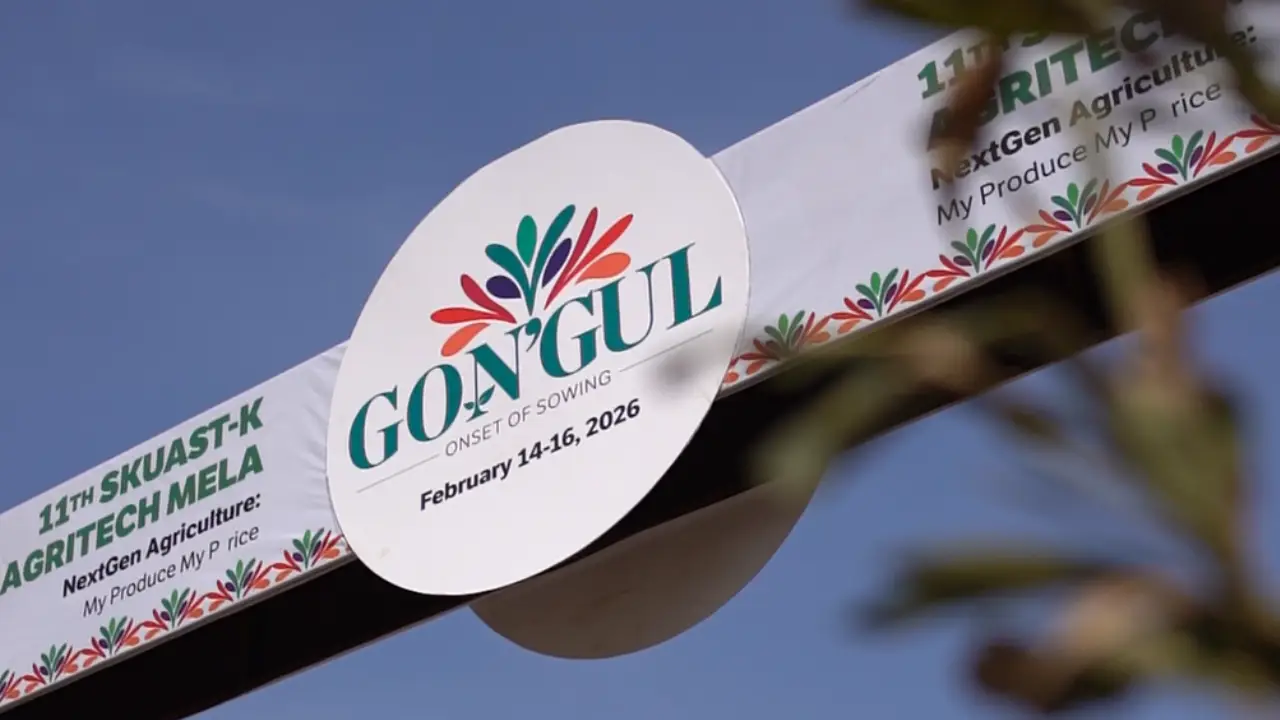
The best illustration of this contrast can be seen at Gongul, the agri‑tech mela organised by SKUAST‑K over the past several years. Over time, this festival has become the premier platform for observing changes in Kashmir’s agriculture and exploring the potential transformations that could occur if both society and policymakers engage with the sector seriously.
SKUAST-Kashmir, one of the best-ranked universities in India, has recently emerged as a platform for both farmers and innovators. Gradually, it is emerging as a campus where challenges are tackled, capabilities are honed, and the successes are celebrated with a clear objective to boost Kashmir`s agriculture. The campus has been opened for faculty-student start-ups based on the innovations they make, and it is changing the landscape of the university. Part of it was on display during the 3-day long festival that tens of thousands of people participated in.
The AI In Agriculture
For many people, a visit to the Centre for Artificial Intelligence and Machine learning (CAIML) was a surprise, if not a shock. Simple tools were explaining how Artificial Intelligence (AI) was changing agriculture globally and how it can emerge as a major force multiplier in producing the best in bulk.
“We are showcasing a range of technologies today, all developed in the CAIML lab of the university,” one scholar attending to the people at the stall said. “Our stall is designed to inform visitors about how farming can integrate with technology in the future.”
The group of scholars said their soil monitoring systems can help farmers understand key soil parameters like moisture, NPK levels, electrical conductivity, and pH. “This information would enable them to calculate the precise amount of irrigation required, making farming more efficient and sustainable,” one of the young scholars said. The CAIML lab has developed advanced drones that promise to significantly benefit the farming community. “First, we have a surveillance drone, which helps farmers monitor their lands and locate livestock. Another is a crop-sensing and monitoring drone, designed to assess soil health, detect damage or disease, and pinpoint affected patches,” explained a scholar. “We also have a spraying drone for efficiently applying fertilisers or pesticides across fields. Our most advanced model is a plane-type drone capable of covering large areas quickly, far more than the other models.”
Behind the stall, a large display depicted a “farm of the future”, where modern machinery and technology streamline agricultural processes for higher productivity and better results.
Currently, these tools are on display primarily to familiarise farmers with the vision of futuristic agriculture they can aspire to. While the application of AI in the fields may take some time, the important point is that the historic gap in Kashmir between advanced technologies and their practical implementation is expected to narrow, thanks to the efforts of SKUAST-K.

An App
FARM2I is an app which helps the farmer know the insights like Crop Health, Soil Health, and time variations of his crop or land. The app is available on both play store and app store
“A vast section of Kashmir farmers need experts’ advice, which would help them in enhancing their productivity and bring in modern science into their farming,” said Shahid Shafai, who has done his master’s in Geo-Information Science and Earth Observation at the University of Twente, Netherlands. “Just as the internet connected people across distances, we wanted to connect farmers with experts so that location would no longer be a barrier. That’s why we developed this app; it links farmers with their farmland and brings technology and scientific research directly into agriculture. This vision is what led to the creation of the app.”
The app uses space technology and AI and was awarded the best startup by IIT Bombay. Shafai`s company has also started making a few agriculturalproducts, which he says, “will increase farmers’ yield by 34 per cent and also help them to save money”.
Farm2I, according to Shafi, is the world`s first app which uses space technology for perennial crops. Still in its growing and bootstrap stage, Shahid`s vision is to take this app to a level where yield improves and costs reduce.
Agri Service Sector
Kashmir’s decisive shift towards high-density plantations, particularly in apples, has begun reshaping the region’s horticultural landscape. A new generation of well-informed and enterprising stakeholders is now actively pursuing the benefits of varietal upgrades and modern orchard management.
With more than three lakh hectares under fruit cultivation, only about 20,034 hectares have so far been converted into high-density orchards. While it may take decades to transform the entire landscape, a growing number of serious players are not just advocating the upgrade; they are actively implementing it.
Garden Guardians is a horticulture services company, established in 2017, to address unawareness among farmers. It currently operates across Kashmir.
“In 2017, upon realising the lack of awareness among farmers about the horticulture sector, the company came into being and, since then, we have made a significant mark in Kashmir,” Inam Mir, the company founder, currently pursuing his PhD at SKUAST-K, said. “We take the research conducted at SKUAST directly to the farmers to help them improve their practices.”
The company engages in Soil Testing, Orchard establishment, and a chain of nurseries across where they make world-class planting material. So far, the company has connected with 70-thousand farmers across Kashmir. It provides jobs to10 people right now.
There are many others like this. Garden Navigator company helps farmers in developing their orchards, establishing apple and other high-density fruit orchards, and conducting training programmes with the farming community.
“Our company has experts with in-depth experience in horticulture, and we help growers understand how to increase productivity and protect their lands from diseases, weed management and pesticide attacks,” said Tafeen Azad, a final-year BSc Horticulture student, who is also MD of his company. “I am from a rural area and have witnessed firsthand how little awareness farmers in my village had. This lack of knowledge persists across Kashmir, causing significant losses. It inspired me to start this company.”

Cred Agro Food, established in 2022, has expanded steadily and is currently operating in what it describes as its “investment phase – Model 2.” The company’s core idea is to address one of Kashmir’s structural agricultural challenges: fragmented landholdings.
“The objective is to work at an economical scale. Most farmers own small parcels of land, which increases production costs and limits their ability to compete in the market. At Cred Agro Food, we are trying to aggregate fragmented land and undertake production ourselves, using technology and modern agricultural research,” said Syed Ashfaq Ahmed, one of the company’s directors.
The company has acquired more than 100 kanals of land in a district of Kashmir and is currently in its growth phase. So far, it has tested products such as honey-based apple preserve, strawberry preserve, and Queen’s apple preserve, all of which, according to the management, have received encouraging market responses. “We do not use preservatives or chemicals. Our focus is on producing clean food products that are both safe and beneficial for consumers,” Ahmed added.
Looking ahead, the company aims to position itself as a leader in traceable and transparent food production. “Our customers should know exactly where the ingredients come from—whether it is fruit, meat, livestock feed, or poultry inputs. We want to build a fully traceable food system where transparency is guaranteed at every stage,” he said.
Red Leaf helps farmers develop high-density orchards by following proper protocols and using the most efficient materials, turning ordinary land into highly productive farmland.
“We follow a strict protocol and work carefully. At the initial stage, we identify the land and conduct a site visit, where an experienced professional inspects the plot to ensure it meets the requirements for the desired productivity. This saves farmers both time and money,” said one of the company’s employees. If the land meets the required conditions, a layout is drawn, followed by the installation of the trellis system, then drip irrigation, and finally, the plantation, the last step in constructing a high-density orchard.
“In the trellis process, we use imported, galvanised, and rust-free materials. For drip irrigation, we employ top-quality systems from leading manufacturers. During the plantation, we use imported plants from European countries such as Belgium and Italy. Recently, many orchards in Kashmir were damaged due to high-speed winds; our trellis materials are designed to withstand such conditions, following NIT-SKUAST guidelines,” he added. The company claims to have planted 100 high-density orchards in 2025.
FruTech is projecting itself as a one-stop solution for farmers, providing everything needed to develop high-density orchards. The company aims to boost apple production in Kashmir, currently at 10 tons per hectare, to levels comparable with Europe’s 50 tons per hectare.
“Our goal is to support growers from start to finish, not just by supplying products but by providing complete solutions for high-density orchards and all agricultural sectors,” said Faisal Burza, Managing Director of FruTech. “We apply scientific methods with a full team of plant pathologists, soil experts, engineers, and soil-testing labs to help farmers achieve optimal results.”
So far, Burza’s company has developed nearly 20,000 kanals into high-density farmland.
Vast Agriculture
In Kashmir, agriculture has remained the real mover and shaker and the only sustainable economy. It is small, but it is vast, and every second crop can make a difference if taken to the next level.
SKUAST has successfully encouraged a system in which it permits scholars and faculty to experiment, fail and succeed, and that has given it a distinct identity amongst all universities in India. The university has 100 patents and more than 90 start-ups, and all of them are growing.
The young minds within and outside SKUAST are experimenting with newer things to bring about a change. The habit of eating unhealthy snacks, for instance, is common in Kashmir. This is a source of obesity, tooth decay, digestive problems, and fatty liver diseases.
Dryum is a young brand with an ambitious goal: to replace unhealthy snacking habits with nutritious alternatives that offer real health benefits rather than hidden harm.
The idea, says its founder Faiq, took shape nearly a year ago. “I began noticing how unhealthy snacking was contributing to various health problems, particularly among young children. After researching the issue and thinking it through carefully, I decided to start Dryum to offer a healthier substitute,” said Faiq, who is currently pursuing his bachelor’s degree at Amar Singh College.
Dryum transforms fresh fruits into convenient, everyday snacks through dehydration, preserving their natural goodness while enhancing taste. The company currently offers dehydrated apple, banana, and kiwi products. “We do not add processed sugar or artificial flavours. Our focus is on keeping the snacks as natural and clean as possible,” he explained.
While still refining its pricing strategy, the company aims to make healthy snacking more affordable. “Even now, our prices are lower than many other so-called healthy products in the market. We provide clean energy and maintain complete transparency with our customers. As we scale up, we intend to further reduce prices, though we understand there is still a long journey ahead,” Faiq added.
In the town of Hajin, the curd prepared by Ghulam Qadir Sheer Gojri was once renowned for its distinctive taste. Years later, his grandson decided to revive that legacy, this time with a modern brand identity.
“After completing my graduation, I wanted to start something of my own. After researching different ideas, I thought, why not create a curd brand that recreates the unique taste my grandfather was known for, while modernising his traditional methods?” said Aaqib Farooq, who now manages Gold Craft Curd. In a short span of time, the brand has carved out a niche for itself.
Launched just a year ago, the product was initially sold only in Hajin-Sonawari. However, visitors who tasted the curd noticed its distinct flavour, and the brand has largely grown through word-of-mouth recommendations.
One striking feature of Gold Craft Curd is its yellow hue. “We add turmeric to our curd. This traditional technique not only gives it the characteristic colour but also enhances the taste,” Aaqib explained.
Beyond curd, the company has already introduced Greek yoghurt and cheese to its product line, with plans to launch another offering, Zeera Dahi, in the coming year.
Aaqib’s entrepreneurial journey blends inherited tradition with contemporary branding and product diversification, reflecting how legacy food practices in Kashmir are being reshaped for modern markets.
Interesting Ideas
Al-Hamdan Crafts Pvt. Ltd., a Kashmir-based enterprise, is built around sheep-skin products and a vision to revive the region’s fading fur industry. Its founder, Tahir Ahmed Kalwal, brings over three decades of experience in the leather trade. With the traditional fur market in decline, Tahir launched the company to re-imagine sheep-skin apparel in line with contemporary fashion trends.
“I have always wanted to revive the fur industry using sheep skin and create a brand that aligns with modern fashion sensibilities,” Tahir said. “With the help of technology, we can imprint unique wild-animal designs onto sheep skin without harming any wildlife. However, we still lack the infrastructure required to scale up production.”
Established in 2024, Al-Hamdan Crafts initially operated on a small scale. The venture recently received a Rs 20 lakh seed grant from the J&K Entrepreneurship Development Institute (EDI), a boost Tahir describes as pivotal. “I am grateful to the EDI department for supporting my journey. This funding will allow us to expand operations and diversify our product line,” he said.
At 57, Tahir views the initiative as both a business and a legacy project. “I want to revive this industry in my lifetime. Through this company, I hope to restore the old tradition of fur garments while also generating employment,” he added.
At its exhibition stall, Al-Hamdan Crafts showcased an array of sheep-skin products, including long coats in contemporary colours and cuts, as well as shawls and stoles, each blending traditional material with modern design aesthetics. “This bag, if branded properly, can fetch Rs 60,000,” he showed a women-exclusive bag on his display. “It needs a good processing to convert a sheep-skin into a wonder, but we are not able to understand the worth we have.”
Kashmir produces more than seven million kilograms of wool a year, but lacks the capacity to even process one per cent of it. The wool is being taken by the non-local textile sector literally at no cost. SKUAST experts said that the drastic disorganisation in collecting and properly managing the sheep wool has led to a situation where the herders throw it away. “We are now planning a system that will help us collect the wool and create some cooperative structure so that it is respected and sold better,” one SKUAST expert said. “It will take some time, but it will eventually happen.”
Organic Growth
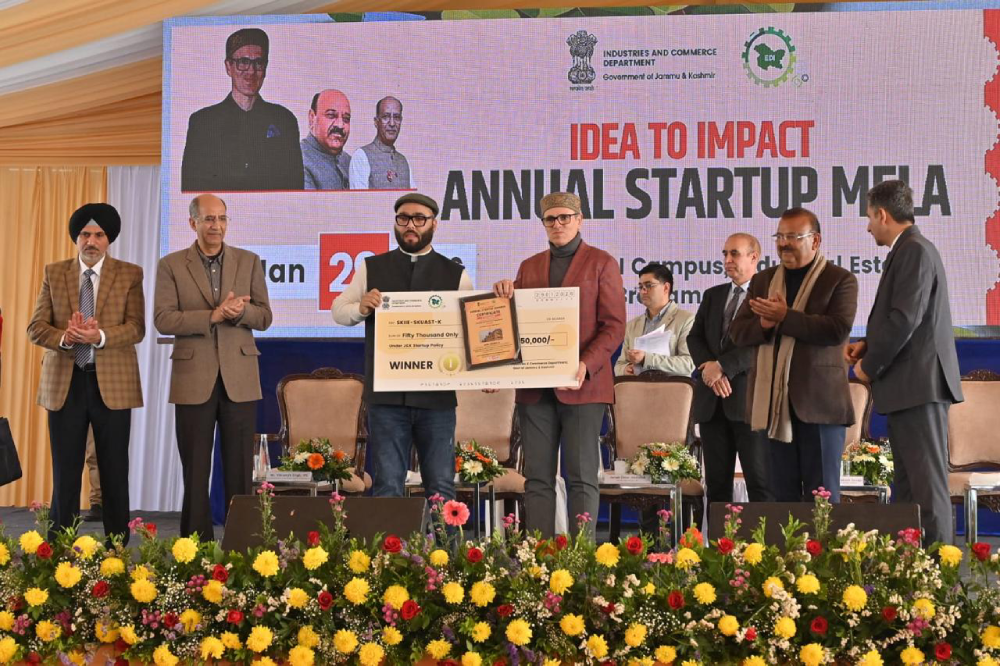
Gongul-2026, the Agri-Tech Mela organised by Sher-e-Kashmir University of Agricultural Sciences and Technology of Kashmir (SKUAST-K), now draws a massive and diverse audience. From young students to elderly farmers, visitors travelled from across Kashmir to witness an event that blended modern innovation with traditional agricultural roots.
This year’s festival featured nearly 400 stalls, each offering innovative ideas on how agricultural resources can be better utilised and value-added. A significant presence came from startups incubated within the Sher-e-Kashmir University of Agricultural Sciences and Technology of Kashmir (SKUAST-K) campus. These ventures showcased a diverse range of products, nutritional supplements, medicinal formulations, speciality teas including nettle-based blends, essential oils, beauty products, and a variety of processed food items.
The strong startup participation has given the festival a distinct identity, positioning it not merely as a traditional agricultural fair but as a platform reflecting the organic growth of innovation within the sector.
“We had planned the festival for two days, but given the overwhelming response, we extended it to three days this year,” said Prof Nazir Ahmad, Vice Chancellor of SKUAST-K. “We are trying our best to showcase the future.”
The VC said they have 35 technologies that have been developed in the university aimed at sustainable agriculture. “We have bio-fertilisers, and we have technologies to manage the pests without the use of chemicals,” he said. “We are into genetic interventions in animals to manage better mutton production and improve the milk production, and we have succeeded in certain technologies which are global firsts, like the one in artificial insemination in sheep.”
“I have been attending this Kisan Mela for the past three years. SKUAST-K has truly created a platform for people like me to experience modern agricultural innovations, understand technology-driven farming, and see the university’s research that will shape the future of agriculture,” said Ghulam Hussain Bhat, a farmer from Baramulla.
Interestingly, the festival also saw significant participation from young people, an encouraging trend for an event centred on agriculture. Their presence reflected how SKUAST-K has evolved into a broader knowledge platform, attracting stakeholders from all walks of life. Beyond farmers, it has become a space where aspiring entrepreneurs, students, and innovators can showcase ideas and engage with emerging trends in modern farming.
“I began full-time farming just two years ago, and this platform has helped me understand agriculture more scientifically. Integrating technology and research into my fields has increased productivity and reduced costs,” said Rameez Ahmad from Shadipora in Srinagar.
Non Native Innovators
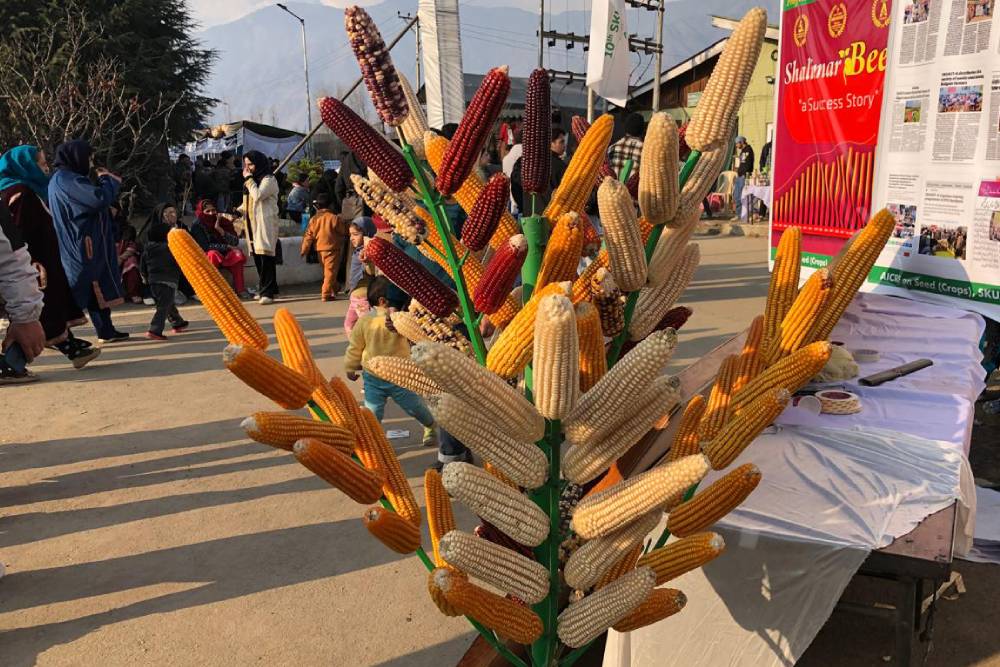
The festival has emerged as a big screen for showcasing the future and innovation in agriculture that non-local innovators book their spaces.
Sepio Health develops health-protection solutions for farmers exposed to pesticides. The company began with an anti-pesticide protective cream and has since expanded its product portfolio.
“I visited over 200 villages in Telangana, my home state, and met nearly 200 farmers in each village. Skin infections during pesticide spraying were a common complaint,” said Dr Om Prakash, Co-founder of Sepio Health. Along with co-founder Dr Pravin Kumar Vemula, he spent four years researching and developing a topical cream designed to protect farmers from infections and the harmful effects of pesticide exposure.
However, farmers later expressed difficulty in applying the cream before every field visit and sought a more practical solution. Responding to this feedback, the founders developed a protective suit, the Kissan Kavach, made from specially engineered fabric capable of neutralising exposure to organophosphates, insecticides and fungicides.
Sepio Health now aims to expand its reach across India’s farming community. Like many other technology-driven startups showcased at the event, it reflects a growing shift toward innovation-led transformation in agriculture, where farmer safety is becoming as important as productivity.