Kashmir’s saffron, the world’s most expensive spice, faces collapse from climate change, failed government schemes, illegal Iranian imports, land loss, and wildlife, threatening almost a 2000-year-old economy, reports Babra Wani
Mubaris was 19 when he first planted saffron. He had grown up watching his maternal family tend the purple-flowering crop across the karewas, the high-altitude plateaux of Pampore, and felt drawn to the work. He began on a single kanal of land.
Six years on, he farms roughly 12 kanals, runs a small processing firm, and is midway through an MBA at the University of Kashmir’s South Campus in Anantnag. He does not plan to take a job.
“My father told me I should expand my business,” the 25-year-old said. But even as he grows, he is watching the crop he has staked his future on contract around him. The yield is falling. The land is shrinking. The market is being undercut. And the government schemes meant to reverse the decline, he claimed, have largely failed.
Mubaris is one of around 150,000 saffron farmers in Kashmir. His ambivalence, committed to the crop, alarmed by its trajectory, is shared by almost every grower in the region. Kashmir’s saffron sector sits at the intersection of ecology, economics, and identity. What happens to it matters far beyond the fields of Pampore.
Kashmir’s Saffron
Saffron, locally known as kuong, is woven into almost every dimension of Kashmiri life. It flavours kahwa and traditional cuisine, features in religious and cultural rituals, and has for centuries represented prosperity for the farming communities who grow it. Demand extends well beyond the kitchen: the spice is used in the wellness sector, in medicines, and in India’s zarda factories.
In 2020, Kashmiri saffron was granted a Geographical Indication tag, certifying its authenticity and giving growers in designated areas of Jammu and Kashmir the right to market it under the Kashmiri name. The certification was designed to curb adulteration and help farmers secure better prices.
Though botanically similar to saffron grown in Spain and Iran, the Kashmiri variety is distinguished by longer, thicker stigmas, a deeper natural red colour, an intense aroma, and a pronounced bitterness. It is processed without chemicals and carries higher concentrations of crocin, the compound responsible for colour; safranal, which gives it its aroma; and picrocrocin, which accounts for its bitterness. It is also the only saffron in the world cultivated at altitudes of between 1,600 and 1,800 metres above sea level.
Cultivation is concentrated in the Pampore belt of Pulwama district, long known as Kashmir’s saffron town, with adjoining pockets in Budgam and Srinagar and a smaller area in Kishtwar. The crop was introduced to the region by Central Asian immigrants around the first century BC. Ancient Sanskrit literature refers to it as Bahukam. Chinese records note that in 647 CE, the king of Kashmir presented saffron as a gift to the Chinese emperor.
According to official figures, the total area under saffron cultivation has held broadly stable at around 3,715 hectares since 2010-11, with 3,665 hectares in Kashmir and about 50 in Kishtwar. Pulwama accounts for the overwhelming share of both land and output. But on the ground, farmers tell a very different story.
The Fall
Mubaris is frank about what has happened to his yields. “Earlier, our land used to produce a substantial quantity of saffron, but the yield has declined significantly,” he said. “Earlier, we could earn around three to four lakh rupees from saffron, but this year the returns may be only around fifty thousand rupees.” The drop is steep enough to threaten the viability of the enterprise entirely.
He identifies several causes. The saffron corms, the underground bulbs from which the plant grows, have become thin and exhausted and need replacing. Rainfall has grown unreliable, and without consistent moisture, the crop suffers. His land in Samboora, near the Lethpora Highway, has no irrigation facility.
“There is no meaningful assistance from the government, and we do not receive any subsidy,” he claimed. He also alleged irregularities in past government schemes. “Some people took the saffron corms provided under subsidy but did not plant them. They kept them aside and simply took the money, which has harmed the sector.”
The price of pure Kashmiri saffron has risen to around five lakh rupees per kilogram this year. But higher prices have not saved farmers whose yields have collapsed. Mubaris noted that many growers, tired of poor returns, are converting saffron fields into high-density apple orchards. “They do not see sufficient profit in saffron cultivation,” he said.
Regardless, he remains committed to the crop, for now. “I am satisfied because I work honestly in this business, but the market conditions are not favourable. If the market improves and saffron sells well, it can still support a family.”
The Official Data
The Jammu and Kashmir government has pushed back against claims of a sector in crisis. Responding to a question raised by Hasnain Masoodi, erstwhile High Court judge, now representing the Pampore segment in the Legislative Assembly, the Agriculture Production Department stated that annual saffron production has not witnessed a sustained decline in recent years.
Before the launch of the National Mission on Saffron in 2010-11, the government said, the picture was indeed dire: the cultivated area had fallen from 5,707 hectares to 3,715 hectares, and productivity had dropped to 1.27 kg per hectare in 2000-01 and 1.68 kg per hectare in 2003-04. Since the rollout of the Economic Revival of the Saffron Sector project, the government asserted, stability has returned.
The official data shows average production at 17.33 metric tonnes in 2020-21, 14.87 metric tonnes in 2021-22, 14.94 metric tonnes in 2022-23, rising to 23.53 metric tonnes in 2023-24, then settling at 19.58 metric tonnes in 2024-25. Productivity reached 6.33 kg per hectare in 2023-24 before easing to 5.27 kg per hectare in the latest year.
The value of total production rose from Rs 302.35 crore in 2020-21 to Rs 564.72 crore in 2022-23, with export value climbing from Rs 272.12 crore in 2020-21 to Rs 491.31 crore in 2023-24.
The government response highlighted the establishment of the Indian Institute of Kashmir Saffron and Technology Centre and the introduction of scientific post-harvest processing, which it asserted improved colour strength from nine per cent under traditional drying to sixteen per cent. Prices realised by farmers rose from around Rs 80,000 per kilogram to approximately Rs 2.20 lakh per kilogram by 2021-22.
The Mission, sanctioned with an outlay of about Rs 400.11 crore, introduced e-auctions to reduce intermediaries and improve price transparency. Around 2,598 hectares have been rejuvenated under it, with productivity in those areas running between 4.4 and 6 kg per hectare.
On irrigation, the government acknowledged that the rollout remains incomplete. Of 124 planned community bore-wells, 85 have been handed over to the Agriculture Department. A government committee found that 77 of those were not functional for extended periods; only eight, four each in Srinagar and Budgam, are currently operational. Officials attributed this to poor participation in tendering, high maintenance costs, and damage to infrastructure. They also flagged land encroachment and real estate pressure in saffron-growing areas as ongoing threats.
Farmers are unconvinced. Ghulam Nabi, a resident of Pampore, said the absence of rainfall driven by climate change is real and damaging, but the Mission that was meant to compensate for it delivered little.
“There was a lot of cost and financial infusion. However, that proved to be useless. Last year, the rainfall was good and timely, and the yield was good as well, but this year it is not even 25 per cent,” Nabi said. He also disputed the official production figures. “The data showing that saffron production is increasing is misleading because traders import saffron from Iran and sell it under the Kashmir brand. The government collects taxes on these sales, and according to that data, it appears that production has increased.”
The Shrinking Lands
Mukhtar Ahmad Tantray has multiple vantage points on the saffron crisis. He is a member of the New Saffron Growers Association, secretary of the Islamic Trust Pampore, and convener of the Pampore Regional Development Forum. He is also a farmer, and he was blunt about the gap between official claims and field reality.
“Let me tell you frankly, saffron cultivation has not been increasing for a long time. When the flowers bloomed in October and November 2025, it became clear that production had fallen sharply. At best, only about 10 per cent of the normal crop was produced,” he said, asserting on every single word. He added his own experience as evidence: “I also have one to two kanals of land. I swear by Allah, I did not yield anything. I spent a hefty amount, but there was nothing. I used to yield 20 tollas of saffron; this year it is not even one.”
Mukhtar said that nearly fifty per cent of the cultivated land has become unproductive, either because the corms have weakened or because farmers have simply stopped.
Urban expansion is compounding the problem. “Earlier, construction on saffron land was restricted, but now houses are being built, and very few people are stopping it,” he regretted. He warned that corms are being removed from Kashmir and planted in other states. “Corms are being taken from Pampore and other parts of Kashmir and planted in Himachal Pradesh and elsewhere. If this continues, the original saffron-growing areas will gradually disappear.”
The National Saffron Mission, he said, was a structural failure. Around 120 pumps were installed and tube wells constructed with pipelines to enable irrigation. “But the system was never properly maintained. The pipes were stolen, and today, none of the pumps are functional. It is not just the government that failed; people are dishonest, too.” He said that instead of those large pumps, there is now a water gun irrigation system available at the Saffron Research Centre that individual farmers can use without heavy expenditure, but awareness remains low.
Soil excavation has added another layer of damage. “In some places, large quantities of soil have been removed from saffron fields. Once the soil is taken away, you cannot expect saffron to grow there again,” Mukhtar claimed. He alleged that influential individuals, including senior officials, have removed topsoil from saffron land to fill wetlands.
In Pampore, he said, one prominent businessman excavated enough soil to fill 150 kanals of wetland. “Nobody will talk about it, or take any action.” Once the topsoil is gone, the land loses its fertility permanently.
Ghulam Nabi pointed to another form of land degradation: cement dust. “The soil has become like concrete because of dust from cement plants in the surrounding areas. Because of this, aeration in the soil is not happening properly.” Shahbaz, another cultivator, said cement factories in Khrew emit sulphur dioxide and fluoride that settle on soil and flowers, stunting growth and contaminating the stigmas.
Switching the Crop
For some farmers, the pressures have already proved decisive. Javed Ahmad Dar, a resident of Charar-e-Shareef, cultivated saffron for nearly 20 years before abandoning it. His reasons were familiar: porcupines appeared in the area and ate the corms; rats compounded the damage; the rains stopped coming at the right time.
“We still tried to grow it, but the porcupines caused so much damage that they ate almost every seed in the fields,” he said. “Because of that, we had to change the crop.”
His family shifted to almonds and apples, crops they already grew in smaller quantities. He said saffron had once been straightforward to maintain.
“Once you planted the corms, they could last for five to ten years. We did not have to change the seed frequently. The work was not very heavy, just cleaning the field once or twice a year and removing weeds.”
In his settlement, around sixty households once grew saffron. Now, almost everyone has shifted. He said farmers might return if conditions improved. “If the government provides seeds or support, then people may start cultivating saffron again. But the seed is very expensive now, and people cannot afford it on their own.”
Wildlife damage is widespread. Ayaan, a saffron farmer from Pampore, said porcupines, monkeys, and rodents dig up corms at night across large areas of fields that are impossible to guard continuously.
“When animals dig into the fields, they disturb the soil structure and displace the corms. Saffron requires well-aerated and undisturbed soil, so once the soil is disturbed, the flowering reduces significantly. With fewer flowers, the production automatically declines,” Ayaan said. Farmers are forced to spend on fencing and night guards, increasing the cost of cultivation. “If these attacks continue every season, many farmers may eventually abandon saffron cultivation altogether.” The wildlife department, farmers said, has not intervened.
Dr Nasheeman Ashraf, Senior Principal Scientist at CSIR-Indian Institute of Integrative Medicine, confirmed that biological threats are a serious and underappreciated contributor to crop losses.
“Corm rot disease is one of the major problems. Along with that, porcupine attacks and rodents destroy the corms in the fields.” She pointed to Charar-e-Shareef as an illustration. “If you look at that belt, where saffron used to grow earlier, today you will hardly find one or two families cultivating it because porcupines have devastated the crop there.”
The Falling Economy
Shahbaz Hamid’s family has grown saffron for more than 150 years. He said that before 2000, the area under cultivation ranged between 5,000 and 6,000 hectares, and yields ran at five to six kilograms per hectare. Today, according to official records, the area is between 3,000 and 3,500 hectares. The decline, he said, has multiple interlocking causes: construction has expanded onto saffron land; apple orchards have replaced saffron in some areas; climate change has altered precipitation patterns that the crop depends on.
“Saffron requires normal precipitation at specific stages, good rainfall in March, April and May, then intermittent rain in July, August and September, and again in October before flowering. After flowering in November, snowfall used to provide moisture that remained in the soil for the entire year.” That pattern has broken down. “When we analyse the data of the past several years, the precipitation has declined sharply.”
Farm management practices have also deteriorated. Saffron requires regular digging, weeding, and the periodic shifting of corms between fields. “Earlier, trained local labourers or family members who understood the crop used to carry out these practices. Over the past five to ten years, many farmers have started relying on unskilled non-native labourers, while they themselves visit the fields only occasionally. Because of this, the proper inter-cultivation processes are not carried out.”
One of the most distinctive features of the harvest, women gathering at dawn to pluck the delicate flowers by hand, families sitting together to separate the crimson stigmas, is becoming rare as outside labour takes over and younger Kashmiris leave for education and work.
Mukhtar described the economic fallout as extending well beyond individual farms. “This place has traditionally been the hub of saffron cultivation. If saffron production declines, it directly weakens the local economy and affects thousands of families who depend on it.” He was stark about the stakes. “If saffron disappears, the region will move towards economic decline.”
The Iranian Problem
Underpinning almost every conversation about Kashmir’s saffron market is the presence of Iranian imports. Mukhtar called it a form of organised deception. “Large quantities of Iranian saffron are imported, processed locally and sold under the Kashmiri brand, which deceives buyers and harms genuine growers. It has become a kind of mafia. Nobody now buys the pure Kashmiri saffron. The farmers do not receive anything.”
Mubaris said the problem is visible along the National Highway. “Iranian saffron is being sold in the local markets, which deceives tourists and damages the reputation of the local product. These dry fruit sellers around the highway have become one of the reasons for our decline.”
Ghulam Nabi explained the market mechanics. Iranian saffron costs around Rs 200 to Rs 250 per gram; Kashmiri saffron sells at roughly Rs 400 per gram. Most buyers cannot distinguish the two specimens. “People do not know how to distinguish between them, so it is not being properly identified,” he said, while alleging that the geopolitical pressures affecting Iran have benefited importers who had stockpiled Iranian saffron. “The conflict going on now has affected the market because people who had already imported Iranian saffron and stored it are benefiting.”
He added that imitation products have also circulated, processors drying the yellow portion of the saffron flower, dyeing it to resemble the red stigma, and selling it as genuine Kashmiri saffron. “All the ingredients still came from the same flower,” he said, noting uncertainty about whether such practices continue today.
The GI tag has improved authenticity for producers who use it, but Shahbaz said production remains too low for the certification to fully protect the market. “Whatever Kashmiri saffron comes to market is sold, but the rate is often influenced by Iranian saffron. Everyone wants saffron but at a lower price.”
India alone consumes around 100 tonnes of saffron annually, a demand that domestic production, running at roughly 19 to 23 metric tonnes in recent years, cannot come close to meeting.
Scientific Limitations
Dr Ashraf has worked on saffron research at a Spanish laboratory considered one of the world’s leading centres for the science. She offered a precise account of the constraints facing anyone trying to improve the crop.
“Saffron is a sterile crop that propagates only through corms and does not produce seeds. Because of that, we cannot perform breeding to develop improved varieties,” she said.
Genes that could introduce drought tolerance or disease resistance have been identified, but the biotechnological technique required to introduce those genes into the crop has not yet been successfully standardised.
She noted that biologically, Kashmiri and Iranian saffron are not different. “Saffron propagates vegetatively. The genotype is the same whether it grows in Iran, Spain or Kashmir. Any difference in quality mainly arises from environmental conditions.” Laboratory observations suggest Kashmiri saffron contains higher quantities of crocin, the colouring compound, though she said no published paper has yet confirmed this conclusively.
The shortage of planting material is acute. When she began working with saffron around 2010, corms cost Rs 10,000 to Rs 15,000 per 100 kgs. Today, the price has reached Rs 1.2 to Rs 1.3 lakh. Part of the reason is external demand: because the floral organs inside a corm are fully formed by August, a corm removed from the soil and kept indoors will still flower. “People buy corms from farmers at high prices and take them outside,” she said, driving up costs for Kashmiri growers trying to replant.
Until scientific breakthroughs arrive, she said, revival depends on better practice. “We have to focus on improved agronomic methods, producing quality planting material, using fungicides at the right time and ensuring proper harvesting and drying. The role of farmers is just as important as the role of scientists.” She called for policy intervention on two fronts: restricting the export of corms from Kashmir, and discouraging farmers from converting saffron land to other uses. “The government has to bring regulations so that planting material is not taken out indiscriminately.”
What Remains
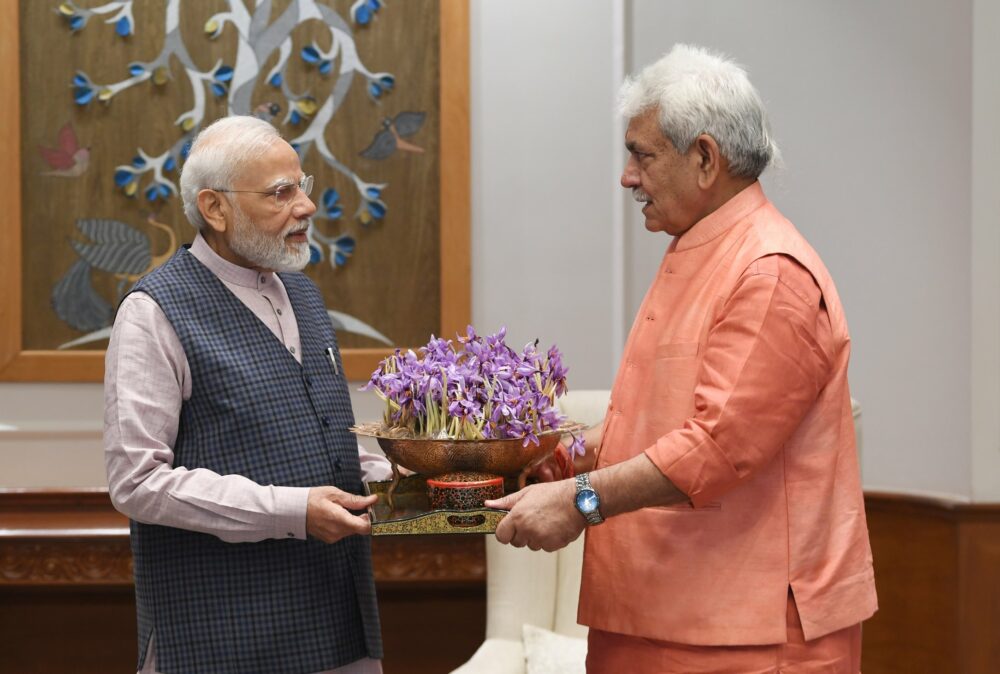
Saffron cultivation in Kashmir is not finished. The crop still grows. Farmers like Mubaris are still expanding. The GI tag still provides a framework for authentication. The IIKSTC still processes thousands of kilograms annually and has registered more than 5,800 growers on its e-auction platform. Official data still shows productivity gains in rejuvenated fields. Some of this is real.
But the convergence of pressures, erratic rainfall, exhausted corms, stolen irrigation infrastructure, encroaching construction, soil excavation, wildlife damage, Iranian adulteration, and the steady departure of skilled farmers is not easily reversed. Every farmer interviewed described a sector in structural retreat. The official line of stabilisation sits uneasily alongside testimonies of fields that produced nothing this season, of yields that have fallen to ten per cent of normal, of communities that have abandoned the crop entirely.
Shahbaz offered the starkest warning. “If the government does not provide attention, financial inputs and incentives, it may become very difficult in the coming years to even see ten to twenty kilograms of Kashmiri saffron produced across the entire Pampore region.”
That is the weight of what is at stake: not just a spice, not just an income, but an identity that has defined this landscape for more than two thousand years.