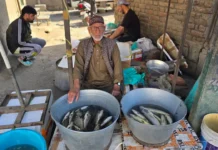
Kashmir’s street vendors, 17,950 strong enough to receive government loans, are no longer just the poor. They are the educated unemployed, surviving Kashmir’s economic stress one cart at a time, reports Asrar Syeed
They have no addresses. No rental agreements. No permanent walls between themselves and the weather, the encroachment squad, or the next economic shock. And yet, they are everywhere, lining the sidewalks of Lal Chowk; crowding the lanes outside ancient shrines in Srinagar’s Shehr-e-Khas, stacking fruit beneath tarpaulin sheets in Batamaloo and Qamarwari.
Kashmir’s street vendors constitute an informal army. It is so vast that 17,950 of them have been extended collateral-free loans by the government. Srinagar city has only 7954 vendors registered with the Srinagar Municipal Corporation (SMC), but the numbers are much higher on the streets. That number is an acknowledgement, however belated, of an economy that exists entirely outside the ledger books of formal commerce.
Vital Trading Sector
They sell cheaply in a market that cannot afford to pay more. Kashmir has been passing through prolonged economic stress for many years now. The liquidity crisis has quietly hollowed out the buying power of ordinary households. They are the people who stand between a family’s budget and the inflated price tags of formal retail. And yet, the same system that depends on them treats them as a problem to be managed rather than people to be protected.
What makes the street vendor economy in Kashmir uniquely telling is who now populates it. Alongside the school dropouts and the men who inherited poverty and made the best of it, the carts are increasingly being pushed by graduates. These are men and some women who spent years in classrooms, earned degrees, and then walked out into a job market that had nothing to offer them.
In India, Kashmir has one of the highest unemployment rates. The consequences of that statistic do not stay neatly inside an economic report. They spill out onto the sidewalks of Srinagar, where an educated young man arranging vegetables on a cart at 7 am is no longer an unusual sight. The cart, for many, is not a last resort born of ignorance. It is a calculated response to a closed door.
The Big Batamaloo
The Batamaloo market has been home to street vendors for decades. For much of that time, it was animated by the constant churn of a major transit hub, the General Bus Stand. The hub drew daily crowds and kept sales moving. Then came the political decision during the BJPDP coalition government to relocate the bus stand. The official shift to Parimpora began in 2017. With it, something essential drained out of the market.
Showkat has watched all of it. In his early forties, he has been a street vendor since he was twelve years old. He was old enough to understand that a difficult situation at home meant studies would have to wait. He was young enough that the cart became his classroom.
“I have witnessed every single change and development this market has undergone,” he said. “Business was good, and all of us here could make ends meet until the bus station was located here. Since its shift to Parimpora, sales have not been that good, and earning even a decent amount becomes difficult during the harsh months of winter.”
Showkat has three children. He is their sole provider. Every day on the cart is a calculation: school fees, household expenses, the creeping anxiety that if he doesn’t earn enough, his children will inherit the same arithmetic of scarcity that shaped his own childhood. “I must earn enough to provide them with a quality education,” he said, asserting every single word. The worry is etched into the way he sits, scanning the market for the next customer in a crowd that keeps walking past.
The market is not empty. People pass through in large numbers each day. But footfall and sales are not the same thing in a market where residents are tightening their belts. On any given afternoon, vendors can be seen scrolling their phones, sitting idle, their carts fully stocked and largely untouched. Their faces tell a story of difficult times.
Mohammed Sultan arrived at this market through a different kind of ruin. In his early sixties, he once ran a small crockery shop in Srinagar’s Khanyar area. It was a modest, stable livelihood until the night it was not. “Sometimes our lives change overnight,” Sultan said. His son suffered a brain haemorrhage. Sultan managed the initial medical expenses somehow. But as the illness progressed, so did the costs. The shop had to go.
“After my son got a little better, I had to think of some new business idea. Buying a new shop was difficult, so I decided to purchase a cart. That is how I landed in this Batamaloo market.” Four years on, he runs his cart daily and watches inflation quietly reduce the number of people who stop to buy.
Among the younger vendors, the story shifts, but the destination is the same. Arif is twenty-four, from Kreeri in Baramulla, and has been selling fruits from a cart for three years. He is not uneducated. He is unemployed. “After completing my studies, I tried to find a job, but unfortunately, I could not,” he regretted. “I am the eldest son, and my father could not work any longer due to old age. After realising the scarcity of jobs, I decided to start selling fruits on a cart.” He did not arrive here by accident. He arrived here by elimination, one rejected application at a time, until the cart was the only door left open.
Arif is far from alone. Across the markets of Srinagar, a quiet demographic shift is underway. The vendors are getting younger. In many cases, they are better educated. Kashmir’s unemployment crisis does not discriminate by qualification. A graduate degree in a region where government jobs are scarce and the private sector remains thin offers little protection against economic exclusion. For many young men and women, the choice is not between a white-collar job and a cart. It is between the cart and nothing at all. The cart, at least, pays today.
Batamaloo currently is home to somewhere between 100 and 200 street vendors. With inflation continuing to suppress demand, many of them wonder how much longer the cart makes sense.
A New Hub
When the General Bus Stand moved to Parimpora, it created a new gravitational centre. Qamarwari emerged as a secondary hub for vendors drawn to the foot traffic around the bus terminal. But it has been a difficult transition. Vendors at the Parimpora market speak of inadequate space and a lack of basic infrastructure. Many who set up carts there have since shut down or moved on.
Mushtaq Ahmed lives in Bemina and studied until the 8th standard. An accident took two years from him during his recovery. By the time he was well again, his classmates had moved on, and his will to return to school had faded. His father worked as a construction labourer. The household needed income, not patience. Mushtaq started by helping a friend with his cart. Then he bought a second-hand load-carrier and launched his own fruit business.
He is not a man without ambition. He keeps a daily ledger. He has a plan. “I have planned about buying a small shop, and I am working towards that goal,” he hoped, though he acknowledged the gap between the goal and the present reality. “The cost of a small shop is even more than ten lakhs rupees. It will take some time to achieve this goal, but I will get there. I cannot continue with this kind of life in my old age.” The ledger is both a financial record and a reminder of the distance still to travel.
Nearby, Rizwan is twenty years old, from Barton Batamaloo. He has been arranging his fruit cart each morning at 9 am for the past three years. He studied until the 8th standard. As the eldest son, he carries the weight of his siblings, who depend on him. He made a deliberate choice to build something of his own rather than join the exhausting and largely fruitless queue for private employment. “Business overall across the country is not so well,” he admitted. “But thanks to the Almighty, due to my products being fresh and worth every penny a customer spends, I have been doing sales which earn me a sufficient amount to fulfil my responsibilities.”
In a market saturated with vendors competing for the same shrinking pool of customers, Rizwan’s emphasis on quality is itself a small business strategy. It is the only kind available to someone operating without capital, credit, or a roof.
The Parimpora market benefits from a captive clientele; buses to various destinations in north Kashmir depart throughout the day. Passengers who arrive early have little to do but walk the market lanes before boarding. That footfall is the vendors’ lifeline, however irregular.
Older Roots, Same Struggles
In Srinagar’s old city, the vendor culture runs deeper. Outside the shrines of Makhdoom Sahib, Khanqah-e-Moala, Dastgeer Sahab and Naqshband Sahib, vendors have been fixtures for generations. They sell vegetables, dry fruits, and devotional goods to the steady flow of pilgrims and passers-by.
In the city centre of Lal Chowk, the sidewalks become informal markets. The city simultaneously tolerates and periodically dismantles them.
Firdous has run his cart in Lal Chowk for 14 years. He was in the 10th standard when his father died of prolonged illness. As the eldest son, there was no interval between loss and responsibility. He borrowed money from friends to buy his first cart.
“At first I found it difficult to manage a cart on the road,” he remembers. “But with time you learn.” Fourteen years later, he sometimes manages three or four carts simultaneously when fellow vendors need a break. It is an informal expertise born entirely of necessity and invisible to any formal employment statistic.
Ghulam Mohammad has been selling vegetables for fifteen years. He started after realising that the salary from working at a relative’s shop could not stretch across the growing demands of a family. He could not afford to buy a permanent shop. So he sold a small portion of his wife’s jewellery to raise the starting capital. The investment survived.
“With hard work and determination, I have earned enough over time to provide for my family and educate my children,” he proudly said. His children are now earning, and they have asked him repeatedly to stop working and come home. Mohammad has refused each time. The independence, the daily act of showing up, setting out the cart, doing the work, is not something he is ready to surrender.
The Sunday Market
Srinagar, like many historic urban centres, has long sustained a thriving flea market culture. It is an informal economy where quality goods, mostly pre-owned but still serviceable, are available at remarkably low prices. The market stretches from the Tourist Reception Centre to Hari Singh High Street (HSHS), covering a considerable length of the city’s commercial spine, the uptown.
On Sundays, the area becomes almost impassable. Residency Road is lined with carts. Tens of thousands of people converge to seek out bargains. The scale of activity offers a revealing snapshot of Kashmir’s street vending economy. In many ways, it functions as one of the Valley’s largest open-air markets: transactions are immediate, cash-based, and typically final, with little room for exchange or negotiation.
Historically, the market was far more diverse in its offerings. “Earlier, there were Jandeh traders who imported used clothing from abroad and auctioned it here,” recalls a long-time vendor. “But they earned well and eventually left the trade, partly because of the stigma attached to being called Jandeh traders, a Kashmiri term referring to second-hand or discarded apparel.”
Today, the market’s character has shifted. Most carts now stock low-cost goods. Only a small segment continues to deal in traditional Jandeh merchandise. Consumer preferences have also evolved. “Buyers now increasingly ask for first-copy branded items or factory discards,” the vendor adds. It offers an idea about a transition from reuse-driven consumption to aspirational, brand-oriented demand.
Market insiders assert that while most vendors assemble in Srinagar for the Sunday flea market, they relocate to peripheral districts during the rest of the week. They operate in smaller, dispersed bazaars.
What stands out, however, is the market’s resilience. Despite shifting economic patterns and changing consumer preferences, it continues to survive—and often thrive. Over the years, it has come to serve as an informal barometer of the situation in the city. If the Sunday market falls silent, it is widely read as a sign that Srinagar itself is not at ease.
A State in Two Minds
Unlike civic authorities, often caught in a constant tussle over balancing traffic flow and pedestrian right of way on congested streets, Jammu and Kashmir Bank recognised the economic potential of street vendors as early as 2007. “Why can’t these vendors be seen as modest businesses that can be supported to move to the next level?” Haseeb Drabu, the then Chairman of the bank and later the last Finance Minister of the erstwhile state, is recalled to have told his team. Within months, a tailored scheme was designed. It offered small, low-cost working capital to vendors. The move saw an enthusiastic response on the ground.
As the broader situation evolved, the initiative gradually receded into the background. It resurfaced, in a more structured form, with the launch of the Prime Minister Street Vendor’s Atma Nirbhar Nidhi (PM SVANidhi) in June 2020, echoing many of the earlier ideas.
Official figures now indicate that 17,950 street vendors across Jammu and Kashmir have been covered under the scheme. A cumulative financial assistance of Rs 50.83 crore has been extended to support and expand their livelihoods.
But this has not changed the vendor security. The most acute threat these vendors face does not come from inflation or seasonal shortfalls. It comes from the periodic arrival of encroachment squads, municipal teams tasked with clearing sidewalks and reclaiming public space. The drives are not new, but their frequency and intensity have grown alongside urbanisation and the shrinking of usable public space in Srinagar’s congested markets.
Vendors do not oppose the principle of managing congestion. What they resist is the asymmetry, the clearing of their carts without any parallel effort to resettle or rehabilitate them. Videos of vendors weeping during these drives, begging for their livelihoods, have circulated on social media with uncomfortable regularity.
“See, we have families which rely upon us and children who look up to us for providing them quality education,” said one vendor in Lal Chowk who must regularly reposition his cart to stay ahead of encroachment teams. “Securing a job is difficult for the educated ones. How could someone like me, who has studied only till class 8th, secure one? Now I would think of buying a shop, but the prices of shops are so high that I cannot even afford to buy the shutter of a shop.”
The remark cuts to the core of the problem. The formal economy offers no entry point, not through employment, not through property ownership, not through the kind of small business infrastructure that might give a vendor a stable address and a measure of legal protection. The cart is not a stepping stone. For most, it is the ceiling.
In Batamaloo, carts covered with tarpaulin and left unmanned have become a common sight. When asked about the absent owners, a fellow vendor explained: “Constant pressures from authorities and low sales have pushed many of them into other work, as labourers, masons, or salesmen at other people’s shops.” The vendor economy, even at its most precarious, keeps reorganising itself rather than disappearing. The conditions that created it have not changed.
Silent Officials
Efforts to get a response from the government proved a failure. Srinagar Municipal Corporation commissioner Faz Ul Haseeb did not respond to a set of questions sent to him.
A mid-level official, speaking on condition of anonymity, acknowledged the persistent dilemma authorities face in regulating street vendors. “I will give you one instance from the post-2019 period,” he said. “In Lal Chowk, there were hundreds of vendors, and it was decided to clear the area. But then a politician intervened and persuaded the Raj Bhawan to allow them to relocate to a parcel of prime land owned by the SRTC. That is how Makkah Market in Lal Chowk came into being.”
The official paused before adding a pointed question: “If that market was created to accommodate a few hundred vendors, why do street vendors continue to occupy Lal Chowk?” Either a new generation of vendors has taken over the spaces the Makka Market people vacated, or the same people have occupied both the spaces.
The officer argued that the proliferation of street vendors has, in many cases, rendered established shops on the main commercial stretch unviable. “Do you know,” he said, “that even some prominent shop owners in Lal Chowk now put up carts in the Sunday market?”
Regardless of the occasional windfall for a few, the larger story remains unchanged.
An Economy without Walls
Conversations with these vendors offer a portrait of an economy that is not marginal but structural. They are not a symptom of poverty. Instead, they are a response to it. Increasingly, they are a response to something broader: the wholesale failure of the formal job market to absorb a generation of young people who did everything right and still ended up on the pavement.
The graduate behind the fruit cart is not an anomaly. He is a pattern. The man who sold his wife’s jewellery to buy his first cart is not a story of failure. He is a story of a system that left him no other door. The twelve-year-old who became a vendor because his home demanded it is not a cautionary tale. He is a portrait of a city that asks too much of those who can afford to give the least.
Each of these vendors carries its own arithmetic of survival. Each cart represents a negotiation, with a city and an economy that tolerates their presence without ever fully accepting it. They fill the gaps the formal market leaves behind. They feed families, school children, and pay obligations that no government ledger records.
Until the conditions that push people onto the pavement change, the carts will keep coming back. Clear them one day, and they return the next. The economy that runs on wheels and tarpaulin does not disappear. It simply waits.
Post Script
In the just-concluded session of the Jammu and Kashmir assembly, the government data revealed that 3,808 gazetted and 24,507 non-gazetted posts are vacant under direct recruitment, while 6,409 gazetted and 24,451 non-gazetted posts remain unfilled under the promotion quota. District-level figures alone account for 2,798 gazetted and 16,812 non-gazetted vacancies under the direct quota. The men and women who would have filled these spaces may not all get on a cart ride, but some of them will essentially start spending their days on the pavement.