As climate change and shrinking land reshape Kashmir’s farming, a quiet revolution in mechanisation, spanning drones, AI, and biotech, is about to transform how the valley grows, irrigates, and harvests its crops, writes Masood Hussain
Kashmir is witnessing a quiet revolution in its fields. Once known primarily for its terraced rice paddies and orchard-draped hillsides, the region is now emerging as a frontier of farm mechanisation. With shrinking landholdings, mounting labour shortages, and the stark realities of climate change, a new narrative is taking root, one that replaces the sickle with sensors and oxen-drawn ploughs with AI-powered sprayers.
This transformation, still uneven and nascent, is laying the foundations for Kashmir to imagine its agricultural future. It has even small niche islands where hydroponics and aeroponic farming are taking root, almost on an experimental basis, outside the laboratories of the Sher-e-Kashmir University of Agricultural Sciences and Technology (SKUAST), one of the best farm universities in India. What was once limited to academic research is now seeing the first signs of real-world trials. If nurtured, this could create an ecosystem where precision farming becomes not just an alternative, but the default.
From Sickle to Sensor
Jammu and Kashmir’s agriculture sector has long been under pressure. The contribution of agriculture to the region’s Gross Domestic Product (GDP) has dropped to between 16 to 18 per cent. Urbanisation, land fragmentation due to inheritance, and climate volatility have all played their part in shrinking the agricultural footprint. But in this adversity, a new solution is emerging – technology.
“Farm power availability in Jammu and Kashmir is still only 0.78 kilowatts per hectare, while the national average is 3.5 kW and Punjab tops at 4 kW,” Dr Showkat Rasool, Assistant Professor at SKUAST-Kashmir and in-charge of its Centre for Artificial Intelligence and Machine Learning, told Kashmir Life. “We need to bridge this gap fast if we want to safeguard our niche crops and farming economy.”
Rasool believes mechanisation is not just a necessity, it is inevitable. But this inevitability must be planned and localised. Machines developed for the plains of Punjab or Maharashtra cannot be directly deployed in the orchards of Shopian or the rice paddies of Budgam. This is where home-grown Research and Development and terrain-specific adaptation comes in.
Orchards, Not Paddies
Mechanisation in Kashmir has surged in part because of a shift in cropping patterns. The valley, once covered in expansive paddy fields, has converted large swathes into apple orchards. Now, Kashmir relies heavily on the rice sales by the Food Corporation of India (FCI), which supplies through Jammu and Kashmir’s state-owned food outlets. This change, driven by better income potential and a relatively lower dependence on irrigation, has also made mechanisation more viable.
“Orchards are more amenable to mechanisation,” said Rasool. “Sprayers, robotic harvesters, intelligent irrigation systems, all of these make more sense in a high-value crop like apples than in traditional rice paddies.”
This explains the spike in equipment like boom sprayers, orchard tillers, and intelligent drip irrigation controllers that are increasingly seen in South and North Kashmir’s apple belts. Farm input dealers and agri-startups have begun to diversify their inventory to meet the new demand. A generation of farmers who once hesitated to invest in even a basic pesticide sprayer is now watching demonstration videos of automated foggers and GPS-enabled pruning machines on their smartphones.

Intelligent Sprayers, Drones
At SKUAST-K’s agri-tech labs, sprayers are getting smarter. A standout innovation is an AI-powered robotic sprayer capable of detecting whether a plant exists, its height, and canopy spread, and spraying accordingly.
“It is not just a robot,” Rasool said, “It is a cost-saver, a health protector, and an environmental guardian.”
Traditionally, Kashmir’s apple growers use 8 to 10 sprays in a season. These are often over-applied due to a lack of precision, leading to pesticide wastage and health concerns. The AI-powered sprayer uses variable rate technology to address this, reducing environmental runoff and farmer costs.
For the last 10 years, Kashmir has been fast converting its traditional apple orchards into high-density plantations. The new orchards have different requirements, including drop irrigation, fog spraying and railing. These precise planting systems demand a matching upgrade in the delivery of nutrients and crop protection. Automation is no longer optional; it is becoming integral.
Meanwhile, UAVs, commonly referred to as drones, are making their presence felt. Drones are already being used for pesticide spraying, disease mapping, and nutrient analysis. Still, it is being used for mere demonstrations only.
“We are trying to set up a scalable UAV hub for the Himalayan region, with support from the Ministry of Electronics and Information Technology. The aim is not just to use drones, but to develop drones suited to our terrain and crops,” Rasool noted.
Smart Irrigation
In a region where only 49 per cent of the land is irrigated, water management has become a critical concern. The traditional reliance on flood irrigation wastes water and risks soil degradation.
In response, SKUAST-K has piloted a solar-powered, IoT-based automatic fertigation system in Ganderbal. This smart network collects soil moisture data via sensors, interprets it through AI algorithms, and irrigates only when and where needed. Farmers receive alerts and reports via smartphone dashboards. With fertilisers integrated into this closed-loop system, there is less wastage and better absorption, ensuring both ecological and economic benefits.
“This is what the future looks like,” Rasool said, “Irrigation systems that think.”
Grassroots Resistance
Despite these technological leaps, adoption remains patchy.
“Traditionally, farmers were wary of machines, costs were high, landholdings were too fragmented, and there was a lack of repair infrastructure,” Rasool concedes. “But that is changing. Today’s farmers are digitally literate, often guided by their children or grandchildren.”
Youth are stepping into this gap. Through MSME-sponsored trainings, more than 100 young agri-entrepreneurs have been upskilled in areas ranging from drone operation to machine repairs. Custom hiring centres are also emerging as a game changer, offering small farmers access to expensive machinery on a pay-per-use basis. The idea of owning a machine is being replaced by sharing access to a machine, an innovation in mindset as much as in method.
Kashmir currently hosts over 100 custom hiring centres, both government and privately run. These not only democratise technology access but are slowly incubating a rural services economy around mechanisation. In many areas, these centres are becoming informal hubs of knowledge exchange, where farmers discuss spray schedules, machine handling techniques, and crop disease alerts.
Machine-Backed Nutrition
But technology in Kashmir’s fields is not limited to machines. In the quiet labs of SKUAST-K, scientists like Professor Amjad Masood Hussain are spearheading biotechnology efforts to breed nutrient-rich crops, resilient varieties, and aromatic rice strains like Mushkbudji.
“Biotechnology and mechanisation are not rivals. They are complementary,” Hussain explained. “Where biotechnology strengthens the plant, machines optimise its environment.”
Hussain’s laboratory is also using microbial solutions to improve saffron production, one of Kashmir’s most iconic but vulnerable crops. Through Stanford collaboration, his team developed a paper-microscope-based saffron test for identifying adulteration, a rare example of blending grassroots awareness with tech-based certification. The development of an AI-based saffron authentication app is a further example of this synergy. It not only protects consumers but also bolsters the credibility of Kashmir’s brand in global spice markets.
Beyond Apples
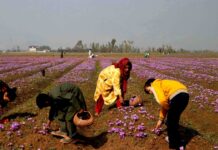
While apple cultivation leads the charge in Kashmir’s farm mechanisation narrative, other high-value crops are increasingly being brought under its ambit. Take saffron, for example, a crop synonymous with Kashmir’s identity but notorious for its labour-intensive harvesting process. Scientists at SKUAST-K, in collaboration with premier engineering institutes, are now developing mechanised stigma separators and robotic harvesters specifically designed for saffron flowers. These innovations aim to ease labour burdens and ensure more uniform processing while preserving the delicate quality of the spice.
In walnut cultivation, too, intelligent nut shakers and shelling machinery are being developed to modernise harvests. Traditionally, walnut collection involves physical exertion and sometimes dangerous harvesting methods, particularly in hilly terrain. Mechanised solutions are being seen as both safer and more efficient. Projects are now underway to integrate mechanical sorting and shell-cracking systems into post-harvest operations, ensuring better market prices and reduced manual fatigue.
Vegetable growers in the region are also beginning to access new technologies. Automatic transplanting machines and polyhouse equipment are now being tested and deployed in various districts, modernising an area long dependent on manual labour. Controlled environment agriculture, once thought suitable only for corporate farms, is now becoming modular and scalable.
Emerging crops like kiwi and dragon fruit, now being promoted under state-backed initiatives, are being grown with support from modern sensors, drip irrigation, and drone monitoring. These high-value crops, once considered experimental, are now part of Kashmir’s expanding mechanised farming landscape.
Meanwhile, protected cultivation is becoming a key part of the technology push. Over 1650 greenhouses are being constructed across Jammu and Kashmir, 75 of them already operational in Kashmir. These are being equipped with automated fertigation systems, microclimate control technology, and AI-based monitoring for disease and growth management.
What emerges is a landscape where farm mechanisation is not confined to a single crop or method. Rather, it is a widening spectrum of technological interventions designed to serve diverse agro-climatic zones, small landholdings, and niche crop economies.
Hiring Model
The success of mechanisation in Kashmir may ultimately rest on the robustness of its service economy. And here, the model of Custom Hiring Centres (CHCs) is central.
Under the Holistic Agriculture Development Programme (HADP), CHCs are being integrated with the KVK network and backed by institutions like JK Bank. The idea is simple: let farmers rent the machine they need for the duration they need it.
“Some farmers even run these centres as micro-enterprises,” Rasool revealed. “This is how we are creating a ripple of tech use, one community at a time.”
Climate Change
The elephant in the room is climate change. Erratic rainfall, untimely snow, and shifting growing seasons have made traditional knowledge unreliable. The old wisdom, passed orally from one generation to the next, no longer applies uniformly. Growing windows have shifted. Pest behaviour has become unpredictable.
“Earlier, June 21 used to mean something precise to the farmer,” said Hussain. “Now, the seasons themselves are confused.”
In this climate crucible, technology is not a luxury; it is survival.
“The farmer no longer trusts the old calendar. He is looking at dashboards, alerts, and AI predictions. This is not just a new era in farming. It is a new kind of farmer.”
The Road Ahead
Despite massive investments, the road to fully mechanised, climate-smart agriculture is long and fraught. The Competitiveness Improvement of Agriculture and Allied Sectors Project (JKCIP), itself an Rs 1,800 crore flagship initiative co-funded by the International Fund for Agricultural Development (IFAD), is suffering from bureaucratic inertia and poor portal uptake. As of mid-2025, only 478 applications had been received from farmers, highlighting the digital literacy and outreach challenge.
At the core of JKCIP’s delivery model is its crop-specific support strategy, which seeks to increase the production and market value of high-potential crops suited to Jammu and Kashmir’s agro-climatic conditions.
In saffron cultivation, the project targets revival across 10,000 kanals at a unit cost of Rs 57,539 per kanal. In the current financial year, 100 kanals have been identified for saffron revival in Pochal, Galhar Bhata and other areas of Jammu. A business plan is under development for a proposed Saffron Centre of Excellence, alongside training in climate-smart farming techniques.
Mushkbudji, the indigenous aromatic rice of Kashmir, is being promoted on 1,000 kanals this year with a unit cost of Rs 14,500 per kanal. SKUAST-Kashmir has already covered 800 kanals, focusing on seed distribution and water management.
In Jammu, basmati rice is being cultivated on 1,000 kanals at Rs 8,000 per kanal, and aromatic rice on 3,000 kanals at Rs 12,000 per kanal, with clusters in RS Pura, Marh and Akhnoor already under sowing.
Apple cultivation remains one of the key pillars of the project, with 5,000 kanals targeted for expansion for Rs 2 lakh per kanal. For the current year, 662 kanals, 462 in Kashmir and 200 in Jammu, are under development. The intervention includes support for high-density plantations, solar fencing, and rejuvenation of older orchards at Rs 30,000 per kanal. As of now, over 82 applications for apple crop management have been received in Kashmir alone.
In walnut production, 910 kanals are targeted in 2025–26, part of a total plan of 8,700 kanals, with only 110 kanals falling in Kashmir and the rest in Jammu. However, farmer interest appears low, with only one application from Kashmir so far. The project also includes setting up nurseries for disease-resistant planting material, budgeted at Rs 26 lakh for every 10,000 saplings.
Mango and litchi are being promoted exclusively in Jammu, with 600 kanals each targeted. Of this, 210 kanals of mango and 174 kanals of litchi have already been identified. Orchard management and post-harvest support are also part of the package.
Kiwi, another high-value crop, is to be expanded across 4,200 kanals at Rs 1.25 lakh per kanal, with 650 kanals planned for the current year. Dragon fruit cultivation, budgeted at Rs 1.08 lakh per kanal, is planned over 200 kanals, with 40 kanals already identified.
For vegetables, including rajma, hill garlic and shallots, the project plans interventions on 13,000 kanals. In protected cultivation, 1,650 greenhouses are being targeted at Rs 7.5 lakh per unit. This year, 125 such units, 75 in Kashmir and 50 in Jammu, are already underway.
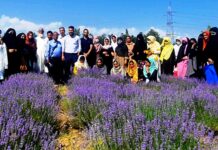
Medicinal and aromatic plants like kalazeera and lavender are also being supported under a niche crops plan, with 200 kanals budgeted at Rs 15,000 per kanal for the current year. Training in sustainable harvesting and value addition is part of the rollout strategy.
While the design and scope of the project remain ambitious and wide-ranging, challenges persist. Regional imbalance is a continuing concern, with Kashmir generating significantly more applications than Jammu. Procurement delays are also proving costly, as key studies such as the Apple Value Chain Analysis and Pony Breed Improvement Feasibility have either stalled or been retendered multiple times due to a lack of bids.
However, the vision remains compelling. Precision agriculture, robotics, AI, and biotechnology, once the reserve of global food giants, are now beginning to find space among Kashmir’s walnut trees, rice paddies, and saffron beds. If these innovations are to deliver their full promise, what is needed now is a deeper partnership between scientists, farmers, financial institutions, and civil society.
And as the farmer’s plough morphs into a machine and his calendar becomes a dashboard, Kashmir is preparing not for a retreat, but a revival.