As Kashmir reels under one of its harshest summers in recent memory, its canals have run dry, crops are wilting, and livestock are perishing. From apple orchards to paddy fields and vegetable farms, the prolonged heat wave and parching dry spell have laid bare the vulnerability of Kashmir’s agrarian backbone. Even as official meetings churn out data, not decisions, scientists warn that the region is staring at a deepening crisis, with lasting consequences for food security, water availability, and rural livelihoods, reports Babra Wani
On the fourth day of Eid ul Azha, 2025, under the glare of the midday sun, 50-year-old Ghulam Rasool was tending to a field, his shirt damp with sweat. Suddenly, a sharp pain struck his chest. Clutching it instinctively, he turned to his employer and asked for a half-day leave, as he was not feeling well. His face turned red, then gradually took on a bluish hue.
Permission was granted.
As he made his way home, his steps grew unsteady. A wave of dizziness came over him, and his heavy eyes struggled to stay open. The world around him blurred. Then, without warning, he collapsed onto the sun-scorched earth. Just before losing consciousness, he saw flashes of his daughters’ faces. His laboured breathing echoed briefly in the air. Then came silence.
He was rushed to a nearby hospital, where doctors declared him dead.
Only an hour earlier, before he began to feel unwell, Rasool had called his wife to ask for drinking water. The heat was unbearable. She later wept, saying she had not even been able to offer him a glass of cold water, one last time. She was already mourning the recent death of her brother, also from a heart attack. Now she sat before her husband’s shrouded body. Together, they had raised three daughters. The eldest had married the previous year. The younger two were still in school.
A resident of the Anantnag village said the doctors had confirmed Rasool died of a massive heart attack due to overexertion during extreme heat. A week earlier, his brother-in-law had died in the same way. The man explained that the field Rasool had been working in required extra effort because it had dried up due to a rain deficit. With a mixture of grief and disbelief, he added, “God is displeased with us. How can a healthy man die so suddenly?”
Drought-Stricken Land
The village, a few kilometres from Anantnag and on the road to Pahalgam, is known for its mustard, paddy, and maize fields. As it mourned Rasool, it also mourned its failing crops.
While Rasool lay dying, a nearby paddy field was withering too. The nearby stream that once irrigated the area had dried up due to the rain deficit. According to a doctor at the sub-district hospital, Rasool’s death was the fourth heat-induced heart attack they had seen between May and June. Unlike the rest of India, Jammu and Kashmir does not count the heat-linked deaths. An open-source report suggests that India reported 195 heat-related deaths in April and 260 in May 2025.
A veteran farmer in the area stated that it was the first time villagers had faced such a crisis. The uncertainty had left them anxious about their future. “We do not know what to do. We pray every day and seek Allah’s forgiveness,” he said.
Rasool’s family owned a small patch of paddy land that had once met their needs. But the rain deficit left it cracked and barren. The land’s failure forced Rasool to work as a labourer in others’ fields, which ultimately led to his death. “We lost both our land and our father,” his eldest daughter cried, her grief overwhelming.
Widening Crisis
In nearby Kulgam, the story is the same. Nasir Ahmad Laway, an orchardist, described how once-thriving paddy fields and orchards now struggled to survive. He said the district was gripped by water scarcity. Seasonal crops were stunted, and apple orchards were failing. He described watching their produce wither under the sun, with the famed Kulgam apples shrinking even before harvest.
The drying up of water sources has also affected households. Streams that once sustained daily life had dwindled, turning the fertile land into a desperate place. Without swift intervention, he feared the destruction of crops and orchards would soon escalate into a humanitarian and ecological crisis.
A cardiologist, speaking anonymously, explained how extreme summer heat increases the risk of heart attacks, especially in older adults or those with heart conditions. Dehydration, thicker blood, and stress on the heart can trigger cardiac events. Heat also causes electrolyte loss and low blood pressure, which may lead to irregular heartbeats or fainting. He warned that staying hydrated and avoiding physical labour during peak heat was crucial.
According to Professor Tasneem Mubarak, Chief Scientist, Agronomy at MRCFC-SKUAST Kashmir, Khudwani, high temperatures were indeed a concern. However, he said the more immediate issue was the availability of water, particularly during the current vegetative phase of rice. He explained that the real threat would come in the reproductive phase. “During flowering and grain filling, temperatures above 30°C can reduce pollen viability, leading to sterility,” he said.
Withering Fields
Professor Tasneem Mubarak warned that if high temperatures persisted during the grain-filling phase, the grains would not develop properly. Many, he said, would end up shrivelled or only partially formed.
He noted that rising temperatures accelerated respiration in rice plants, causing much of the food produced through photosynthesis to be lost rather than stored for grain development. Both high and low temperatures, he added, affected pollen viability. For temperate rice varieties grown in Kashmir, the ideal range was between 20°C and 30°C.
Although a drastic drop in productivity was not yet expected, he stressed that water scarcity remained the larger concern. Rice, he explained, needed consistent water. Despite water-saving methods such as alternate wetting and drying or direct-seeded rice, basic field saturation was still necessary.
Water shortages were already affecting several areas, impacting tillering and early shoot development, and threatening later stages of crop growth. Tasneem cautioned that if the heat wave continued into the reproductive phase, rice productivity would certainly suffer.
Bleeding Agrarian Economy
Kashmir’s cropping patterns are shifting. Repeated losses and shrinking profits have pushed thousands of farmers to abandon paddy fields in favour of apple orchards. Official data reveals a sharp decline in paddy cultivation, from nearly 162,000 hectares in 2012 to 129,000 hectares in 2023, a drop of over 33,000 hectares.
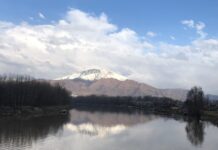
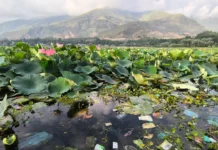
Reports point to extensive crop damage caused by erratic conditions. Apple orchards in Shopian and Baramulla have suffered up to 50 per cent losses. Saffron production has fallen by nearly half. Paddy fields have dried up, irrigation systems have collapsed, and historic water sources like the Achabal Spring have dried up, leaving people in mourning. The River Jhelum, once a symbol of Kashmir’s water wealth, has fallen below gauge zero at several critical locations.
These losses have resulted in financial damages of over Rs 10 lakh per orchard in many instances, contributing to a 0.4 per cent decline in Jammu and Kashmir’s Gross State Domestic Product.
Strain of Orchard Life
A farmer from Tral described how the heat wave and prolonged dry spell were hurting apple cultivation. He explained that apple trees, dependent on cool, moist conditions, were ripening early. This led to sunburnt skin, premature fruit drop, and a fall in both yield and quality. The dry conditions caused water stress, reducing fruit size, colour, and firmness, making them less suitable for markets.
He explained that to cope with the dry spell, farmers had to increase irrigation. This added pressure to already limited water sources, especially in areas without proper irrigation infrastructure. The cost of water management was rising, making farming more expensive and more labour-intensive.
To protect their orchards, growers were now investing in water systems, pumps, anti-stress sprays, shade nets, and mulching. These added costs were cutting into profits and making apple farming increasingly difficult, especially for smallholders.
He also warned that the long-term sustainability of apple orchards was at risk. Prolonged heat and recurring water stress weakened trees, disrupted their growth cycles, and increased their vulnerability to pests and disease. If these trends continued, the region’s apple industry could face declining productivity and uncertain prospects.
As drought tightened its grip, threatening Kashmir’s paddy fields, a high-level meeting was held at the Civil Secretariat in Srinagar earlier last week. Several legislators, however, voiced sharp criticism, calling the government’s response inadequate and disconnected from the pressing crisis unfolding in the fields.
The Ground Reality
The government acknowledged the seriousness of the crisis in its official statement. Minister Javed Rana, who convened the meeting, called for both short- and long-term strategies to secure the water supply for paddy fields during the sowing season. He admitted the gravity of the situation caused by adverse climatic conditions, stating that while there were shortcomings, solutions had to be found.
Additional Chief Secretary of Jal Shakti, Shaleen Kabra, presented detailed data on irrigation infrastructure across Jammu and Kashmir. He discussed the drop in river gauge levels and how declining rainfall had affected irrigation schemes under NABARD, PMKSY-HKKP, and the Capex Budget 2025–26.
However, legislators present said the presentation lacked urgency. One MLA remarked that while the data showed rivers were drying up, what they needed was a clear plan, not bureaucracy.
“A Man-made Disaster”
Bashir Ahmad Veeri, MLA from Bijbehara, said the crisis is not merely climate change but largely the result of human neglect, unscientific planning, and unregulated sand mining. He explained that the Dedi canal’s capacity had dropped from 9 to 4.5 cumecs, while the command area had tripled. He claimed to have walked 28 kilometres in freezing temperatures to personally inspect the damage, finding most of the headworks destroyed.
Unregulated mining, he said, had lowered the riverbed at Sangam, leaving the canal intake four metres above water level. As a result, lift irrigation schemes in his constituency were now defunct, their intake points suspended above dry channels.
Veeri noted that in some places, canals once 55 feet wide had narrowed to just 6 feet due to unchecked encroachments. He said some canals had become open drains, clogged with domestic waste and animal remains. The lawmaker spoke with emotion, saying the sight broke his heart.
He stressed that paddy farming required continuous water, unlike horticulture, and shifting to orchards had not resolved the water crisis because the system itself was failing. In Bijbehara, he said, agricultural output had fallen by up to 30 per cent. In Home Shalibug, the loss was closer to 50 per cent.
He blamed the irrigation department for not acting five or six years ago, which, he argued, could have prevented the current crisis. “There was zero accountability for the damage,” he said.
Uneven Distribution
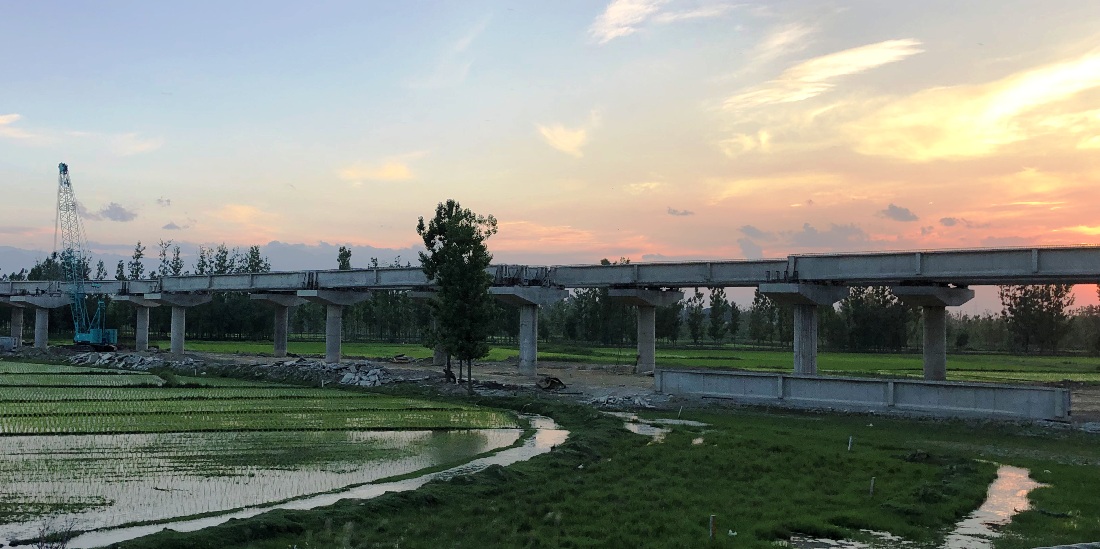
The meeting revealed that over 1.29 lakh hectares of cultivable land in the region depended on a mix of gravity and lift irrigation schemes. Only 40 per cent of this was covered under Medium and Minor Irrigation (MMI) schemes, while 60 per cent relied on smaller systems.
An official document cited multiple MMI schemes across Budgam, Baramulla, Anantnag, Ganderbal, Pulwama, and Kulgam, sourced from rivers like the Jhelum, Lidder, Sindh, Madhumati, and Veshow Nallahs. Though these networks fed vast areas, water availability had become increasingly erratic. Irrigation projects, built for 75 per cent water dependability, were now struggling to meet that threshold due to reduced rainfall, disrupting supply across major agricultural belts.
Northern districts were among the worst hit. Kupwara lost twenty irrigation storage schemes, and Handwara lost eight. In Anantnag, a major breach in the Awantipora Canal on the night of June 16–17 threatened 2,000 hectares of paddy land. The breach, measuring 40 metres in length and 20 metres in depth, was plugged within four days, with full water supply restored by June 21.
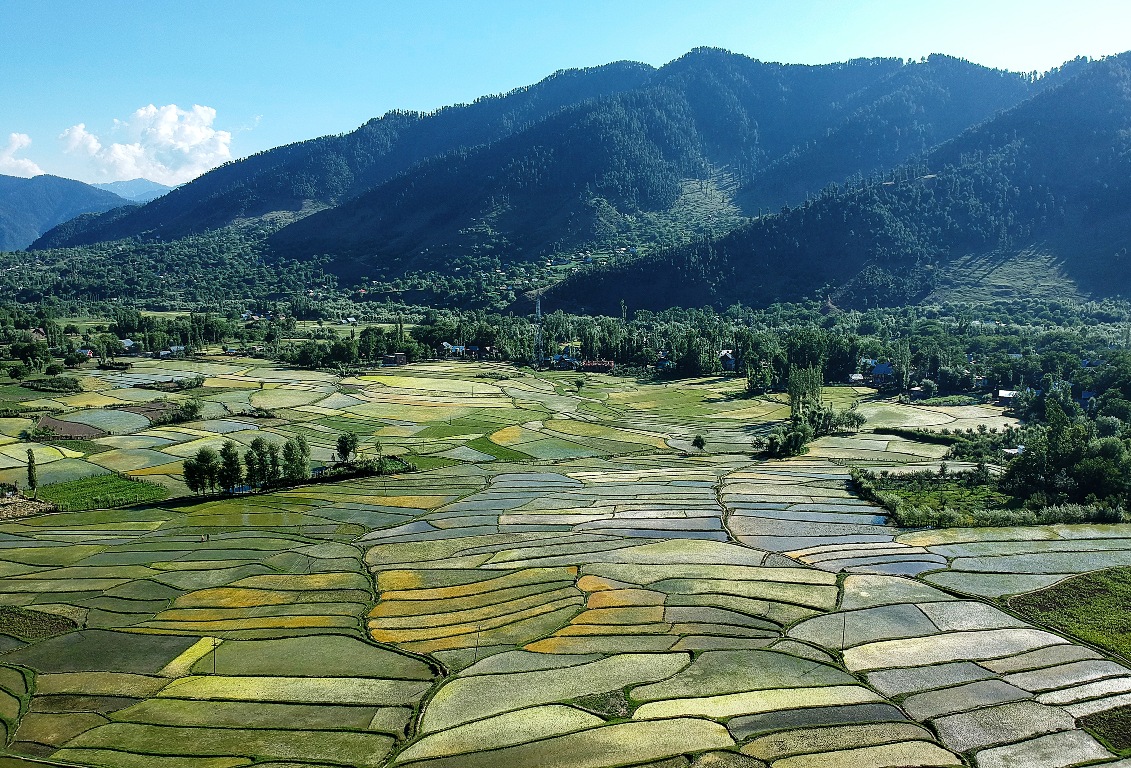
The document also noted that gravity schemes served about 81,000 hectares, lift irrigation reached 46,000 hectares, and smaller systems such as tubewells and tanks covered 3,000 hectares. But with increasing climate unpredictability, sustaining these systems would require substantial upgrades and stronger water management.
On the Margins
A resident of Rafiabad, speaking on condition of anonymity, said rain deficit and water scarcity would not affect their land even for a decade, as it remained naturally moist, locally called Aebi Zameen. However, he said, farmers on upland fields, or wudder, were suffering under the current heat and water shortage.
Dar Nouman, a nursery owner in the Handwara area, said this summer’s heat had caused significant damage. Kitchen gardens and paddy fields, he said, were experiencing heat stress and heat stroke. He had seen leaves burn in nurseries, particularly in perennial plants like red maple. The horticulture sector, especially apple orchards, was also struggling, with leaf burn reducing both fruit size and yield.
He explained that the biggest challenge during the heat wave was a severe shortage of water. Ponds used for irrigation had dried up as river levels fell, depleting groundwater in turn. This, he said, made it nearly impossible to cope.
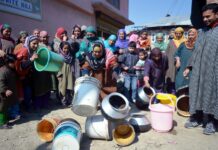
In Dedikoot Check, Umar Mukhtar described his village’s long struggle for water. “For two decades, we have pleaded for drinking water, but no one listens,” he said. Most families relied on vegetable farming, but the village lacked a single functional water source. He said the situation had now worsened, calling it heartbreaking that in 2025, people were still being forced to live without this basic necessity.
A video that recently circulated on social media showed a man in North Kashmir trying desperately to water his dried-up field, a stark illustration of the larger crisis.
Livestock in Distress
In Kupwara, a farmer reported that his 1.5 kanals of paddy land had dried up completely. His family was at a loss, not only over the crop failure but also the death of a cow from heatstroke. “It is a desperate situation,” he said.
Dr Qazi Mudasir, a veterinary expert, warned that rising temperatures in Kashmir were now affecting not just humans and crops, but livestock, especially dairy animals. He said that heat stress in large animals during hot and humid conditions could significantly reduce productivity and result in economic losses for farmers.
Dr Qazi said that the physiological toll on animals ranged from dizziness and loss of sweating to death if not managed in time. He stressed the importance of shade, clean drinking water, ventilation, and cooling techniques like sprinklers and misters for livestock during summer.
He explained that managing heat stress required a combination of environmental, behavioural, and nutritional strategies. Feeding should be scheduled during cooler parts of the day to reduce heat generated during digestion. Animals also needed rest during peak hours, and grazing should be limited to cooler periods.
He recommended oral rehydration and electrolyte solutions to replenish minerals lost through panting and sweating, which would support animals in regulating body temperature more effectively.

Relentless Heat
The summer of 2025 had been unusually harsh in Kashmir. According to Faizan Arif, an independent weather forecaster, June alone had shattered multiple records. Srinagar recorded its hottest June since 1978 and the second hottest in over 130 years. The minimum temperature touched 25°C, a level once typical of daytime highs just decades ago.
Qazigund, Kokernag, Pahalgam, and Kupwara also recorded unusually high temperatures, with both daytime and night-time readings nearing or exceeding historic highs.
According to data from the India Meteorological Department, from June 1 to 25, Srinagar had a 65 per cent rainfall deficit. Bandipora recorded a 71 per cent shortfall, Kulgam 62 per cent, Shopian 44 per cent, Baramulla 47 per cent, Ganderbal 54 per cent, Kupwara 36 per cent, and Pulwama 13 per cent.
Faizan observed that the defining feature of this summer was not just the daytime heat, but the unrelenting night-time warmth, which had disrupted natural cooling-off periods. The prolonged dry spell, he said, had lowered water levels in rivers such as the Jhelum and placed early stress on agriculture. Crops, particularly in unirrigated areas, were now facing severe moisture deficits and declining productivity.
If this pattern continued into July, he warned, even larger towns like Srinagar would begin facing water shortages, not just the remote villages.
Issues Everywhere
The water scarcity is felt seriously in Srinagar as well. In the Harwan belt, at the peak of summer, people would go in hordes for bathing. This year, the area is a no-go belt. Residents said they lack access to tap water, and they use the canal water, but hundreds of people who drive to the place from the city and the periphery bathe there and pollute the water. They approached the government and got the area banned for bathing, car washing and other activities.
The scarcity of water in Srinagar could be understood by the fact that Chief Minister Omar Abdullah personally flagged off a water tanker in the city. People associated with the engineering wing of the PHE, who supply tanked water to people, say they are working around the clock as demand has soared to a new high.
Experts believe that climate change is the main reason, and it is just the start of it. Kashmir is headed towards more harsh days, a situation that could change crop patterns and livelihoods significantly.
(Note: Some names in this story have been changed to protect the privacy and identities of individuals.)