Jammu and Kashmir’s apple industry sustains millions but suffers heavy post-harvest losses due to inadequate storage and processing, making infrastructure expansion, technology adoption and policy intervention economically imperative, writes Dr Mushtaq Ahmad Beigh

The apple industry of Jammu and Kashmir, valued at nearly Rs 12,000 crore annually, directly or indirectly supports around 3.5 million people in the Union Territory, making it the Valley’s most important horticultural sector and a major pillar of the regional economy. With approximately 1.72 lakh hectares under orchards, continuous improvements in fruit quality and productivity have significantly enhanced the livelihoods of growers and the families dependent upon this activity.
The Union Territory currently produces about 21 lakh metric tonnes (MT) of apples annually, of which nearly 8 lakh MT are classified as A-grade, 7 lakh MT as B-grade, and 6 lakh MT as C-grade.
Crisis, Half Managed
A-grade apples require Controlled Atmosphere (CA) storage to maintain quality during storage, which also helps in regulating market supply. However, instead of the requisite 8 lakh MT storage capacity, the existing scientific storage capacity in the UT is only 4 lakh MT. As a result, the remaining 4 lakh MT of A-grade apples are sold immediately after harvest at lower prices.
Although 10-12 new CA storage units of 5,000 MT capacity each are added every year in Kashmir, at this rate, the UT would require another 7-8 years to achieve the total CA storage capacity needed for all A-grade apples.
However, CA storage alone is not sufficient to preserve fresh fruit quality. Once apples are removed from CA stores after 5–8 months and transported to distant markets in India, they rapidly lose quality due to long transit periods and high temperatures. The shelf life of apples is only 8–10 days, and even shorter when temperatures exceed 40°C, after being taken out of controlled atmosphere storage, leading to reduced market value compared to imported apples.
To overcome this challenge, apples must be treated with 1-MCP within 1–2 days of harvest at proper maturity. When CA-stored apples are treated with 1-MCP, they can retain quality for up to 25 days after removal from storage, enabling better transportation, access to premium markets and higher returns to growers. The 1-MCP application technology has already been tested and disseminated by the Division of Food Science and Technology, SKUAST-K, and has been successfully adopted by many CA storage owners in the Valley.
The Grade 2
B-grade apples, accounting for nearly 7 lakh MT, are currently transported directly to local and national markets. The major national marketing centres for B-grade Kashmiri apples include Delhi, Mumbai, Kolkata and Chennai. The normal shelf life of Red Delicious, which is the Valley’s dominant variety, is 20–25 days when the temperature remains below 25°C. However, by the time these apples are harvested, packaged, transported and delivered to distant markets, usually within 15–20 days, they lose firmness and juiciness, and therefore reach consumers in a mealy and poor condition, consequently fetching low market prices.
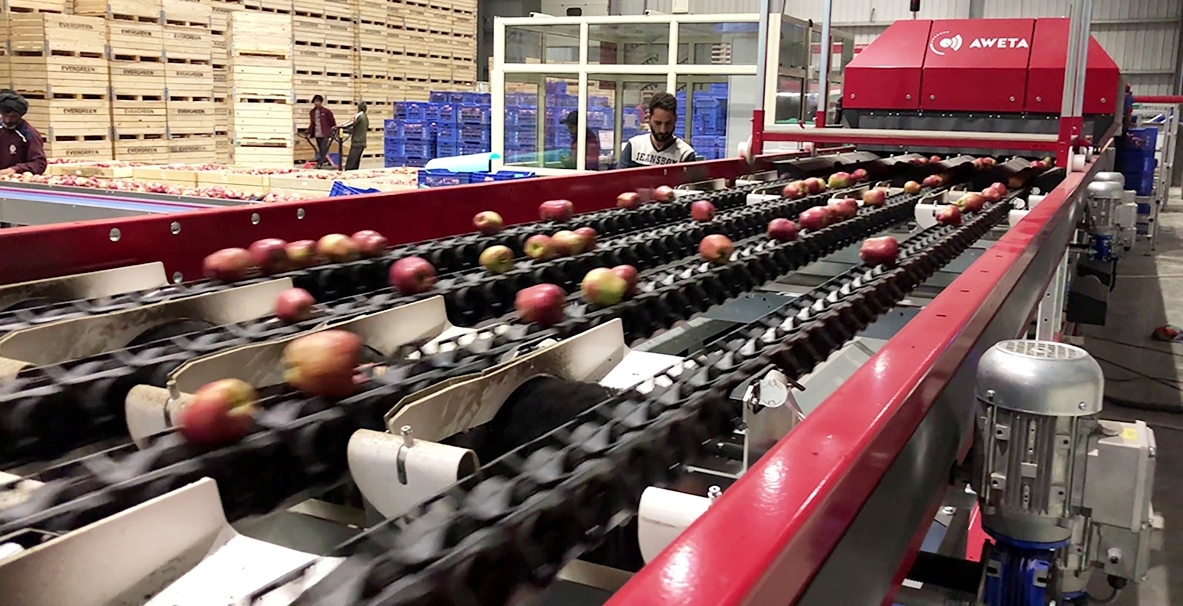
Farmers are compelled to flood fruit mandis across the country with nearly 11 lakh MT of apples (7 lakh MT B-grade plus 4 lakh MT displaced A-grade), providing temporary psychological relief in the short term once the produce is dispatched. Unfortunately, when farmers receive their final sales statements, the returns are far below expectations, causing distress and financial losses in the long term. It is, therefore, essential that the administration also focuses on establishing adequate cold storage facilities across the apple-growing regions of Kashmir to hold B-grade apples as well as the remaining A-grade apples until they are dispatched to the market. This would regulate supply, prevent market flooding, preserve quality and enable better price realisation.
Pre-Sale Treatment
Additionally, all apples, whether A-grade or B-grade, can be treated with 1-MCP in these cold stores before being sold as fresh fruit, ensuring that produce reaches consumers in good condition. Until sufficient storage infrastructure for 11 lakh MT of apples is created, the Division of Food Science and Technology, SKUAST-K, has successfully tested an alternative method to extend shelf life using 1-MCP-coated strips and sachets. When these strips and sachets are placed inside airtight packaging, the controlled release of 1-MCP is activated by the moisture produced through fruit respiration during transport and retail. The released 1-MCP competes with ethylene for receptor sites in fruit tissues, preventing ethylene-induced ripening and thereby slowing softening and quality deterioration.
These 1-MCP-coated strips and sachets are now available in the market through several companies. For effective use, apples must first undergo a starch-iodine test, and the starch index should be 2.5–3.0 (optimum maturity stage). A 1-MCP sachet sufficient for 10 kg of apples costs Rs 14, while one for a 17 kg box costs Rs 20.
The C Grade
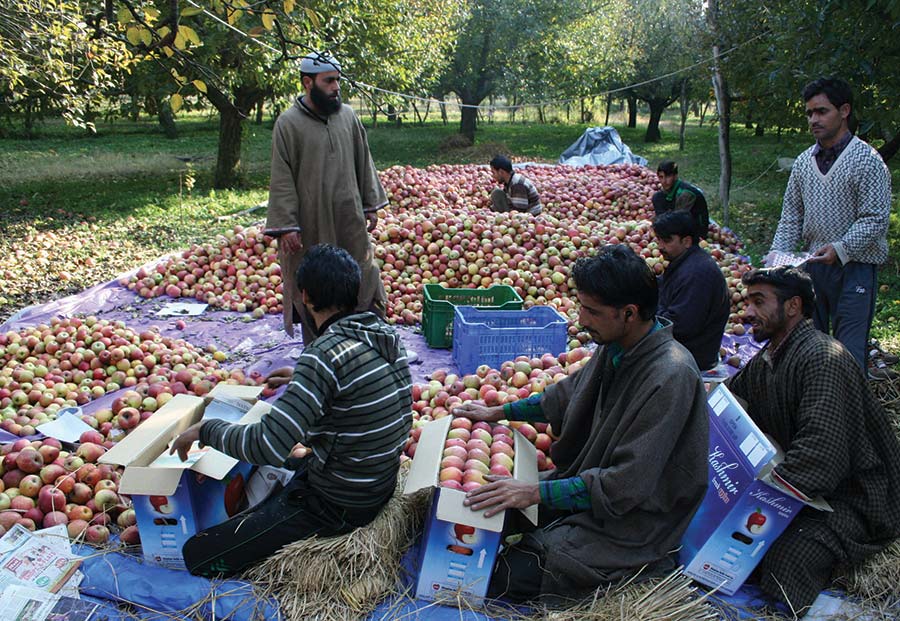
C-grade apples (6 lakh MT) include pre-harvest drops, mechanically damaged fruit during harvesting or other operations, bird-damaged fruit, and similar categories. These apples are meant strictly for processing and must not be transported outside the Valley to be sold as fresh produce. Selling them fresh in other states damages the reputation of Kashmiri apples and adversely harms the horticulture industry. In 2025, some growers transported pre-harvest drop apples outside the Valley, and due to heavy rains and landslides, the national highway remained closed for more than 20 days. When these pre-harvest drop apples, classified as C-grade, remained stranded on the highway for more than 10 days, they rotted, creating severe disposal and environmental issues.
The Division of Food Science and Technology, SKUAST-K, strongly recommends that C-grade apples should not be sold as fresh produce, particularly outside Kashmir, and should only be used for processing into value-added products with national and international markets, like Apple juice, Apple concentrate, Apple cider, Apple powder, Apple chips, besides jams and preserves.
However, the UT’s present apple processing capacity is only 1 lakh MT. Although some 40,000–50,000 MT of C-grade apples are sold locally as fresh fruit, the remaining nearly 4.5 lakh MT goes to waste, contributing to 19–20 per cent post-harvest loss in apples, a burden borne entirely by farmers. Bearing a 20 per cent loss is economically unsustainable for farmers, and the administration must act urgently.

Post-Harvest Deficits
Jammu and Kashmir continues to face significant post-harvest losses due to gaps in infrastructure, handling, storage and logistics. Central sector schemes of the Ministry of Agriculture and Farmers’ Welfare, Ministry of Food Processing Industries and Ministry of Commerce and Industry, along with APEDA, NHB and region-specific initiatives such as Holistic Agriculture Development Programme (HADP), can collectively address these challenges through financial support, infrastructure creation and technology adoption. These schemes should not only reduce quantitative and qualitative losses but also promote value addition, agro-entrepreneurship, and FPO strengthening and export competitiveness.

Through these schemes, entrepreneurship in fruit processing can be promoted by involving educated unemployed youth, especially those trained in horticulture, post-harvest technology and food technology. This would help create a robust processing sector, reduce post-harvest losses in apples to below 10 per cent, enhance farmer income, and, in turn, lead to accelerated GDP growth across the Union Territory. Overall, an integrated, scheme-driven approach is essential for enhancing apple value addition, minimising post-harvest losses and unlocking the vast potential of the horticulture business in Kashmir.
(The author is an Assistant Professor, Division of Food Science and Technology, SKUAST-Kashmir. Ideas are personal.)