From Kashmir’s disappearing rice fields, Tuiyba Anwar traces the quiet revolution that once stirred each season, when women discovered rare freedoms, communities thrived on barter, and the cadence of labour carried folklore through the valleys. Today, mechanisation has hollowed out the soul of this tradition, leaving behind only a deep yearning for a slower, more rooted way of life.
It was an early morning in June 1988 when 15-year-old Naza Banu stood in her family’s paddy field in the Arwani region, Kashmir’s down south, her feet dipped in water and mud, worried, waiting for her friends and the women from her village. They were taking longer than usual. She feared the kaad, the gathering of people for paddy transplanting, would be smaller this time. She looked out for the kaadeir, the mostly female group who plant the rice saplings, hoping they would arrive soon. She was anxious that their group might appear smaller than those in the neighbouring fields.
Soon, however, people began to arrive, just like every year, to help with the thaejkaad, the large seasonal gathering for transplanting paddy, when young rice seedlings were moved from thaejwan, the nursery beds, to the main field. Banu saw the kaadeir coming in their old clothes, the ones reserved for fieldwork. She felt relieved. “The fear of our field looking emptier than the others went away,” she said. Nearly 30 people had come.
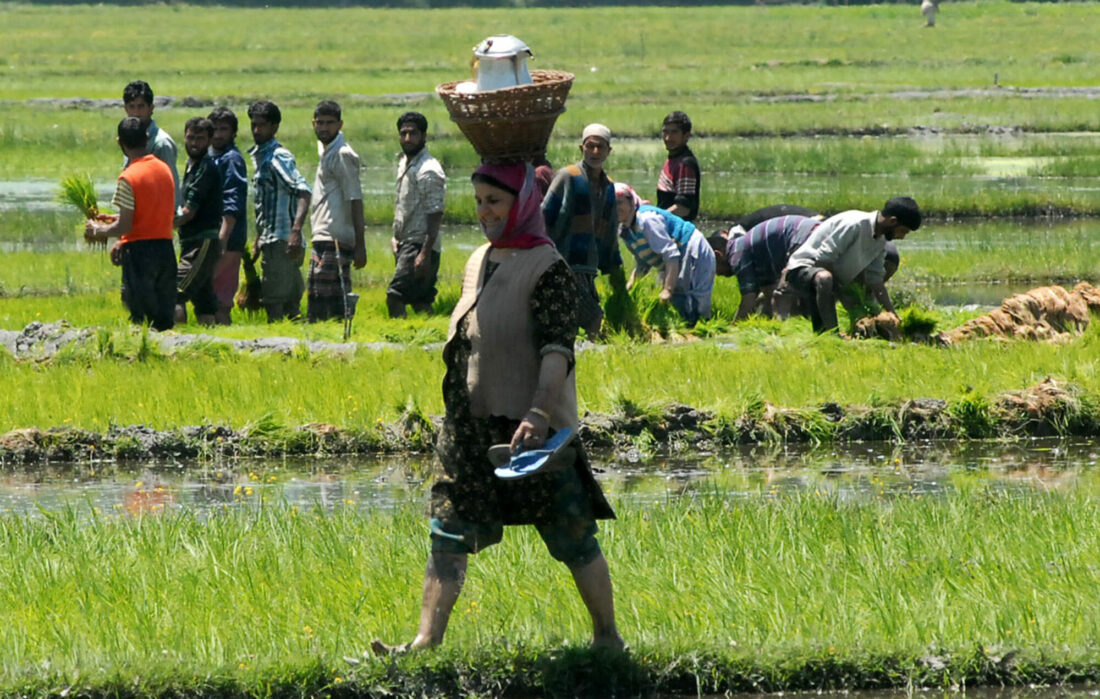
They greeted one another, giggled, laughed, and began planting the rice seedlings, a process known as thal ruvin. The field was long, and they had just started. Many more fields still awaited. They noticed that others were ahead, so they picked up their pace. The thal, or rice seedlings, were distributed by two men across the field, while a few small girls passed the thaej baed, or bundles of seedlings, to the kaadeir, who planted them with skilled hands deep into the muddy soil.
By around 11 am, two women arrived carrying a kehweh samavar, the traditional Kashmiri teapot, along with bread, makai and tomul tchott. Everyone took a break. Some had two cups, some three. “It was the moment when, apart from the momentary chit chat while working, the actual conversation started– sharing freely the happenings of life. We would talk about everything, sorrows and joys, with kehwa in our hands,” Banu said. After the tea, they returned to the half-finished field.
Singing and Working
A relative of Banu’s began singing in a high-pitched, melodious voice, as women did in nearby fields. “We would sing all kinds of songs, but mainly thaejkaad songs,” she said. She softly recited one: Thal drenthvaiy thaejkadas, az raatas gindvaiy (We will plant the seedlings today, dear sisters, and we will play all night long).
After that came the lukeh baeth, or other folk songs. Lunch was delayed, as often happened during thaejkaad. They completed a large field by 3 pm and went to the host, Banu’s home, where they were served lunch, half wazwan if not a full one. After eating, they returned to another field and began again, carried by singing, laughter, joy, and, of course, exhaustion. By 5 pm., they were served noon chai in the field. They worked until 8 pm, finishing everything, and returned home under the zoon gaash, the moonlight, still singing, still content.
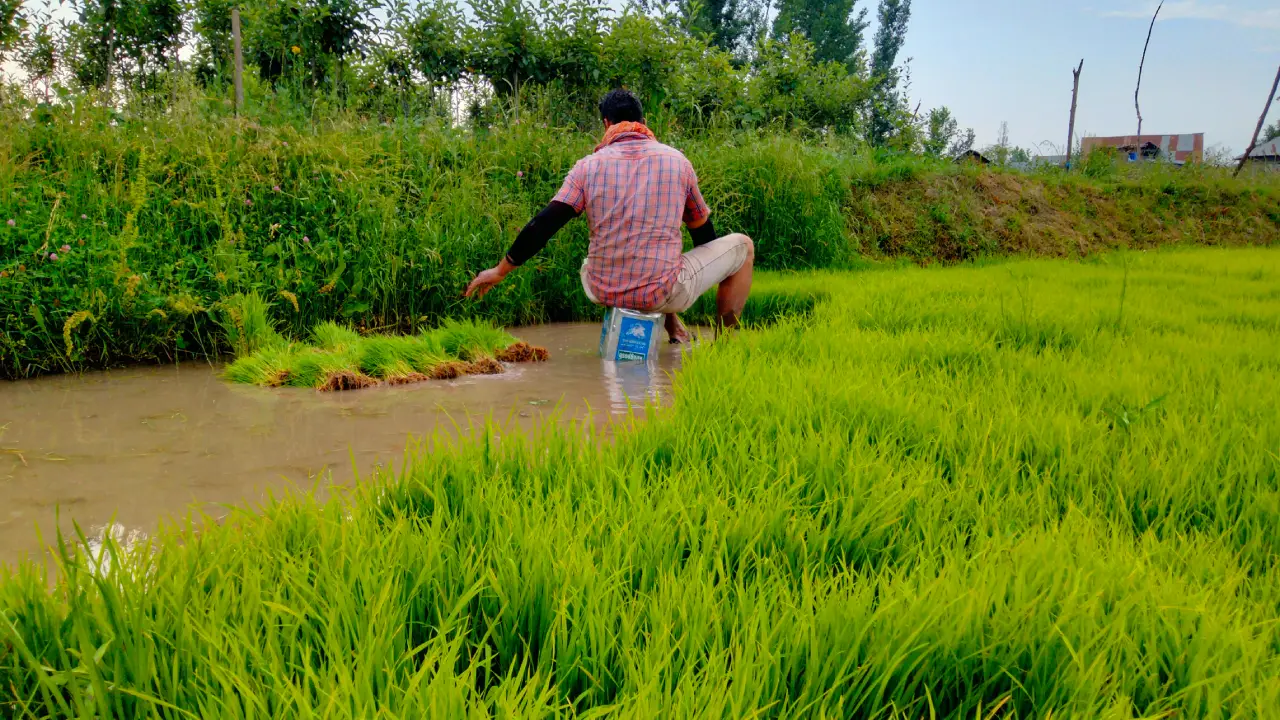
Now, 37 years later, Banu, 52, married and living in Zainapora in Shopian, misses the celebration that rice cultivation brought from April to October. When she walks into her family’s small paddy field, with most other land now under apple orchards, her mood dulls. There is only one co-kaadur (worker). No singing. No kehweh samavar. No gathering. She sees just two or three people in neighbouring fields, mostly labourers, trying to finish quickly.
“Today, it has become just a formality. Everything runs on money now,” she said. “Back then, it was all driven by warmth and love.”
The Rhythm of Rice
Shabir Ahmad, 45, from Tengjen in Kulgam, remembered when rice cultivation in Kashmir had been more than just agriculture. It was a source of joy, peace, and social connection. Today, as paddy lands diminished, those still farming felt the process had lost its intimacy. Earlier, every step had drawn people together in ways that now seemed lost.
Ahmad recalled that the process had once kept people engaged for nearly the entire year. It began in mid-April with the preparation of thaejwan, a small nursery plot. Husked rice, used as seed, was soaked in water for several days in weathran, a big straw-woven bag. After germinating in five to six days, the seeds were sown in the nursery or, in rare cases, directly into the fields. This less common approach, known as the waeter method, skipped transplanting and required later thinning.
Direct seeding, waeter, was the age-old traditional method of growing rice. It was less scientific and would require a lot of manual de-weeding, the nendeh, which would make farmers sick. As the rice varieties changed and a basket of high-yielding Chinese varieties was introduced, the direct seeding method was abandoned for a slightly less labour-intensive transplantation. The use of weedicides helped grow rice better.
Some of the pre-germinated seeds were roasted to make baiel tomul, a snack enjoyed by children and adults alike, often with sugar.
The nursery bed took about 40 days to mature. By then, the main rice fields were prepared. Ploughing was done two to three times, followed by levelling, usually with oxen and wooden ploughs, or sometimes with spades. The first ploughing was a celebration with growers celebrating it as goungul, when sweets would be distributed. Then, from late May to early June, the fields were flooded and levelled, either by foot or with a mond, a wooden log dragged by hand. Field levelling would start after the first ploughing. Locally called phitrawun, breaking the soil clods, it required using wooden mallets, called yeptcheat or yetfur. It would be repeated after the second and final plough, and later, post-irrigation, the mound would level the rest of it.
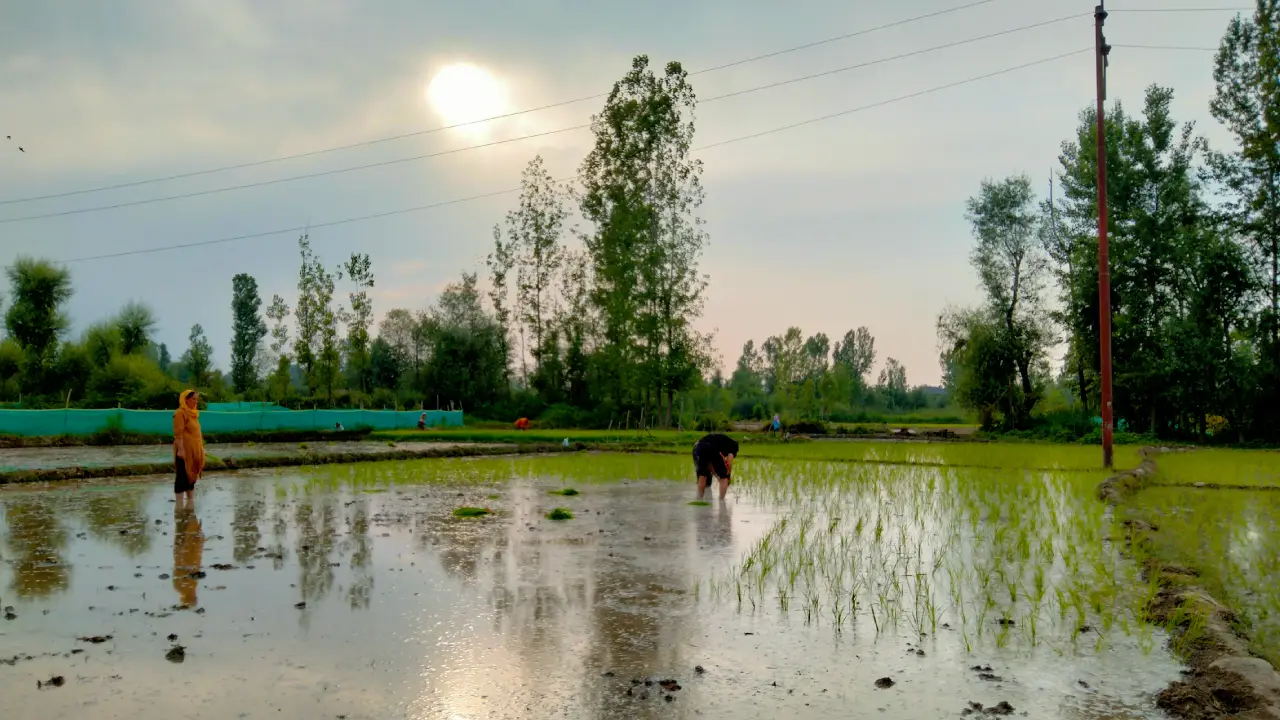
Two or three men would then visit the nursery to pull out the seedlings, organise them into bundles (thaej laey), and carry them to the fields for distribution. The next morning, the women kaadeir arrived early to begin transplanting in rhythmic coordination.
After the kaad, whether completed in a day or more, a break of six to eight days followed to allow the roots to take hold. During this interval, raavat had to be done, which involved managing water levels and other field needs.
Then came nendeh, or hand weeding, carried out on a large scale by men. The nendier, or weeders, often sang as they worked. Their arms, legs, and feet would swell from khaez (insect bites), but they carried on. The swelling was treated with doyin goul, the outer shell of walnuts. Ahmad said two or three rounds of nendeh usually sufficed to ensure a good harvest.
The Harvest
As Harud, the harvest season, arrived in September, the green fields turned golden. The harvest was communal. People cut the stalks (lonun), tied them into bundles (gandun), and grouped four bundles into a tchaakh, then stacked them into three-ended heaps known as trev. At this stage, the rice remained unthreshed. Using the sreh, the farmers would take the harvested crop along with the straw to home.
Finally, gouni were built either in the fields or at home. These house-like stacks of harvested rice awaited threshing, a process called chhombun. The husked rice was then dried and stored in a kuthh or kutchh, the grain houses made of wood, usually built in the courtyard of the households.
Some of the husked rice was taken to the mill, originally a traditional kanz, and later mechanised, powered by water or electricity. After milling, families stored the rice and settled in for winter, which began in November.
“All of these processes, transplanting, hand weeding, harvesting, collecting, and threshing, were done by families and communities, driven by love and brotherhood,” Ahmad said. Though the structure remained, he felt something essential had faded. “Although the overall skeleton is the same for the whole cultivation process, it’s somehow not the same anymore.”
Rice, Rantas, and Rasul Mir
The process of rice cultivation was inseparable from Kashmir’s cultural identity. It formed a vital strand of tradition and social cohesion.
Meema Akhter, a 55-year-old farmer from Qaimoh in Kulgam, remembered how harud, the season of harvesting, once brought families and neighbours together, regardless of whose fields were being harvested. Out in the open, there was an unspoken understanding that help would be offered freely.
She recalled how gathering the crop, stacking it into piles, and carrying it home turned the season into a carnival of shared labour. The entire cycle, particularly harud, reflected the quiet simplicity of rural life, where work was unhurried and shaped by cooperation, not profit.
Akhter noted that barbers, potters, ironsmiths, and others would arrive during harud to collect their annual maangaey, dues owed by the farmers after harvest. Even wandering mystics and saints came to claim their customary share.
Children, too, played their part. They scavenged leftover grains from the fields, sometimes stealing from the heaps, and bartered them for kijjeh mithaey, a sticky toffee. Local vendors offered monji, halwa, and paratha in exchange for handfuls of fresh harvest.
Until the 1990s, farmers said, harud still carried echoes of a barter economy. It was never just about food. It reflected a culture of mutual care that gave rural Kashmir its character. Men and women of all ages worked side by side, and Akhter believed this collective rhythm kept people healthy, both in body and mind. “You help me and I help you,” Abdul Rashid, a nonagenarian, explained that most of the agriculture was barter. “It was a community effort in which you will help me in the paddy plantation or harvest, and I would return the favour in equal terms.” Even the ploughing was a community effort. Farmers would own an ox each, and ploughing would require two, so one family was dependent on another.
Beyond labour, Kashmir’s rich oral traditions thrived in the fields. Folktales and songs travelled from one generation to the next amid the rice stalks. Stories of mythical beings, raantas, raachok, and tasruphdar were believed to appear at various stages of cultivation.
For Naza Banu, these stories were not figments of imagination. It was part of a society’s collective memory, their lived experience and real in the realm of a literal unreality. She recounted how her uncle, Ammeh Kaakh, once encountered a raantas while tending to the water in the fields during raavat. She also recalled that elderly neighbours spoke of tasruphdar helping them during harud, especially with stacking the gouni or assisting lone workers. She narrated one instance where a man was helped by someone who appeared to be a fellow villager, only to find out later that no such person had been there.
“These stories were real to us,” Banu said. “Now, there is no rice cultivation, no tasruphdar, and no stories.”
Songs of A Society
Singing, too, marked each stage of the work, from ploughing and nursery preparation to weeding and harvesting. These songs ranged from folk and love ballads to naats, lukeh-baeth, and verses from Sufi poets. “We sang Rasul Mir’s poetry, naats, prayers, Yusuf Naam, and love songs,” Banu said.
Akhter, too, remembered how workers sang throughout the day. It helped ease their labour and kept their spirits high.
These songs, conversations, and communal gatherings brought a subtle form of agency, especially for women. Meema explained that women would often sing to express their emotions. Daughters-in-law and other women voiced their grievances and feelings aloud during the shared labour of paddy cultivation. For many, it became a rare outlet, sort of a catharsis.
She recalled how women would sing their hearts out, sometimes expressing longing and sorrow through folk couplets. Humming one such verse, she recited:
“Baayav lagyav tche teh chaenis naadas,
thaejkaadas saadihem naa.”
(Oh my brother, I would give my life for you and your name, won’t you come and stand by me in thisthaejkaad).
Akhter felt that this space also gave women a kind of mobility and agency that was otherwise restricted by circumstances. She remembered how the arrival of thaejkaad meant travelling to other villages, which brought joy and a sense of freedom. Moving between fields and spaces for rice plantation, the women, and also men, would sit around, interact, make friends and talk tensions out.
She also recalled how, at a time when there were few spaces for young couples to meet, many would find ways to work in the same field. Pretending to help with the harvest, they found brief moments of connection. They would talk indirectly, exchange glances, tease, or show silent support during the work. Sometimes, these interactions would mark the beginning of new families.
On a Wednesday evening, Akhter filled a kettle with tea and gathered some biscuits for three non-native labourers before heading to her small field, where paddy transplantation was underway. She looked nostalgic and faintly melancholic.
Today, she said, life offered convenience but no peace. There was money and comfort, but the richness had faded. Ploughs had been replaced by tractors, and nendeh kaad by weedicides. Everything happened instantly now, yet she often longed for the slower, deeper rhythm of earlier days.
Agriculture is now a quasi-mechanical exercise. The rice fields have shrunken and converted into dense apple orchards. Whatever remains is mostly mechanical. The tractors have sent oxen to the butchers. Albaein, the plough has ceased to exist. Women do not require taking Gouh, the cow dung, to the fields to enrich the soil organically. People now use fertilisers, Potash, DPA, and Urea, to grow more. The wooden mallets and the Sreh are long gone. Even the cows have moved out of fashion as cowsheds do not exist. Now, paddy threshing is done in the field itself, and the yield is taken on a handcart.
The drill that would keep men and women busy, shuttling between the home and khah, rice fields, from spring to autumn, would keep folks fit and healthy. Now they meet at ration depots every month, to offer their finger impressions on the POS machine to purchase grains or at the doctor’s clinics where they are treated for new lifestyle diseases like diabetes and obesity.
While changing Kashmir, the Kashmiris have changed a lot.