In a small Kashmiri town, an ancient tradition of communal dining dissolves barriers of sect, class and creed, reports Afreen Ashraf
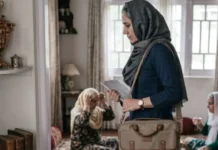
Zehra moves slowly through the narrow lanes of Magam, a steaming pot held carefully in her hands. Around her, other women emerge from their homes, each carrying dishes prepared since before sunrise. All of them are heading to the Eidgah, where a gathering is already taking shape.
This scene repeats itself every year in Magam, Budgam, as the town comes together for Leaj Khean, a communal meal rooted in faith, equality, and an open-hearted generosity that asks nothing of those it feeds.
A Tradition
Leaj Khean is observed during the days of Ayam-e-Fatima, a period of remembrance dedicated to the life of Sayyidah Fatimah, the daughter of the Prophet of Islam and the wife of Hazrat Ali. For the predominantly Shia community of Magam, the tradition is a living expression of her example, a lady who, organisers believe, gave to those in need without ever asking who they were or where they came from.
“At Fatimah’s dastar khawaan, no one is asked about his sect or status,” said Yaseen Hyder, a resident. “Here, everyone is equal. On that spread across the ground, there is no hierarchy.”
The exact origins of Leaj Khean are not precisely known, but residents believe it has been practised for generations, gradually becoming woven into the cultural and religious fabric of the town. Magam’s central position among Shia communities in the region, along with the long presence of Shia families in and around the area, made it a natural gathering point for this tradition to take root and endure.
Served With Love
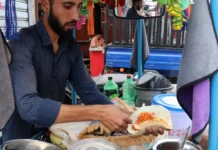
What distinguishes Leaj Khean from other community feasts is that the food is not prepared collectively in a central kitchen. It is cooked in individual homes using individual hearths, and that distinction matters enormously to those who participate. Women across Magam wake before sunrise, perform ablution, and begin cooking with care and quiet devotion.
“I remember when I was a child, how the women of my family would wake up before dawn,” recalled Qassim Abbas, a resident. “They would perform ablution and prepare all the food with great devotion and love. For them, it was their way of remembering Fatimah.”
The community could, of course, pool money and arrange a meal collectively, as other communal feasts are organised. But Leaj Khean, Abbas explains, is deliberately different. “Here, people prefer to be personally involved. They want to prepare the food themselves and serve it with their own hands.”
There is also no fixed menu. Each family brings whatever they can afford and wish to offer; some carry chicken or meat, others simpler dishes, and all of it becomes part of the shared spread. Zehra said the last two times she prepared food for Leaj Khean, she chose to make chicken. “But there is no restriction. Anyone can bring whatever they like.”
Strangers around the Same Plate
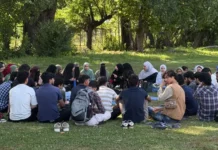
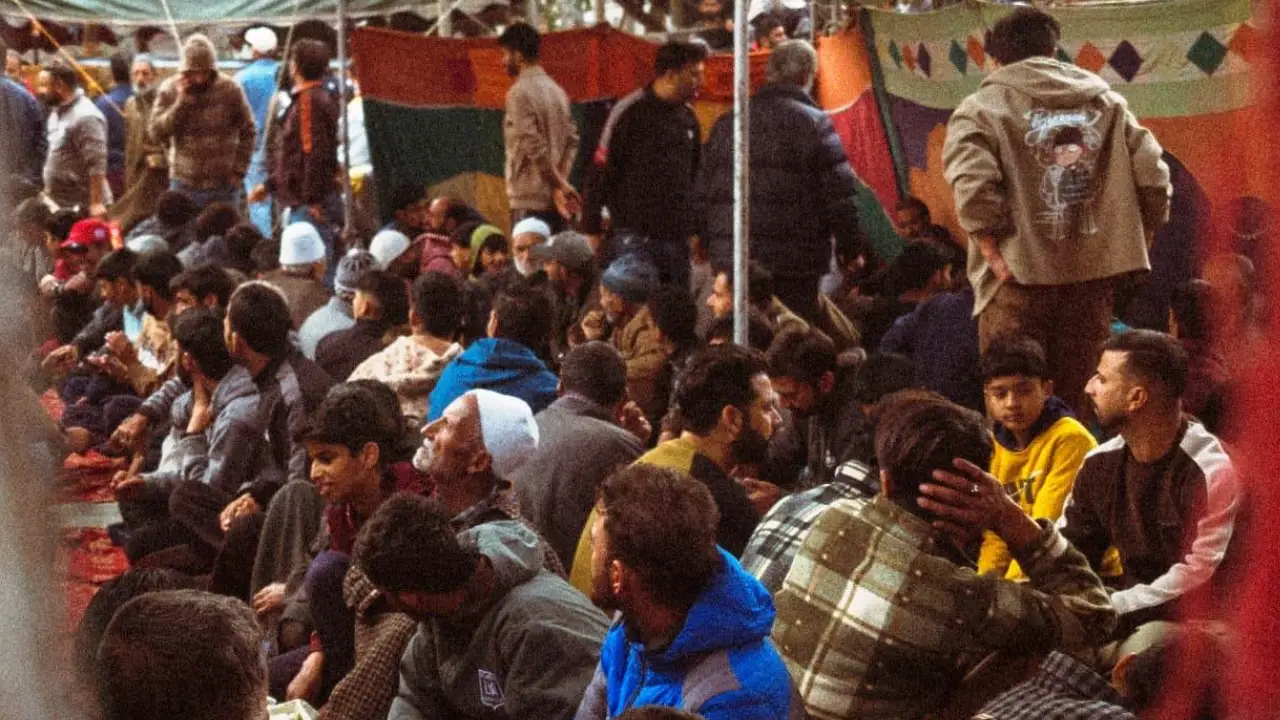
As people arrive at the Eidgah, volunteers step forward to receive the dishes, sorting and organising them by flavour before the dastar khawaan is laid across the ground. Large traditional Kashmiri copper plates, tramis, heaped with rice, are set down, and people gather around them in groups of four. Often, those four people have never met before.
No invitation is required to attend. Anyone who wishes to join simply comes. The person sitting beside you may be wealthy or modest, Shia or Sunni, from your own neighbourhood or from somewhere entirely unfamiliar. In that moment, none of it is of consequence. They share the same food from the same plate, and for that brief time, Leaj Khean becomes a quiet, unhurried lesson in equality.
“Differences between sects may always remain,” said a Sunni cleric who teaches at a local darsgah in Lal Bazar, Srinagar, “but acts like this still allow us to stay united.” His sentiment is echoed by Ali Hyder, a Shia cleric from Baramulla, who has spoken in support of the practice. “If I were to describe Leaj Khean,” said a local lecturer, “I would not call it a ritual practised only by Shia Muslims. It is a tradition that brings people together.”
A Spiritual Depth
For many, Leaj Khean carries a spiritual depth that extends well beyond its communal warmth. Over the years, stories have circulated of people finding comfort after eating from the feast. These accounts are spoken of not as curiosity but as sincere testimony, passed quietly between families across generations.
In Kashmiri culture, the act of sitting together at a shared meal already carries considerable meaning. Tehri and Sus Rus are the other two forms of community feasting, but these have different systems and situations.
In Magam, that meaning is amplified and made deliberate. Leaj Khean does not merely invite people to eat together; it gently insists that the boundaries brought to the table are left at its edge.
Families of every background prepare food and pour it into the same vessels. The wealthy and the poor sit on the same ground; the devout and the doubtful share the same copper plate. In a time when divisions so often dominate public life, this simple act of communal dining has become something quietly radical, a reminder that a shared meal can, if only for an afternoon, help dissolve what distance and divisions have built.