SRINAGAR: As a step towards de-escalation along the Line of Actual Control (LAC), Defence Minister Rajnath Singh announced that the disengagement process between Indian and Chinese troops in eastern Ladakh is nearing completion.
Speaking at the inauguration of the Bob Khathing Museum in Tezpur, Assam on Wednesday, Singh highlighted that recent discussions had led to a consensus for restoring the ground situation on an equal and mutual security basis.
The announcement follows extensive negotiations at both diplomatic and military levels. An agreement covering patrolling rights and grazing access in traditional areas has reportedly been reached, reflecting efforts to reduce friction that began with the border standoff in 2020.
The tension that began in eastern Ladakh after Chinese military actions escalated in June 2020, leading to a deadly clash in the Galwan Valley, had plunged India-China relations to their lowest in decades. The renewed agreement has seen both nations shift towards diplomacy, with both sides aiming for peace along the LAC.
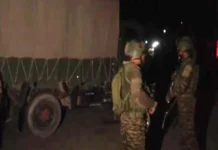
Defence Minister Singh underscored that while disengagement is almost complete, more time will be needed to fully resolve the complexities of border management and patrols. Army sources indicate that disengagement at two key friction points—Demchok and Depsang Plains—is progressing. With verification underway, Indian and Chinese troops are expected to resume patrolling soon, marking a return to pre-2020 patrolling patterns. Ground commanders are reportedly engaged in talks to establish patrolling modalities, including the dismantling of temporary structures such as tents and sheds.
In parallel, a display of goodwill is planned with Indian and Chinese troops scheduled to exchange sweets on Diwali, symbolising diplomatic progress. Although the exact locations for this gesture remain unspecified, such exchanges have long been a custom at border posts during festivals.
The first structured meeting in five years between Prime Minister Narendra Modi and Chinese President Xi Jinping, held recently on the BRICS summit’s sidelines, also played a role in the progress achieved. Both leaders emphasised the importance of bilateral ties for regional stability. Xi echoed these sentiments through Chinese Ambassador Xu Feihong, who expressed hope that ongoing improvements in relations will not be disrupted by specific disagreements. Xu reiterated that handling differences constructively remains crucial for steady diplomatic ties.
As part of a parallel strategy to reinforce India’s defensive infrastructure, a new airfield is being constructed in Mudh, Nyoma, in eastern Ladakh. At 13,700 feet and located approximately 35 kilometres from the LAC, this high-altitude airfield will provide vital strategic support to defence operations. Ninety-five per cent of the runway, which spans three kilometres, is now ready, and the airfield is expected to be fully operational by next year. According to Colonel Ponung Doming, Commander of the 755 Border Roads Task Force (BRTF) for Project Himank, the airfield is designed to accommodate emergency landings, underscoring its strategic importance.
With diplomatic and military coordination at an all-time high, Indian and Chinese forces seem poised to reset ties along the LAC, while India simultaneously strengthens its border infrastructure. These developments mark a pivotal moment in both nations’ pursuit of peace and stability, as well as the region’s broader security.
(With PTI inputs)