With a recorded history of around five millennia, Srinagar, the City of Kashmir has been a settlement explored and rediscovered by people for the last many decades. Sadaf Wani’s latest book, City As Memory intends to walk the talk against the backdrop of the situation that the city endured for more than 30 years, writes Humaira Nabi
Srinagar, one of the world’s oldest cities, has a history spanning thousands of years. Its vibrant and diverse heritage has captivated the interest of countless scholars, historians, and writers over the centuries. Serving as the capital for numerous empires throughout its existence, Srinagar has been a silent witness to an unparalleled array of historical events. While its pivotal role in these empires significantly contributed to the city’s development and cultural richness, the region’s turbulent and often troubled past has deeply shaped not only the city’s urban design and infrastructure but also the psyche, lifestyle, and daily experiences of its inhabitants. The way people live, feel, and interact within the city is profoundly influenced by the city’s complex historical legacy.
In her book City as Memory, Sadaf Wani delves into the personal experiences and memories of individuals who were born and raised in Srinagar, using their stories as a lens to explore how the city’s history is deeply intertwined with their sense of home and identity. Sadaf examines how the region’s complex past marked by political upheaval, conflict, and cultural shifts has left an indelible mark on the memories and emotional landscapes of its people.
Personal Experience
The author, a senior communications professional, draws from her own childhood experiences during the mid-1990s, a time marked by a waning insurgency and escalating militarisation, as well as her adolescence in the early 2000s, which saw deadly cycles of violence in response to civilian protests. Through this personal lens, she explores how Kashmir’s turbulent history is deeply intertwined with the memories of home for its people. Her reflections offer an understanding of how the region’s political upheavals and conflicts have shaped the collective and individual experiences of those who call Kashmir home.
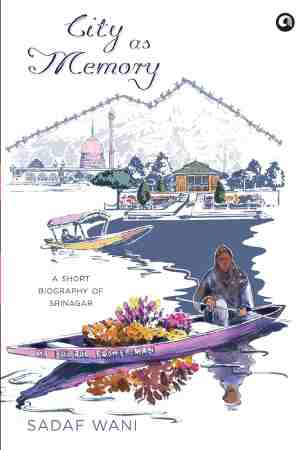
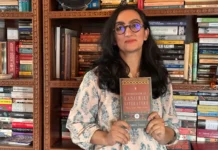
Published by Aleph, the book opens with Sadaf Wani reflecting on her initial hesitation to write about Srinagar. When first approached with the assignment, she agreed but soon found herself grappling with self-doubt and anxiety, questioning, “Why should I impose my version of the city as a generalised biography?” Her uncertainty lingered until she came across Joan Didion’s essay “Why I Write”, in which he asserts, “In many ways, writing is the act of saying I, of imposing oneself upon other people, of saying: listen to me, see it my way, change your mind.” Didion describes writing as an inherently assertive, even aggressive act, where the writer’s sensibility invades the reader’s private space. This realisation resonated with Sadaf, affirming for her that this imposition is not only inevitable but central to the very act of writing.
In discussing the purpose behind writing the book, Sadaf shares that her editor wanted her to craft a narrative that would entice readers to visit Srinagar. However, Sadaf aimed to maintain a more neutral stance, preferring to examine the city as a mosaic, giving equal weight to all the pieces that make up its intricate whole and acknowledging the diverse life worlds that coexist within it.
Born and raised in Baramulla, more than 50 km in north of Srinagar, Sadaf admits her limitations in capturing the essence of the city. She confronts the fact that her own experience in the city has not been extensive enough to claim to have read the ‘pulse of the city’. For her, Srinagar was initially associated with her father’s Mataamal (maternal home), and during her childhood, it represented a distant destination, a city reached after a long one-and-a-half-hour journey from her hometown of Varmul, where her family would occasionally go for picnics.
The Book Construction
The book is divided into four chapters, with the first titled It’s Pronounced Sirinagar. This chapter provides a historical and cultural overview of the city, viewed from the majestic Hari Parbat, a hill that has long held strategic military importance for the imperial forces that ruled Kashmir. Located in the heart of Srinagar, Hari Parbat has played a central role in the city’s defence throughout history. Sadaf traces the origins of the walled city, Naagar Nagar, centred around Hari Parbat and built during the reign of Mughal Emperor Akbar in Kashmir. Later, under Durrani rule, Ata Mohammad Khan Barakzai constructed the fort that still stands atop the hill today. Over the centuries, the fort passed through various rulers, from the Durranis to the Sikhs, then to the Dogras and today, the tricolour flies over it, symbolising the changing regimes in the region. Sadaf also explores how Hari Parbat holds religious significance for the three major faiths of the region Hinduism, Islam, and Sikhism highlighting the hill’s deep cultural and spiritual resonance for Kashmir’s diverse communities.
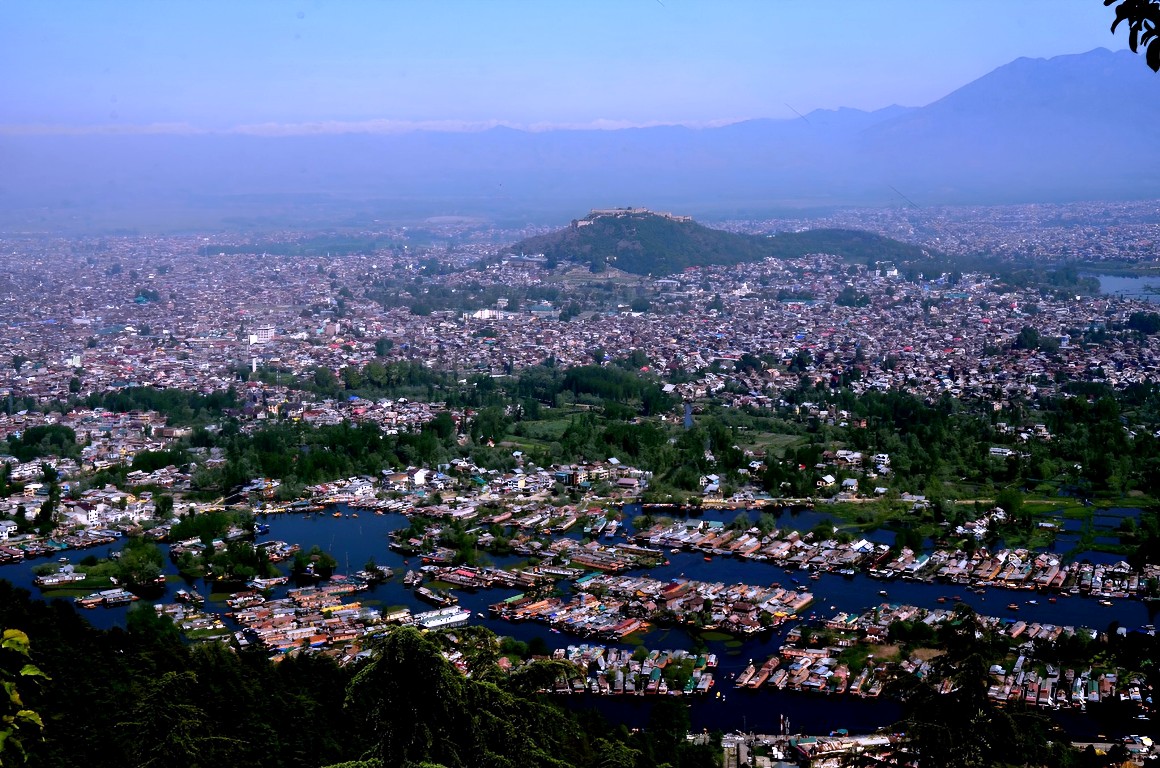
The author then discusses a conversation with a professor who corrected Sadaf’s pronunciation, emphasising that it is not Srinagar but Sirinagar, as there is no Sri sound in the Kashmiri language. It is followed by a historical exploration of the name “Srinagar,” tracing its roots to the earliest texts on Kashmir, including the Rajatarangini, stating that the city served as the most important capital and is believed to have been founded by the Buddhist King Ashoka in 250 BCE.
The Down Town
The next chapter, titled Between Shahr-e-Khas and Downtown, explores the significance of Downtown Srinagar in understanding the region’s conflict. Downtown, like the rest of Kashmir, was radically transformed by the political and socio-cultural upheavals that shook the valley beginning in 1989. Sadaf argues that Downtown is the symbolic ground zero for understanding the scale of the conflict and its impact on Kashmiri lives. It was here that key events unfolded: the first public display of arms, the proclamation of Kashmir’s resistance through the Tehreek, the establishment of separatist leadership, the collapse of state authority, the euphoric crowds awaiting Aazadi, and the confrontations that led to death at point-blank range for protestors played out in the streets of Downtown.
Sadaf, referencing “experts,” suggests that the mass euphoria that swept through Downtown Srinagar in 1989 and the years that followed was influenced by major geopolitical events: the Soviet withdrawal from Afghanistan, the fall of the Berlin Wall, and the reunification of Germany. However, this interpretation appears somewhat detached from local reality, as decades later, only a small fraction of the population is even aware of the Berlin Wall’s fall or other global milestones from that period.
Chapter three, titled (UN) Belonging in the Shahr, explores Srinagar’s infrastructural transition from its medieval past to modernity. Sadaf describes how, after a period of relative stability under the sultanate and Mughal rule, Kashmir fell into a cycle of neglect and decay under Afghan, Sikh, and early Dogra rulers. These rulers, characterised as weak-willed and self-indulgent, showed little interest in the region’s development or public welfare. Consequently, what had once been the promising medieval Shahr-i-Kashmir deteriorated, facing severe civic challenges, including neglected drainage and sanitation systems that led to frequent epidemics and famines.
Sadaf also addresses the informal division of Srinagar into Downtown and Uptown and explains how, by the 2000s, the outskirts of the city saw a significant influx of migrants from other parts of Kashmir. This migration transformed the demographic landscape, complicating the social fabric and generating fractured senses of belonging. With much of the middle and upper-middle class relocating from Downtown, poorer populations were left to bear the impact of insurgency and public protests during the 2000s. To distinguish the original residents of the city from newcomers, the cultural identity of being an Asli Shahruk became increasingly pronounced. While the Shahri identity guarded against new settlers, migrants often felt alienated and disconnected in Srinagar, even after decades of residence. Sadaf reinforces this by sharing the experiences of a few long-settled migrants in Srinagar who, despite years of residency, were still occasionally made to feel like outsiders.
The Social Life
Chapter four, Paled Hands that Love Beside the Shalimar, examines the breakdown of social life in Srinagar from 1989 onward. Sadaf, quoting historian Sameer Hamdani, notes that “during the 1990s and its aftermath, Srinagar became more inward-looking and suspicious.” Social interactions fragmented, and people created confined zones of safety stretching from their homes to their workplaces, limiting city interactions to these safe corridors. Movement within Srinagar became largely service-oriented, with people travelling only when necessary. Stepping into public spaces during the insurgency involved the constant risk of being caught in encounters, protests, crossfire, or tear gas shelling.
Sadaf describes how, over the years, the concepts of leisure and recreation have become psychologically and spatially out of reach for local populations. Srinagar has been transformed into a tourist attraction tailored for outsiders, with the city’s design and marketing increasingly shaped by the tourist gaze. While these manufactured bubbles of normalcy may offer outsiders the spectacle of a “paradise,” locals have few options to disengage from their challenging lived realities.
Sadaf reflects on the profound loss felt by those like her, born in the 1990s, who have no memories of a peaceful homeland to reminisce about. For them, the harsh realities of violence have always overshadowed daily life, becoming the primary lens through which they understand and recount their experiences of Kashmir.
Memories In Focus
Throughout the book, Sadaf employs memories and stories from multiple diverse voices to paint an intimate portrait of Srinagar. However, a significant drawback is her lack of personal experience as a witness to the events she recounts. While she navigates through the memories of others, her absence leaves a void, making the narrative feel somewhat detached. This creates a sense of walking through a landscape of memories that belong to others, rather than an authentic exploration of her lived experiences. As a result, the work risks feeling like a collection of others’ memories, lacking the depth and resonance that a personal connection could provide.