Debasmita Dasgupta’s Terminal 3 follows 17-year-old Khwab Nazir, a Kashmiri jiu-jitsu player, navigating dreams, conflict, and resilience. Through vibrant visuals, it highlights Kashmir’s beauty, strife, and underrepresented human stories, writes Muhammad Nadeem
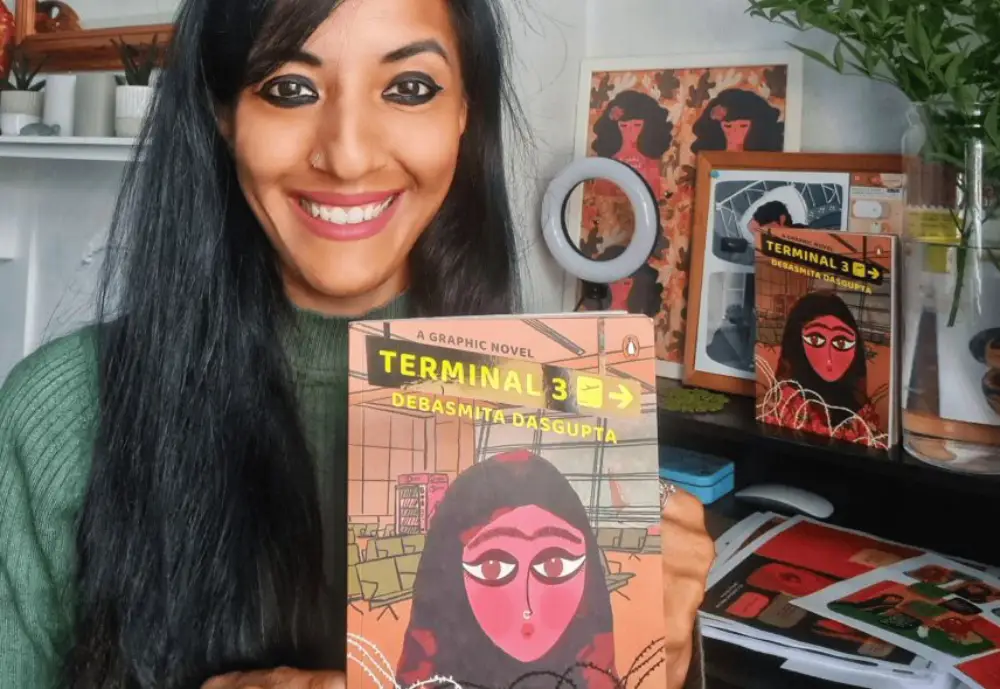
Debasmita Dasgupta’s graphic novel Terminal 3 offers a glimpse into the world of a young Kashmiri woman pursuing her dreams amidst conflict. Set primarily in 2017-2019, the book centres around Khwab Nazir, a 17-year-old jiu-jitsu player aspiring to represent India on the international stage. Through Khwab’s journey, Dasgupta explores the paradoxical nature of Kashmir, both breathtakingly beautiful yet filled with uncertainty and strife.
While not a native of Kashmir herself, Dasgupta conducted some research to understand the fabric of everyday life there. She has spoken with certain selective Kashmiris from various walks of life to grasp their experiences and perspectives. This informed the development of the characters and story.
The narrative structure interweaves past and present, seamlessly shifting between 2017, when Khwab begins her athletic journey and 2019, when she awaits her flight at Delhi’s Indira Gandhi International Airport bound for a tournament in San Francisco. This nonlinear approach layers the story, offering insight into Khwab’s background and motivation while building suspense.
A central relationship in Khwab’s life is with her best friend Noor, an independent young woman who falls in love with Yusuf Najar, an idealistic poet. Tragedy strikes when Noor loses her eyesight during a violent protest, a sobering reminder of the human toll of the conflict. Yet Noor resiliently soldiers on, symbolic of the indomitable Kashmiri spirit.
A Life In Grey
Dasgupta’s illustrations, awash in bold pops of colour contrasting with sombre grey tones, capture the contradictory essence of life in Kashmir. The dreamy, lyrical quality of the visuals aligns with Khwab’s optimistic imagination, envisioning a peaceful future despite surrounding strife. Creative layouts guide the reader’s gaze through emotive scenes. The characters’ expressive faces convey volumes, from Khwab’s irrepressible smile to her father Rafi’s kind but concerned eyes.
As a young hijab-wearing Kashmiri woman determined to pursue sports rather than marriage, Khwab rebels against ‘gender norms’ which somehow reflect less the traditional Kashmiri culture and more of her feminist ideology. Although Khwab finds encouragement from two caring male figures, her father Rafi and her coach Omar Khan, she attempts to resist ‘patriarchal limitations’. But the narrative is viewed in such a way that it represents only this family providing support to their daughter, and the majority of the Kashmiri men are oppressors.
Khwab crowd-funds her trip to compete internationally, showcasing a pragmatic approach to overcoming financial barriers. This nod to crowdfunding’s potential was inspired by the author’s professional background in social justice initiatives. The themes of agency and proactive problem-solving shine through.
The novel examines the harsh realities of life in Kashmir, from punishing curfews to communication blackouts. Dasgupta highlights the devastating impact of suddenly losing telephone and internet access during the 2019 lockdown. She also spotlights perseverance, inner strength, and human connections that endure despite overwhelming odds.
While avoiding direct political critique, Terminal 3 sheds light on how seismic policy shifts can overnight upend ordinary lives. Without vilifying any group, Dasgupta focuses on illuminating underrepresented experiences. Kashmir serves as a microcosm for broader global issues of justice and human rights.
Unlike most Indian graphic novels, Dasgupta’s distinctive visual style opts for vibrant colours and energetic illustrations over sparse minimalism. This adds vibrancy and distinction to the storytelling. The mixed media art incorporates cinematic photographic elements with lively drawings, menus, social media posts, and text excerpts. This multimedia collage of styles heightens the immersive experience.
Filling A Void
Terminal 3 fills a void as one of the relatively few graphic novels set in Kashmir. With very few works produced by native Kashmiri artists, the perspective of an outsider telling this story is somewhat problematic, as I believe non natives have never truly translated the pain Kashmiri people have endured.
The novel elevates positive narratives from the region, moving beyond reductive stereotypes. Dasgupta focuses on relatable personal stories reflecting universal human experiences, love, loss, fear, and hope.
While at times vague, the open-ended nature of the story and symbolism invites personal interpretation and discussion. The book encourages readers to seek deeper truths by questioning the dominant narratives they encounter about Kashmir.
There is a lack of multifaceted Kashmiri representations beyond Khwab’s immediate circle and the absence of a strong central driving plot. The sparse dialogue occasionally comes across as stilted.
The poetic visual language compensates for the sparse prose. And the loser narrative, centred on mood and character rather than events, allows readers to inhabit Khwab’s perspective. The emotional focus on relationships and inner turmoil rather than dense plotting or action renders the work more of an introspective fable than a traditional epic.
Game In Spotlight
Dasgupta achieves her goal of shining a spotlight on the often-overlooked achievements of Kashmiri women athletes. The book serves as an ode to their perseverance in meeting immense social and political barriers. But beyond sports, Terminal 3 fails to recognise that Kashmiris share certain dreams and struggles which are hard to find in the world.
While the narrative avoids casting explicit judgment, Khwab’s guiding spirit symbolises the hope for peace and community prevailing over division and conflict. Her ambition to excel as an athlete despite myriad obstacles mirrors Kashmir’s longing for normalcy.
Through atmospheric visual storytelling and an empathetic lens, Dasgupta’s Terminal 3 illuminates overlooked perspectives from a troubled region. Blending dreamlike creativity with sharp social commentary, this lyrical tale offers insight into the culture and the resilient human spirit of Kashmir.
A Few Storytellers
In the shadow of Chinua Achebe’s profound words, “Until the lion learns how to write, every story will glorify the hunter,” lies a truth that resonates with Kashmiris. Within the dominion of graphic novels, a medium that wields the power to convey stories with visual intensity, the voices of Kashmiri artists have been few and far between.
There are only a few graphic novels penned by Kashmiri writers. There is one by Naseer Ahmed, Kashmir Pending, but the artist who turned his words into graphics is Saurabh Singh. Kashmir Ki Kahani Graphic Novel is a collaborative effort by Newslaundry, and obviously, there is MUNNU by Malik Sajad.
Kashmir has immense artistic talent, where faces like Basita Shah, Mir Suhail, Suhail Naqshbandi, Ifra Shah, and others possess the ability to weave compelling tales through graphic storytelling; it is a bitter irony that outsiders still lay claim to our stories.
Works such as Joe Sacco’s Palestine, and Footprints in Gaza, Art Spiegelman’s MAUS, and Marjane Satrapi’s Persepolis, have demonstrated the immense impact of graphic novels in bringing to light the struggles and histories of oppressed communities.
Despite the power and potential of Kashmiri artists, the dominance of non-natives in narrating their experiences persists. This phenomenon robs the community of agency, perpetuating an unsettling narrative where the hunter’s story reigns supreme, overshadowing the lion’s perspective.
Significance of Stories
Kashmir must recognise the significance of authentic storytelling. By empowering Kashmiri artists, it can unlock the true potential of graphic novels as instruments of change and empathy. When artists are given the platform and opportunity to craft their narratives, a powerful shift occurs, one that dismantles the hegemonic representation and nurtures an inclusive space for diverse perspectives.
Telling their own stories allows people to reclaim their heritage, challenge misrepresentations, and preserve their history for generations to come. By cultivating a culture that values authenticity, they foster a richer and compassionate society that celebrates the plurality of human experiences.
In this pursuit, readers, publishers, and creators alike play pivotal roles. But unfortunately, readers are still clutched either by the propagandist literature of Khalid Husseini or futilely overwhelmed by the “bastardisation” of Sufism by Elif Shafak’s Forty Rules of Love.
Kashmir only has a couple of traditional publishers who will never take a risk to publish anything creative and original because it will not benefit them, as there is no market for creative outputs. Kashmir artists are either settling abroad or are too afraid to vent their creative outbursts.
(Author is a Srinagar-based writer whose core focus is book reading. Ideas are personal.)