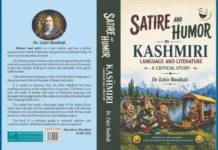
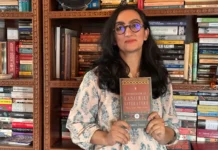
A debut novel frames Kashmir’s trauma and displacement through intimate human stories, recovering a culture’s lost melody in three chapters of winter, writes Mehreen Firdous

RJ Umair Ahmad Khan’s choice of title for his debut novel is itself an act of quiet precision. The Valley of Unfinished Songs names Kashmir not as a political geography but as an emotional one, a place where stories accumulate without resolution, voices fall silent mid-sentence, and grief outlasts the events that caused it. The valley is real. The unfinished songs are everything it has swallowed.
Khan structures the novel around a meteorological calendar that doubles as a map of the human spirit. The three chapters, Chilai Kalan, Chilai Khurd, and Chilai Bacche, borrow their names from Kashmir’s harshest winter cycle. Chilai Kalan, the great cold, carries the novel’s most extreme pain and desolation. Chilai Khurd, the lesser chill, softens the temperature without erasing the ache, as healing tentatively begins. Chilai Bacche, the baby chill, brings the winter toward its end, not warmth exactly, but the first credible hint of it.
It is an elegant structural choice, using nature’s own rhythm to carry characters from crisis through endurance toward something that resembles, if not peace, then at least the capacity to continue.
Emotion, Not Politics
Novel’s historical backdrop is the early 1990s, when Kashmiri Pandits left their Kashmir homes in one of the subcontinent’s painful episodes of mass displacement. Khan neither turns away from this history nor allows it to consume his story. The political facts are the ground beneath the characters’ feet; what the novel concerns itself with is what people carry when the ground shifts. Memory is the novel’s main subject, its persistence, weight, and the way it refuses to recede.
The characters are drawn as emotional archetypes without being reduced to them. Kabir, the elder son, is exhausted in the particular way of people who have appointed themselves responsible for everyone else’s survival. He is strong not because strength comes naturally but because he cannot afford the alternative. His wife Umika presents a complementary portrait: outwardly composed, she carries inside her an unspoken love for Kashmir and for music that she has buried under layers of practicality and care for others. Together they represent the enormous private cost of holding a family together when the world around it is breaking.
Kanval, the always-asking daughter, is the novel’s restless conscience, someone trying to locate herself in a landscape that keeps changing shape. Indravati, the mother, is shaped by past fear into a woman who finds trust nearly impossible; her present shadowed permanently by what she has already survived. Around this family, Ramzan chacha, Shamrita, Shabhir and Daarji offer the warmth of community, not solutions, but presence.
Interesting Characters
Tarannum and Sarfaraz carry the novel’s tenderness, embodying the hospitality and friendship that persists even when everything institutional has collapsed.
The most striking character may be Armaan, an 11 year old blind boy whose relationship to the world runs through sound, touch, and emotional intelligence rather than sight. His handicap, crucially, is treated not as tragedy but as a distinct way of knowing, one that, in a novel deeply preoccupied with what lies beneath surfaces, gives him an unusual clarity.
Children in fiction are often sentimentalised. Armaan is not. He is acute.
The cultural texture of the novel is dense and purposeful. Kehwa is not merely a drink here but a ceremony of gathering, warmth, and the refusal to let connection die. The pheran, Kashmir’s traditional cloak, becomes a symbol of identity and protection, something that encloses and preserves.
Dal Lake appears in its double nature, beautiful as memory but carrying underneath it depths of grief and loss. The Jhelum River runs through the narrative as a figure of continuity, always moving forward while holding within it everything Kashmir has known. Chinar trees mark the turning of seasons, the cycle of decline and return.
Poetry, Ghazal, Sufi thought, and prayer are woven throughout as emotional registers unavailable to ordinary speech. When characters cannot say what they feel, they turn to these forms, and in doing so, the novel quietly insists that Kashmir’s cultural inheritance is not background decoration but the actual medium through which its people have historically processed suffering.
The author also traces Kashmir’s connections outward, to Iran, Uzbekistan, Samarkand, as though to remind the reader that this is not a parochial story but one belonging to a wider civilisation of exchange and tradition.
Argument for Coexistence
What holds the novel together, finally, is its insistence on the coexistence of beauty and devastation. The warmth of strangers who become family, the hospitality that survives hardship, the bonds between Pandits and Muslims that the politics of displacement never entirely severed, these are not consolations imposed on a dark story. They are the story.
The novel asks its readers to sit with incompleteness, with the songs that were never resolved, the emotions that were never fully expressed, and the friendships sealed inside walls. It does not offer easy closure. It offers something more durable: the reminder that to remember, and to move forward holding that memory, is itself a form of survival.