by Iqbal Ahmad
A rare Kushan-era sculpture from Pandrethan depicts Buddha’s birth and reflects the ancient tradition of childbirth at parental homes.
Although in the Kashmir Valley there hardly exists any Buddhist population or any living Buddhist monument, and this faith is hardly practised anywhere here nowadays, in ancient times the majority of Kashmiris are believed to have followed this faith. In fact, a number of ancient remains of Buddhist sites and artefacts have, from time to time, appeared across the Valley, which speaks volumes about its ancient Buddhist heritage.
History records that Buddhism had a deep and fascinating influence in Kashmir, stretching back over two millennia. It was once one of the most important centres for Buddhist learning in the country.
It is usually believed that Buddhism entered Kashmir during the reign of Emperor Ashoka (3rd century BCE), who is said to have built the first stupas and monasteries in the region. Later, Kashmir quickly became a stronghold of Buddhist scholarship and learning.
According to the Chinese pilgrim Xuanzang (often written as Hiuen Tsang), Kashmir was a major centre of Buddhism during his visit in the 7th century CE.
In his travel record, Great Tang Records on the Western Regions, he describes Kashmir (he called it Kia-shi-mi-lo) as having around 100 Buddhist monasteries (viharas). Thousands of monks mainly followed the Mahayana Buddhist tradition. Numerous stupas, many believed to have been built by or associated with Ashoka, also existed there.
He portrays Kashmir as a flourishing intellectual and religious hub where Buddhist scholars were engaged in debate and study. At the same time, he also notes the presence of Hindu temples, showing that the region had a diverse religious landscape.
However, the relics of Buddhist heritage have not yet been fully explored and documented. The forthcoming generations are also not sufficiently aware of this rich heritage.
One significant event associated with this culture was the Fourth Buddhist Council, traditionally believed to have been held in Kashmir under the patronage of Kanishka (2nd century CE). This council helped systematise Buddhist teachings and commentaries. Where exactly this council was held in Kashmir remains an unsolved puzzle.
Indeed, archaeologists have so far discovered scores of Buddhist sites and exhumed treasures of artefacts from their archaeological layers. These magnificent artefacts have today become the pride of various museums and art galleries. In this brief paper, it is not possible to mention all the Buddhist masterpieces. However, in connection with the celebration of Buddha Purnima, it would be in the interest of readers to discuss one of the most interesting and exquisite Buddhist sculptures depicting the birth of Buddha.
This is a unique sculpture not only because of its texture, artistic qualities, and iconographical details, but also because it appears to commemorate the celebration of Buddha Purnima in ancient times.
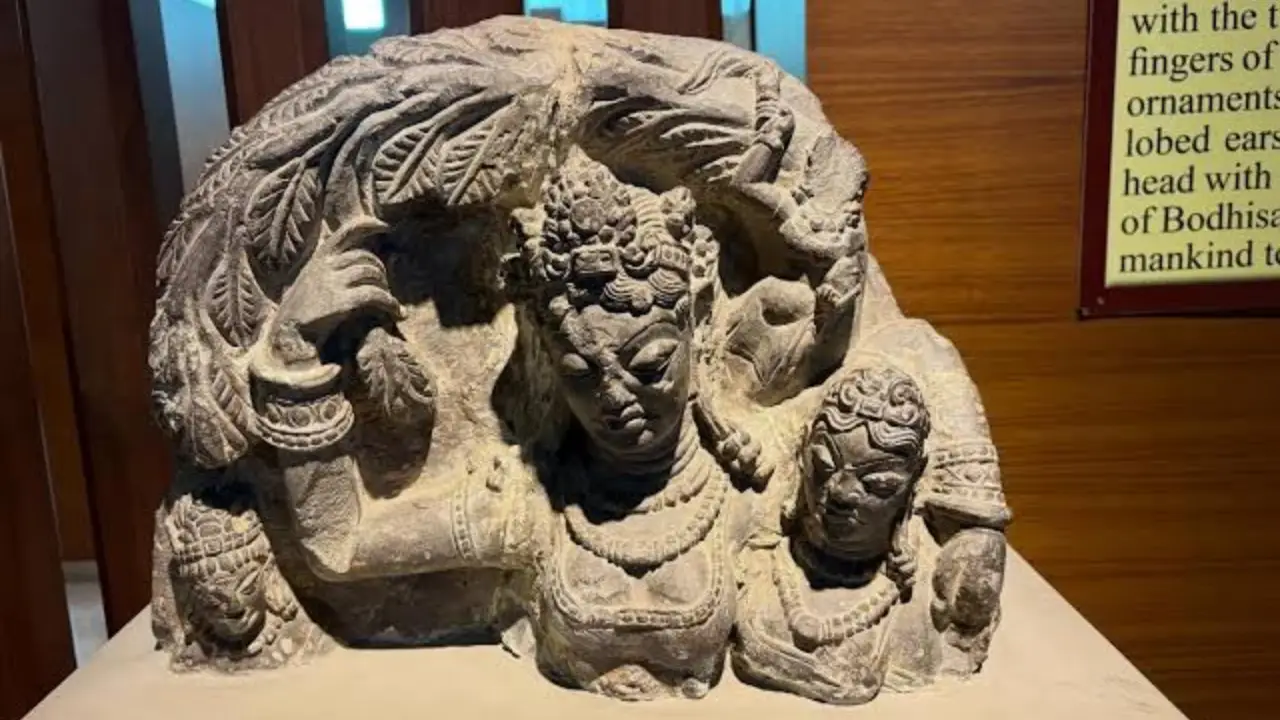
It is one of the magnificent and very rare Buddhist stone sculptures found long ago at Pandrethan (ancient Purindistana), on the outskirts of Srinagar, and is presently displayed in the archaeology gallery of Srinagar’s SPS Museum. It depicts the wonderful scene of Lord Buddha’s birth and appears to have been commissioned during the Kushan era, perhaps to commemorate the event.
It is a medium-sized stone sculpture of Queen Maya and is believed to have been commissioned during the Kushan era (100–400 CE), when the progressive Buddhist doctrine known as Mahayana Buddhism was flourishing here. Symbolising the grace of Gandharan Buddhist art, the elegant high-relief sculpture depicts several figures, the principal one being a crowned queen identified as Queen Maya, the mother of Lord Buddha.
She is shown wearing a long pair of ornaments connected to the crown. She also wears two necklaces, one loose and the other tight, formed of beads. She is shown wearing a set of jewel-studded bangles.
The sculptor, besides other human motifs, also depicts the curved branch of a tree under which the queen appears to be resting. The sculpture portrays the birth scene of Siddhartha, who later came to be known as Lord Buddha. It also reflects the centuries-old cultural practice of women giving birth at their parental homes.
As per Buddhist traditions, Buddha was born into a royal family at Lumbini around 563 BC. This ancient janapada was then associated with Kosala and today falls partly within Nepal. His early life and works are extensively recorded in classical Buddhist literature and chronicles.
Tradition states that when Queen Maya was expecting her child, her parents sent Prajapati, her younger sister, to bring her back to her parental home. While travelling back, Queen Maya suddenly felt labour pains. Since she was accompanied by her younger sister, who was a courageous woman, she received support and was taken to a nearby garden called Lumbini Garden. They stood under the shade of a tree, later associated with Ashoka. It was in this garden, under the shade of this tree, that Buddha was born.
Thus, she could not deliver her child in her parental home. However, she was later taken there and cared for by her family. Buddha’s birthday appears to have been commemorated in Kashmir as well, and this remarkable sculpture may have been commissioned to mark the occasion.
In its iconographical details, the upper part of the relief depicts Queen Maya in the centre, her sister Prajapati to her left, a small figure of another deity to her right, and a partially defaced goddess figure in the upper left shown waving a fly-whisk.
Maya is shown placing her left hand on the shoulder of her sister, while with her right hand she holds the branch of the tree beneath which she stands. She is depicted receiving support from both her sister and the tree branch at the moment Prince Siddhartha was born and later became known as Buddha.
The sculpture not only depicts the birth scene but also symbolises the ancient Eastern culture of childbirth at the parental home.
Although the centuries-old practice of a pregnant woman going to her parents’ home for childbirth is not followed as strictly today, there was a time when it was almost mandatory, particularly in Eastern cultures, for a woman in the seventh or eighth month of pregnancy to move to her parental home.
This appears to have been a social and cultural practice followed across Eastern societies without religious distinction. It was practised among Buddhists, Hindus, Christians, Muslims, and Sikhs alike.
There may have been several reasons for the evolution of this tradition, but the most important was perhaps to provide physical and emotional support to pregnant women. A woman would feel more relaxed in her parental home, where she could expect affection, care, and assistance.
Such an atmosphere was often difficult to find in her in-laws’ household.
In fact, in older conservative societies, the hardships faced by daughters-in-law were well understood. This practice may therefore also be linked to cultural beliefs about postpartum care and the supportive role of extended families.
Even in the modern scientific age, pregnancy and childbirth remain critical periods in a woman’s life. One can therefore imagine the challenges faced by women in ancient times when modern medical facilities were unavailable.
Providing parental care was often the only means of offering physical and emotional support. This support proved invaluable during such critical periods.
It is due to these social and cultural considerations that the tradition has not entirely disappeared. Today, very few women deliver children at home, and most births take place in hospitals, nursing homes, or maternity centres. However, pre- and post-delivery care is still frequently provided by a woman’s parents rather than her in-laws.
Traditionally, when a woman entered the seventh or eighth month of pregnancy, her parents would send a relative, often a sister or aunt, to bring her back home. Her in-laws would bid her farewell and pray for a safe delivery.
Generally speaking, this was one of the most widespread customs of ancient societies, observed not only among common people but also among royal families. While tracing its origins, scholars often regard it as a deeply rooted tradition in ancient Indian and Chinese cultures, frequently mentioned in historical records.

In Kashmir, this cultural practice continues in modified form. Although women now generally give birth in maternity hospitals, owing to advances in medical science and healthcare facilities, the tradition of returning to the parental home during pregnancy remains very much alive.
It has been a popular tradition in Kashmir since ancient times, and the sculpture discussed above stands as testimony to this enduring cultural practice.
(The writer is a senior archaeologist and author. Ideas are personal.)