by Sadaket Ali Malik
Recent floods have renewed questions over whether climate change, unsustainable riverbed mining and weak environmental governance are increasing Kashmir’s vulnerability.
Every monsoon, Kashmir’s rivers remind us that they are far more powerful than the bridges spanning them or the roads built along their banks. This year proved no exception. Intense rainfall and cloudbursts triggered flash floods that damaged roads, inundated habitations and disrupted normal life across several parts of Jammu and Kashmir. While the immediate cause was extreme weather, the destruction has revived a more difficult and uncomfortable question: are human activities making the Valley’s rivers more vulnerable and, in turn, worsening the impact of floods?
The answer is neither straightforward nor convenient.
Scientists broadly agree that climate change is altering rainfall patterns across the Himalayan region. The mountains are warming more rapidly than many other parts of the world, and short-duration, high-intensity rainfall events are becoming increasingly common. Such weather is capable of overwhelming even healthy river systems. Yet climate change alone cannot explain why some rivers recover more quickly while others leave behind widespread damage. The condition of the river itself plays a critical role in determining how it responds to extreme weather.
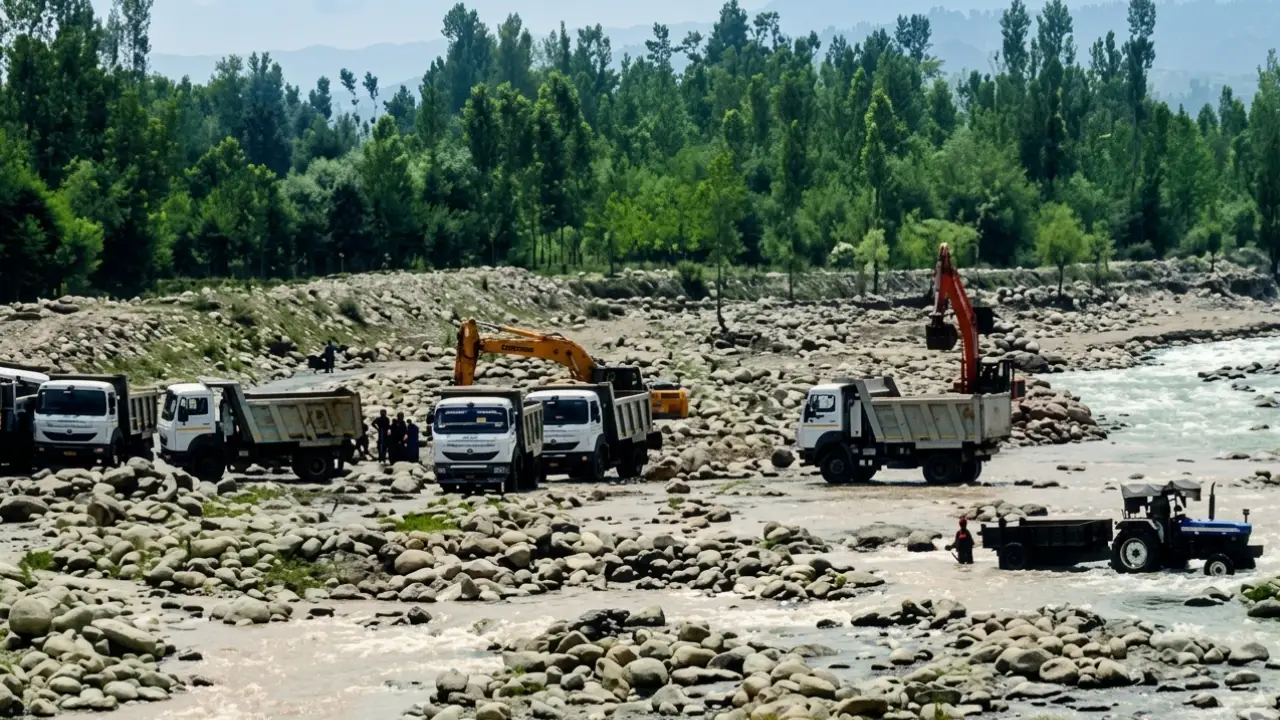
A river is not merely a channel carrying water from one place to another. It is a living ecological system whose natural features help regulate the movement of water. Boulders slow the force of floodwaters, gravel beds absorb and filter water while helping recharge underground aquifers, and sand deposits support the natural movement of streams as well as providing habitats for aquatic life. When these natural components are removed faster than they can regenerate, the river gradually loses its ecological balance and its ability to withstand environmental stress.
This is why riverbed mining has emerged as one of Kashmir’s most debated environmental concerns.
It is important to recognise that mining of riverbed material is not unlawful in itself. Modern infrastructure, including roads, schools, hospitals and homes, depends upon sand, gravel and boulders extracted from rivers. The law permits such mining, provided it is undertaken within scientifically determined limits and under strict environmental safeguards, including replenishment studies and effective monitoring. Problems arise when extraction exceeds sustainable levels or when environmental conditions are ignored.
The Sukhnag River in Budgam district has become perhaps the most prominent example of this challenge.
Growing concerns over mining activity in the river eventually reached the National Green Tribunal through Original Application No. 1211 of 2024, filed by environmental activist Dr Raja Muzaffar Bhat. The proceedings evolved into one of the most significant environmental examinations undertaken in Jammu and Kashmir in recent years. Rather than remaining confined to allegations and counter-allegations, the issue was subjected to scientific investigation and institutional scrutiny.
Joint inspection teams comprising the Jammu and Kashmir Pollution Control Committee, the Department of Geology and Mining and other government agencies surveyed the affected stretches of the river. Their findings raised serious environmental concerns.
Reports submitted before the Tribunal estimated that between 10.62 lakh and 15.3 lakh metric tonnes of riverbed material had been extracted from sections of the Sukhnag between 2020 and December 2024. This quantity was assessed to be equivalent to nearly one lakh dumper loads. Inspections also recorded excavation reaching depths of up to 5.22 metres below the riverbed in certain locations. The teams highlighted concerns relating to groundwater recharge, river stability and the health of aquatic habitats.
The expert committees recommended restoration of damaged stretches, scientific replenishment studies and stronger regulatory oversight. They also emphasised that mining operations must comply with environmental safeguards and national guidelines governing sustainable sand mining. These recommendations underscore the importance of managing rivers not simply as sources of construction material but as ecosystems that require protection and careful stewardship.

The significance of the Sukhnag proceedings extends beyond the river itself. The case demonstrates how environmental governance is intended to function. Public concern prompted scientific investigation. Scientific findings were subjected to judicial oversight. Government agencies were required to account for their actions, while ecological restoration became an integral part of the discussion. It illustrates a process in which environmental questions are addressed through evidence rather than assumption.
Dr Raja Muzaffar Bhat deserves recognition for bringing the matter before the Tribunal. Regardless of whether one agrees with every argument advanced during the litigation, the proceedings have ensured that the condition of Kashmir’s rivers is now part of public discourse instead of remaining buried in official records. That alone represents a significant contribution to environmental accountability.
At the same time, caution is necessary when interpreting the relationship between riverbed mining and floods. It would be scientifically inaccurate to conclude that mining alone causes flash floods. Flood disasters result from the interaction of multiple factors, including extreme rainfall, cloudbursts, deforestation, shrinking wetlands, construction on floodplains and changing patterns of land use. Riverbed mining is only one part of this wider picture. However, where extraction becomes excessive or unscientific, it can weaken a river’s natural resilience and reduce its capacity to cope with extreme weather.

The broader lesson emerging from recent events is unmistakable. Rivers cannot be viewed solely through the prism of economic extraction. They are essential ecological infrastructure whose health directly influences agriculture, drinking water supplies, fisheries, biodiversity and resilience against natural disasters. Once these systems are degraded, restoration is neither quick nor simple.
As Kashmir rebuilds after successive floods, attention should not be confined to repairing roads, bridges and public infrastructure. Equal priority must be given to restoring damaged rivers, protecting floodplains, conserving wetlands and ensuring rigorous enforcement of environmental laws. Development and environmental protection are often portrayed as competing objectives, but in the fragile Himalayan landscape they are fundamentally interdependent.
A river communicates through its flow, its ecology and its capacity to sustain life. When that natural balance is disturbed, its warning rarely comes in words. It arrives in the form of floodwaters. Whether Kashmir chooses to heed that warning may shape its preparedness for the monsoons yet to come.
(The writer is the author of the book Cultural History of The Valley of Chenab. Ideas are personal.)