by Iftikhar Hakim
The government promises decongestion, resilient cities and GIS-based Master Plans, but building-rule amendments and Ease of Doing Business provisions raise concerns over planning safeguards, environmental protection and disaster resilience.

Jammu and Kashmir’s cities and towns face mounting pressures from unplanned growth, traffic congestion, inadequate infrastructure, environmental degradation and increasing exposure to natural hazards. Srinagar illustrates these problems particularly starkly: congested roads, deficient parking, encroachment on public spaces, inadequate drainage and sewerage, weak waste management, and the loss of wetlands and open spaces are placing growing pressure on the city’s ecological systems and quality of life.
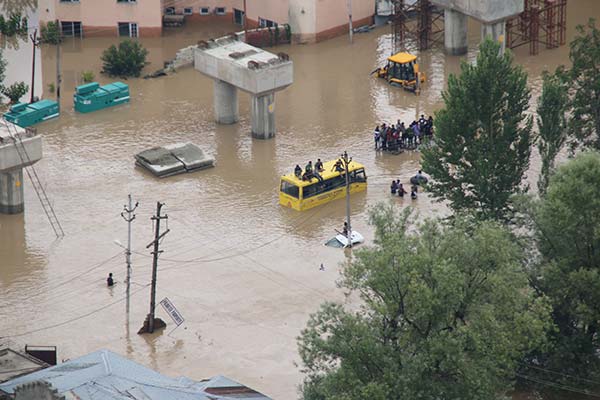
These are not ordinary urban challenges. Srinagar lies in a flood-prone valley, depends on an interconnected system of lakes, wetlands and watercourses, and faces significant seismic risk. Development decisions therefore have consequences beyond individual plots. More built-up area means greater demand for roads, water, sewerage and parking; less permeable ground can increase runoff; and inadequate access can compromise emergency response. Other cities and towns across Jammu and Kashmir face related pressures, though their local conditions differ.
The Government has acknowledged the need for decongestion, planned growth, environmental protection, GIS-based Master Plans and resilient infrastructure. Yet recent regulatory and legislative decisions raise a fundamental question: do actions on the ground reinforce these policy objectives, or are they creating a contradictory trajectory?
Decongestion: beyond roads and flyovers
On August 19, 2026, Chief Minister Omar Abdullah reviewed infrastructure and civic projects across Srinagar’s eight Assembly constituencies, emphasising decongestion, parking shortages, particularly in Shehar-e-Khaas, and the timely completion of bridges, flyovers and underpasses. The concerns are real, but congestion is not simply a road-engineering problem. It also reflects the distribution of land uses, development intensity, public transport, parking policy and travel demand.
Bridges and flyovers may relieve specific bottlenecks, but cannot by themselves resolve structural congestion. Without integrated public transport, pedestrian facilities, parking management and coordinated land-use decisions, additional road capacity may simply redistribute congestion or encourage more vehicle trips. The objective must be to improve access and mobility, not merely to move vehicles faster.
An Urban Commission: useful only if it changes decisions
On 22 September 2026, MLA Tanvir Sadiq submitted proposals to the Chief Minister calling for a dedicated Urban Commission, drawing on Kerala’s experience. The proposals included river-based mobility, electric transport, integrated drainage and lake management, and boardwalks around Khushal Sar and Gil Sar to conserve fragile ecosystems while improving public access.
A commission could help develop a coherent urban policy linking spatial planning, mobility, infrastructure, environmental management and disaster resilience. But a new institution will matter only if its mandate, authority and relationship with existing agencies are clear. Jammu and Kashmir already has statutory planning instruments and multiple development institutions; the persistent problem is that their decisions do not always operate within a common framework. Institutional reform should improve coordination and accountability, not add another advisory layer whose recommendations remain disconnected from budgets, regulations and implementation.
Master Plans: the gap between commitment and delivery
The Government has set a target of finalising GIS-based Master Plans for 25 cities and towns during the current financial year. Master Plans are essential: they provide the statutory framework for land use, infrastructure, housing, mobility, environmental protection and future expansion. Yet a report dated 17 October 2026 indicated that only the Anantnag–Bijbehara–Mattan plan had reached the draft stage, while Bandipora’s preliminary draft was under scrutiny and several other plans remained at earlier stages. Srinagar, Jammu, Udhampur and Katra already have notified Master Plans, but progress elsewhere remains uneven.
The gap between announcing a deadline and having the technical, institutional and administrative capacity to meet it is consequential. A Master Plan is not merely a map. It requires reliable spatial data, population and economic projections, infrastructure-capacity assessments, environmental and hazard analysis, public consultation and an implementable programme. Equally, notification is only the beginning: permissions, public investment and development decisions must then conform to the plan. It is inconsistent to announce an ambitious Master Plan programme while introducing mechanisms that may allow development to depart from statutory plans without equivalent scrutiny.
UBBL amendments: cumulative effects matter
The successive interventions in the Unified Building Bye-Laws (UBBL), 2021—S.O. 304 dated December 1, 2025, S.O. 58 dated 26 February 2026, and Draft Amendment 3 dated 9 September 2026—raise questions about the cumulative impact of changing development controls without a clearly demonstrated, evidence-based assessment.
Draft Amendment 3, for example, proposes removing the 10 per cent aggregate setback for residential plots of 125–275 square metres while retaining Floor Area Ratio (FAR) 220. It also proposes reducing the road-width threshold for stilt parking from six metres to three metres, leaves access requirements unspecified for certain small plots, and permits extensive mixed use along roads of six metres or more. Each change may appear limited in isolation, but together they could alter ground coverage, building separation, ventilation, emergency access and the amount of permeable surface.
FAR alone is not an adequate measure of development intensity. Ground coverage, setbacks, height, access and open space collectively determine the built form and its effects on the neighbourhood. Relaxing these controls without assessment may increase runoff, traffic, parking demand, water consumption and sewage generation, while reducing space for drainage, emergency access and greenery. In Srinagar, these are not technical details; they directly concern public safety and resilience. Substantial amendments should follow a defined problem statement, technical justification and assessment of the previous changes—not a succession of regulatory adjustments whose combined consequences remain untested.

EoDB: facilitation must not displace planning
The Ease of Doing Business (EoDB) Act, 2026, raises a broader question about the continuing authority of statutory planning. Facilitating investment, reducing unnecessary permissions and eliminating arbitrary delays are legitimate objectives. But procedural simplification must be distinguished from the dilution of substantive development controls.
Section 22, particularly subsections (1), (2) and (3), raises questions about executive relaxation of Master Plan conditions, deemed changes of land use and enterprise approvals notwithstanding existing planning and building regulations. Read with the relevant Schedules, these provisions may create a parallel route to development approvals with parameters different from those applied through ordinary municipal procedures. The possibility of one regulatory trajectory for citizens and another for enterprises warrants scrutiny. Any claimed difference in permissible FAR or development intensity must be verified against the operative provisions and justified through transparent planning and infrastructure assessments.
The consequences extend beyond equal treatment of applicants. Greater development intensity creates additional demand for roads, drainage, parking, water supply, sewerage and emergency services. An exhaustive Negative List cannot substitute for spatial planning: an activity may not be prohibited, yet still be unsuitable at a particular location because infrastructure is inadequate or the site is environmentally sensitive or hazard-prone.
Other concerns include the proposed moratorium on inspections, the effectiveness of enforcement against unauthorised construction, minimum infrastructure standards for schools and colleges, professional accountability, and the design of the EoDB Council and Executive Committee. If the new institutional structure adds bureaucratic layers, it may defeat the Act’s stated purpose. The essential question is whether the Act makes compliance simpler while preserving planning safeguards, or creates uncertainty about whether those safeguards continue to apply.
Risk-informed planning: the missing link
Urban development in Jammu and Kashmir must systematically account for floods, earthquakes, landslides and climate-related hazards. Risk depends on the interaction of hazards with exposed people and infrastructure and the vulnerability of the built environment. It cannot be managed through building-level checks alone.
Development intensity, access, building separation, open spaces, drainage and infrastructure capacity all influence risk. Intensifying construction in flood-prone areas without improving drainage can increase losses during extreme rainfall. In seismically vulnerable settlements, inadequate separation and emergency access can complicate evacuation and rescue. A resilient city is not simply one that rebuilds after a disaster; it anticipates risk and incorporates it into land-use decisions, infrastructure investment and development regulation. This requires a shift from reactive projects to risk-informed spatial planning.
From contradictory actions to coherent governance
The contradiction is clear. The Government speaks of decongesting Srinagar, preparing GIS-based Master Plans, protecting wetlands, improving mobility and creating resilient cities. At the same time, successive building-regulation amendments and provisions of the EoDB framework raise concerns about increased development intensity, discretionary relaxations and possible departures from statutory planning controls.
These measures may have different immediate objectives, but their cumulative effects must be considered together. Urban policy cannot function coherently if one agency prepares Master Plans, another relaxes development controls, and another invests in infrastructure to manage the resulting pressures.
Before further substantial relaxations are finalised, the Government should undertake a Regulatory Impact Assessment of the successive UBBL amendments and examine the EoDB provisions against statutory planning, infrastructure capacity, environmental safeguards and disaster resilience. GIS analysis, three-dimensional modelling and neighbourhood-level assessments should test impacts on FAR, ground coverage, access, parking, traffic, drainage, water and sewerage. Any exceptional relaxation should rest on objective criteria, recorded reasons, technical scrutiny and transparent accountability. Changes to statutory plans must follow the prescribed legal procedures.
Jammu and Kashmir does not lack policy declarations; it needs coherence between policy, legislation, institutional responsibility and action on the ground. The objective is not to prevent development, but to ensure that it occurs in appropriate locations, within sustainable limits and with infrastructure capable of supporting it. Investment and environmental protection are not opposing goals, nor are efficient approvals and statutory planning incompatible.
The measure of urban reform cannot be the number of projects announced, Master Plans commissioned or permissions expedited. It must be whether decisions collectively produce safer, more functional, environmentally secure and resilient cities and towns. Until policy statements and regulatory actions reinforce rather than contradict one another, Jammu and Kashmir’s urban future will remain caught between ambitious promises and uncertain outcomes.
(Iftikhar Hakim is an Urban Planner and Disaster Risk Management Specialist and former Chief Town Planner, Jammu and Kashmir. Views are personal.)