by Dr Hakim Mudasir Maqsood
Kashmir has the natural resources and institutional foundation to expand trout farming. But profitability, affordable access, processing, cold-chain infrastructure and reliable markets will determine whether it becomes a regional food system.
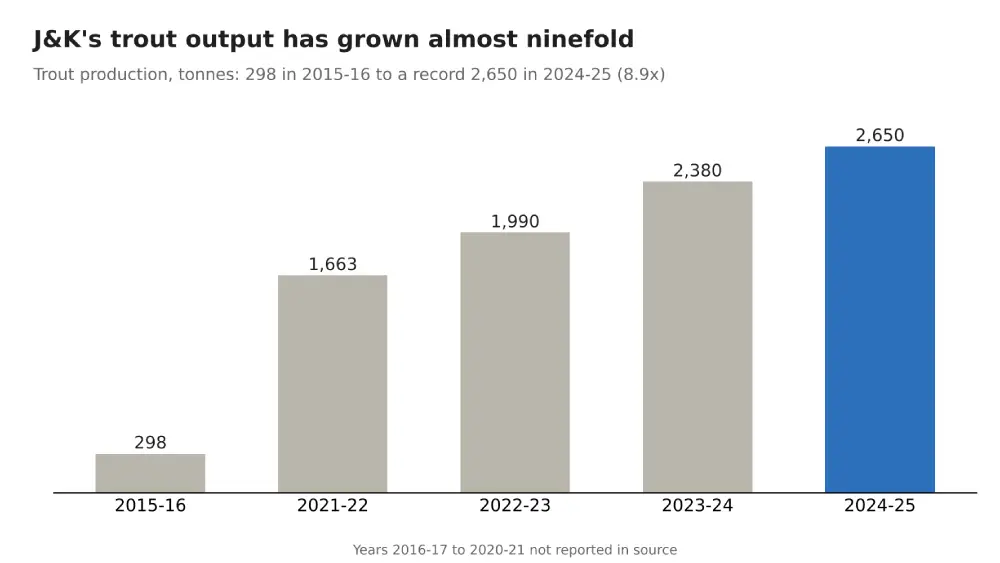
Kashmir has a natural advantage that many aquaculture-producing regions would struggle to replicate: cold-water ecosystems, a long tradition of trout farming, established hatchery infrastructure and a growing identity as a destination for high-quality fish. Yet an important question remains: can Himalayan trout evolve from a premium product associated with restaurants and tourism into a commercially viable component of the region’s wider food system?
The answer depends on how success is defined. If it means producing more fish, expanding raceways and establishing additional farms, Kashmir has already made significant progress. But if success means generating reliable income for farmers, delivering safe and accessible protein to consumers, creating processing and logistics jobs, and reducing avoidable losses across the supply chain, the challenge becomes considerably more complex. The future of Himalayan trout will not be determined by production capacity alone. It will depend on how effectively production connects with people, markets, infrastructure and nutrition.
Productive Capacity
Rainbow trout (Oncorhynchus mykiss) is particularly suited to appropriately managed cold-water environments. Its biological requirements make parts of the Himalayan region suitable for commercial farming, provided temperature, dissolved oxygen, water quality, stocking density, feed management and disease risks remain within appropriate limits. Unlike many warm-water aquaculture species, trout farming requires specialised infrastructure and continuous operational discipline. The availability of water alone does not guarantee productive capacity. Its quality, consistency and seasonal reliability are equally important.
Kashmir has developed a foundation for the sector through government hatcheries, private farms, technical institutions and emerging commercial aquaculture operations. The Holistic Agriculture Development Programme (HADP) has also identified fisheries development, entrepreneurship, production expansion and market-chain creation as important objectives. The opportunity is significant, but progress should not be measured simply by the number of farms established or the volume of fingerlings distributed. More meaningful indicators include survival rates, harvestable biomass, feed conversion, production cost per kilogram, sale price, farmer margins and the consistency of market demand.
A farm that produces efficiently but cannot sell its harvest at a sustainable price is not a successful enterprise. Equally, a farm that commands a high sale price but experiences recurring disease outbreaks, poor survival or expensive inputs may struggle to remain commercially viable. Kashmir therefore needs to move from measuring aquaculture development predominantly through infrastructure and output to assessing productivity, profitability and market performance.
Food Security
The question of food security raises another important consideration: who can afford trout? Fish contributes high-quality protein and provides important micronutrients and fatty acids. Fisheries and aquaculture can consequently support food and nutrition security alongside employment and income generation. The Food and Agriculture Organization (FAO) has long recognised these multiple contributions of fisheries to livelihoods and food security. However, the nutritional value of a product does not automatically make it accessible to the people who need it.
Himalayan trout is frequently positioned as a premium fish. Its association with tourism, hospitality and specialised retail markets can support attractive prices. However, premium positioning can also restrict its reach among ordinary households when its price competes with other animal-protein options. This raises a strategic question: must trout remain a premium product, or can Kashmir develop a differentiated market that serves both premium consumers and price-conscious households?
The answer need not be an either-or choice. Whole, fresh trout can continue to serve restaurants, hotels and specialised retail outlets. At the same time, smaller graded fish, portion-controlled packs, frozen products and carefully developed value-added formats could help reach additional consumer segments. Suitable lower-cost freshwater fish can complement trout in the broader regional nutrition strategy rather than requiring one species to serve every market.
There is also an important distinction between food availability and food security. Producing more trout does not necessarily improve local nutrition if most of the additional supply moves into distant, high-value markets while affordability and local distribution remain unresolved. A genuinely nutrition-sensitive trout sector must therefore examine not only how much fish is produced, but also where it is sold, who consumes it, what consumers pay and how much product is lost before reaching the plate.
Farmer Economics
For trout farmers, commercial viability ultimately depends on the relationship between biological performance and financial outcomes. Feed, fingerlings, labour, water infrastructure, electricity where applicable, maintenance, mortality, financing and transportation all contribute to production costs. Their relative importance varies according to farm design, scale, management and local operating conditions.
Research examining the economic viability of fish culture in Kashmir has identified feed and fingerling expenditure as important factors influencing trout production outcomes. It has also highlighted technological gaps and the value of farmer participation in extension activities. This points to a critical opportunity: improving the productivity of existing farms before assuming that expansion alone will deliver better livelihoods.
Consider two farms producing the same quantity of marketable trout. The farm with better survival, more efficient feed utilisation, fewer grading and handling losses, and stronger market access may generate a substantially better return without increasing its production volume. The sector should therefore prioritise practical farm-level benchmarking. Farmers need understandable information about feed conversion ratios and feed costs per kilogram of fish produced, survival and growth rates, the time required to reach market size, disease incidence, mortality and preventive costs. They also need to understand energy, water-management and labour expenses, harvest losses, transport mortality, final sale prices, net margins per production cycle and returns on invested capital.
Reliable seed, appropriate feed, technical extension and access to working capital remain essential. So does collective bargaining. Small farmers who purchase inputs individually and sell their harvests through fragmented channels may have limited influence over both input and farm-gate prices. Farmer producer organisations, cooperatives and cluster-based marketing arrangements could improve aggregation, standardise grading, coordinate harvesting and strengthen negotiations with buyers. The objective should not be to maximise the number of trout farmers, but to increase the number who can remain profitable across successive production cycles.
Processing Potential
One of the biggest constraints in fresh fish marketing is the narrow window between harvest and consumption. Trout quality can deteriorate rapidly when harvesting, bleeding where appropriate, chilling, handling, packaging and transportation are poorly managed. This is where processing becomes more than a downstream business activity. It becomes an instrument of market development.
A functioning processing ecosystem could offer chilled whole fish, gutted and cleaned trout, portioned fillets, frozen portions, smoked products and other appropriately validated value-added products. Each format would serve different customers and require its own product specifications, packaging, shelf-life validation and food-safety controls.
The commercial logic is straightforward. A hotel may prefer standardised portions, while a household may value convenient, ready-to-cook packs. An institutional buyer may prioritise consistent sizes, documented traceability and predictable deliveries. A distant market may require frozen products because maintaining a reliable chilled distribution chain is not always practical. These are distinct customer requirements and should not be treated as interchangeable sales channels.
Processing can also improve the utilisation of harvested biomass. Appropriate edible portions and suitable secondary streams may create additional value, subject to food-safety requirements, consumer acceptance and viable economics. However, processing should not be introduced merely because equipment is available. It must be supported by credible demand, realistic throughput, cold-storage capacity and disciplined cost accounting.
The industry should first identify its target customers, their specifications and purchasing volumes, and then design processing capacity around those requirements. An underutilised processing plant is an expensive asset. A plant linked to dependable procurement, market commitments and efficient logistics, on the other hand, can become a strategic advantage.
Market Access
Trout quality is not determined at harvest alone. It is the outcome of the entire journey from farm to consumer. A healthy fish can lose commercial value through inappropriate fasting and harvest planning, rough handling, delayed chilling, temperature abuse, inadequate packaging or poorly managed transportation. Similarly, a high-quality processed product can be rejected if its appearance, texture, colour or consistency fails to meet buyer expectations.
For Kashmir, these risks become particularly relevant when fish moves from farms to Srinagar, Jammu and markets outside the Union Territory. A commercially mature supply chain requires coordinated planning across production, harvesting, processing, transportation and retail. It also needs clear responsibilities and records at every stage.
Harvest planning must align available biomass, fish size and harvesting schedules with confirmed orders. Standardised grading should define size ranges and product specifications for each customer segment. Temperature control should involve documenting product temperatures at dispatch, during transit and upon receipt, with corrective action whenever deviations occur. Traceability requires batch identification linking the farm, harvest date, processing lot and customer. Transport performance should be assessed through transit time, rejected quantities, mortality where live transport is used, and product-quality complaints. Customer feedback must also be examined to distinguish recurring farm-level defects from failures in processing, handling and distribution.
Food safety must remain central to this system. Good hygiene practices, sanitation, hazard analysis and critical control point principles where applicable, documented temperature management and compliance with relevant Food Safety and Standards Authority of India (FSSAI) requirements are essential to building buyer confidence.
Live trout requires specific attention to oxygen availability, water temperature, stocking density and transportation duration. For slaughtered and processed trout, hygienic handling and an effective chilled or frozen chain become the priority. The principle remains the same in both cases: quality must be preserved throughout the supply chain, not inspected into the product at the final stage.

Regional Markets
Kashmir does not need to choose between supplying local consumers and accessing external markets. A more resilient strategy would develop several complementary marketing channels. The first is the local fresh-fish market, where dependable availability, transparent pricing and appropriate portion sizes can encourage repeat purchases. The second is the hospitality and tourism sector, which can support premium whole-fish and portioned products. However, the industry should not rely exclusively on seasonal tourist demand.
The third opportunity lies in regional urban markets, including Jammu and other cities where organised retail, restaurants and institutional buyers may offer recurring demand. The fourth is the wider domestic market, where chilled or frozen products can reach buyers looking for consistent specifications and dependable supplies.
These channels require different levels of processing, packaging, distribution and customer service. They should therefore be developed through market research and pilot programmes rather than a single, undifferentiated expansion strategy. The government’s HADP framework already recognises the importance of developing marketing chains and transforming the trout sector into an industry. The next step is to translate that policy ambition into operational systems connecting farmers, aggregators, processors, transporters, retailers and consumers.
Digital market platforms could improve the visibility of available harvests, indicative prices and buyer requirements. Cluster-level collection and chilling facilities could reduce fragmented logistics, while contracts with institutional buyers could help farmers plan production and harvesting schedules. Shared processing infrastructure could also reduce the investment burden on smaller enterprises. Such interventions are most effective when designed around actual market demand, supported by transparent service charges, clear ownership and measurable commercial outcomes.
Environmental Sustainability
Sustainability is another consideration that cannot be separated from the sector’s commercial future. The Himalayan environment is an asset, but it should not be treated as an unlimited production resource. Trout farming depends on suitable water temperatures, adequate oxygen, reliable flows and good water quality. Changes in seasonal water availability, warmer conditions, sediment loads, pollution and extreme weather can affect production performance.
Intensive systems also create operational risks associated with oxygen demand, waste accumulation, biofilter performance where recirculating systems are used, and disease transmission. Expansion must therefore be matched with site-specific assessments of water availability, environmental carrying capacity, infrastructure reliability and climate-related risks.
Recirculating aquaculture systems may enable greater control over water use and production conditions in suitable applications. However, they require capital, energy, technical competence, monitoring and contingency planning. They should not be presented as universally superior to well-designed flow-through farms. The appropriate technology depends on local conditions and the business model.
Sustainable intensification means producing more saleable fish from responsibly managed resources while reducing avoidable losses and maintaining animal health and welfare. This requires biosecurity, appropriate stocking densities, good nutrition, effective water-quality management, responsible veterinary oversight and reliable mortality investigations. The strongest commercial argument for sustainability is also the simplest: healthier fish, efficient resource use and fewer losses improve the resilience of an enterprise.
Practical Roadmap
For the next phase, Kashmir’s trout sector would benefit from a phased approach that places market development alongside production improvement. The first priority should be establishing a reliable baseline covering production, the number of farms, survival rates, production costs, sale prices, local consumption, processing capacity and market destinations. Official production statistics should also be reconciled across reporting systems before they are used to set targets.
The second priority should be strengthening farm economics through practical extension services, farm benchmarking, biosecurity training, feed-management support and disease surveillance. Success should be measured through improvements in productivity and profitability rather than infrastructure creation alone.
The third phase should focus on building demand-led value chains. Standardised fresh, chilled and frozen products could be piloted with selected buyers, with product quality, shelf life, packaging and transportation performance validated before production volumes are expanded. The fourth priority should be organising farmers and logistics through collection points, shared cold-chain infrastructure and aggregation mechanisms in suitable production clusters. Transparent pricing arrangements and repeat procurement contracts would help provide greater certainty to farmers.
The final phase should measure the sector’s contribution to food security. This requires tracking not only total production and revenue, but also local retail availability, consumer prices, product losses, farmer margins, employment and access to fish among different consumer groups.
Implementing this roadmap will require collaboration among the Department of Fisheries, research institutions, farmer organisations, private aquaculture enterprises, processors, logistics providers and food-safety authorities. No single stakeholder can build a regional food system independently. Each controls a different part of the value chain, and the performance of one depends on the others.
Regional Transformation
Himalayan trout has the potential to become far more than a specialised product for restaurants, hotels and affluent consumers. It can support rural enterprises, skilled employment, regional food processing, organised distribution and access to nutritious food. But this transition will not happen simply by increasing production targets or subsidising more farms.

It requires a change in development priorities: from infrastructure to utilisation, from biomass to saleable output, from farm-gate production to end-to-end quality, and from market access in theory to dependable demand in practice.
It also requires recognising that commercial success and food security are related but distinct objectives. Premium markets can generate income and investment, while wider access requires deliberate attention to affordability, product formats, distribution and consumer demand.
Kashmir should preserve the premium identity of its trout while building the infrastructure, institutions and commercial relationships needed to serve a wider market. The real measure of success will not be how much trout Kashmir can produce, but how reliably it can turn that production into profitable livelihoods, safe food, reduced waste and lasting regional value.
That is how Himalayan trout can move beyond a premium niche product and become a meaningful component of Kashmir’s food-security and rural-development strategy.
(The author is Lead Scientist (Quality and Disease Control) at Khyber Aquaculture. Ideas are personal.)