Knowledge expands capabilities, but wisdom must guide choice ethically. True progress requires aligning intellect with conscience, justice, and compassion to counter prejudice, govern technology responsibly, and ensure human and ecological flourishing.
Ghulam Mohammad Khadim, a famous school teacher of Srinagar’s Islamia School, with his senior Pandit Arjun Nath and students. He later succeeded Pandit Nath as headmaster of the oldest Kashmir school.“The ultimate purpose of knowledge and wisdom is to seek truth, cultivate character, advance justice, and serve humanity. From Socrates and Confucius to Al-Ghazali, Lal Ded, Ambedkar, and Tagore, and from the Qur’an (39:9) to Micah 6:8, enduring traditions affirm that understanding must transform conduct. Knowledge enlightens the mind; wisdom guides judgement; conscience directs purpose; compassion humanises power. True greatness lies not in what we acquire, but in what we contribute to humanity and the world we share.”
“He grants wisdom to whom He wills; and whoever is granted wisdom has certainly been granted abundant good.” (Qur’an 2:269)
Nudrat-e-fikr-o-amal se mojizaat-e-zindagi
Nudrat-e-fikr-o-amal se sang-e-khaara la‘l-e-naab -Iqbal
Ahl-e-kamaal ko nazeer-e-ahl-e-jahaan ne kya diya
Ahl-e-jahaan ko kya nahin ahl-e-kamaal de gaye
Humanity has accumulated extraordinary knowledge, transformed its material conditions, and developed technologies capable of reshaping life and civilisation. Yet ignorance, prejudice, injustice, conflict, and cruelty persist. We can understand the mechanisms of destruction without possessing the wisdom to prevent it; communicate globally without understanding one another; and educate the mind without necessarily enlarging the heart. This contradiction raises a fundamental question: Is the ultimate purpose of knowledge and wisdom merely to know more and accomplish more, or to understand reality more truthfully, live more meaningfully, and become more humane?
The answer depends on distinguishing information, knowledge, intelligence, expertise, and wisdom. Information supplies facts; knowledge organises and interprets them; intelligence helps us reason and solve problems; expertise develops through disciplined practice. Wisdom brings understanding to bear on life’s deeper questions: what matters, what is right, what consequences follow, and how should we act when values conflict? Knowledge expands our capabilities, but wisdom helps us use them responsibly.
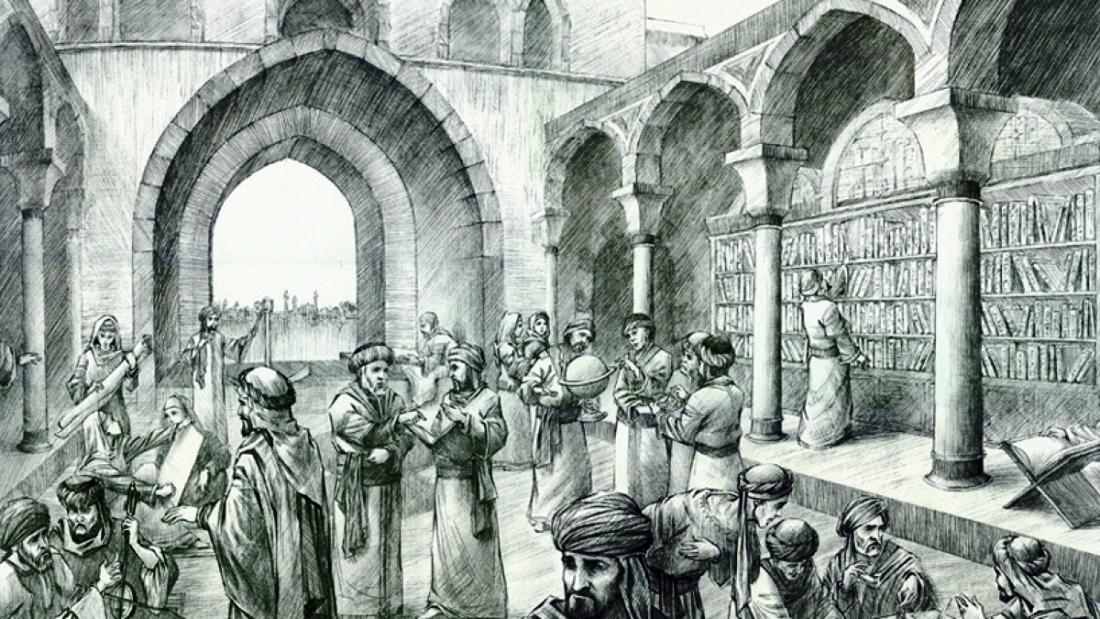
Almost 1200 years ago, Baghdad hosted the House of Wisdom, an academy of knowledge, for nearly half a millennium and it was crucial in the continuation of knowledge from earlier civilisations to the rest of the world. It was the world’s most vital translation centre. A sketch by 1001 Inventions.
Knowledge enlarges human possibility; wisdom guides human choice; conscience interrogates human purpose; and compassion and justice test the human consequences of our understanding. This relationship offers a framework for examining learning across philosophical, religious, scientific, literary, and cultural traditions without pretending that they share a single doctrine.
In Plato’s Apology and Republic, Socrates challenges intellectual complacency and invites the examination of assumptions. His enduring lesson is that recognising the limits of one’s knowledge is a condition of genuine inquiry. Aristotle, particularly in Book VI of the Nicomachean Ethics, distinguishes theoretical understanding from phronesis, or practical wisdom, the capacity to judge well in particular circumstances. Knowledge tells us what may be possible; practical wisdom helps determine what ought to be done.
Confucian thought, especially the Analects, connects learning with moral cultivation and responsible relationships. The Tao Te Ching, associated with Laozi, questions excessive striving and the impulse to control everything. Buddhist teachings examine ignorance, suffering, and ethical transformation, while the Upanishads explore knowledge, reality, the self, and liberation. These traditions differ in their metaphysical commitments and conceptions of human fulfilment. Their value lies not in forced agreement but in the questions they enable us to examine together.
Sacred scriptures likewise connect understanding with moral responsibility, though their theological foundations and interpretations differ. The Qur’an asks, “Are those who know equal to those who do not know?” (39:9), affirming the significance of knowledge. Qur’an 61:2–3 challenges the contradiction between professed beliefs and actual conduct. In the biblical tradition, Proverbs 1:7 associates knowledge with reverence for God; 1 Corinthians 13:1–3 warns that extraordinary gifts without love are inadequate; and Micah 6:8 emphasises justice, mercy, and humility before God.
The Bhagavad Gita 4:38 presents knowledge as profoundly purifying within its wider account of disciplined action and spiritual understanding. The Dhammapada 183, according to common numbering, summarises an ethical path through refraining from evil, cultivating good, and purifying the mind. The Sri Guru Granth Sahib connects spiritual understanding with truthful living, humility, remembrance, and service. These passages should be interpreted within their respective traditions, not reduced to interchangeable formulations. Yet they collectively invite a searching question: What is the worth of learning if it leaves our conduct untouched?
In Islamic intellectual history, Al-Ghazali’s The Book of Knowledge, within The Revival of the Religious Sciences, examines the relationship between learning, intention, character, and spiritual transformation. Ibn Khaldun’s The Muqaddimah investigates historical change, social institutions, political power, and the rise and decline of societies. Their distinct approaches remind us that understanding requires both inward examination and critical attention to the structures shaping collective life.
Kashmir mystic and poet Lal Ded in conversation with people, as imagined by AI
Kashmir’s intellectual heritage adds another dimension. Lal Ded’s vakhs, preserved through complex oral and written traditions, invite inward reflection and the search for deeper understanding. Sheikh Noor-ud-Din Noorani, widely known as Nund Rishi, is remembered for a spiritual and moral sensibility emphasising humility, simplicity, and human conduct. Their legacies emerge from distinct contexts, yet both remain significant to Kashmir’s cultural memory. Their study can deepen self-understanding while encouraging a more thoughtful engagement with the region’s diverse intellectual and spiritual inheritances.
Literature reveals what abstract reasoning can overlook: the inner complexity of human experience. Shakespeare’s King Lear, Macbeth, and Othello explore ambition, authority, jealousy, and misjudgment. Dostoevsky’s Crime and Punishment and The Brothers Karamazov probe conscience, freedom, guilt, and moral responsibility. George Eliot’s Middlemarch examines character, sympathy, and the consequences of choice. Toni Morrison’s Beloved confronts historical trauma, memory, identity, and the enduring injuries of oppression. Literature enlarges moral imagination by enabling us to encounter experiences beyond our own, although imagination must remain accountable to evidence and reality.
Rabindranath Tagore’s Nationalism, Personality, and educational writings resist the reduction of learning to mechanical instruction or narrow utility. Education should cultivate curiosity, creativity, independent judgement, and engagement with humanity. Examinations, qualifications, and employability matter, but they cannot alone measure intellectual maturity or moral growth. Education fulfils a deeper purpose when learners become capable of questioning responsibly, respecting evidence, understanding differences, and contributing constructively to society.
Science demonstrates the power of disciplined inquiry, empirical evidence, testing, and the correction of error. Its strength lies not in infallibility but in its capacity to revise conclusions when stronger evidence emerges. Yet scientific findings do not independently resolve every ethical or political question. Evidence can clarify consequences; decisions still require judgement about rights, fairness, competing priorities, and the distribution of risks and benefits. Wisdom neither rejects scientific knowledge nor asks it to settle questions beyond its methods.
History demonstrates why this distinction matters. Scientific and technical achievements have improved countless lives, but specialised knowledge has also enabled warfare, exploitation, surveillance, and sophisticated systems of exclusion. Technical competence does not guarantee moral progress. Knowledge detached from accountability can increase the efficiency of injustice; intelligence without ethical restraint can serve destructive purposes. The challenge is not to fear knowledge but to ensure that power remains answerable to humane purposes.
Knowledge itself is shaped by institutions, languages, historical circumstances, and relations of power. Colonial systems sometimes classified and represented colonised peoples in ways that served administrative and political interests, even as scholarship also preserved cultural records and supported resistance. Ngũgĩ wa Thiong’o’s Decolonising the Mind examines language and cultural domination; Linda Tuhiwai Smith’s Decolonising Methodologies interrogates research in relation to imperial histories and Indigenous peoples; and Miranda Fricker’s Epistemic Injustice examines how people may be unfairly discredited as knowers or denied the interpretive resources needed to make their experiences understood.
These questions extend to gender, caste, class, disability, race, and linguistic exclusion. Simone de Beauvoir’s The Second Sex examines women’s social position, while Bell Hooks’s Teaching to Transgress explores education as a practice of freedom. Their work challenges institutions that marginalise certain experiences or restrict access to intellectual authority. A more inclusive pursuit of knowledge does not mean accepting every claim uncritically; it means ensuring that relevant evidence, testimony, and experience can be heard and fairly assessed.
The digital age makes responsible judgement more urgent. Artificial intelligence can support research, accessibility, healthcare, and complex analysis, but it can also amplify misinformation, reproduce bias, undermine privacy, and concentrate power. Fluent answers are not necessarily true, rapid communication is not understanding, and technical sophistication is not wisdom.
UNESCO’s Recommendation on the Ethics of Artificial Intelligence, adopted in 2021, provides a framework addressing human dignity, human rights, fairness, transparency, environmental sustainability, and responsible governance. Technology must be judged not only by what it can do, but also by whom it benefits, whom it harms, and how its use can be challenged and governed.
Knowledge and wisdom also shape freedom and social transformation. B. R. Ambedkar’s Annihilation of Caste confronts entrenched social hierarchy. Paulo Freire’s Pedagogy of the Oppressed examines education’s capacity either to reproduce domination or to cultivate critical consciousness. Amartya Sen’s Development as Freedom evaluates development through substantive human freedoms, while Martha C. Nussbaum’s Creating Capabilities: The Human Development Approach explores the conditions necessary for human dignity and flourishing.
Their approaches differ, but they challenge any definition of progress that overlooks people’s actual opportunities. A society may possess wealth, advanced technologies, and prestigious educational institutions while denying many citizens healthcare, security, political participation, or freedom from discrimination. Knowledge serves humanity more fully when it expands people’s capabilities, strengthens their agency, and helps them participate meaningfully in decisions affecting their lives.
This principle should inform schools, universities, governments, media, religious institutions, and public life. Education should unite subject knowledge with ethical reflection and critical literacy. Universities should defend intellectual freedom and academic integrity. Governments should welcome scrutiny, disclose relevant evidence, and correct mistakes. Media organisations should distinguish verification from repetition. Religious and cultural institutions should preserve meaningful inheritances without silencing legitimate questions. Expertise deserves respect, but no institution should be placed beyond accountability.
Wisdom must also be ecological. Wangari Maathai’s Unbowed: A Memoir reflects a life connecting environmental stewardship, community participation, and civic responsibility. Scientific knowledge helps explain ecological change; ethical reasoning examines our obligations; political judgement determines how responsibilities should be shared. The IPBES Assessment Report on the Diverse Values and Valuation of Nature (2022) reinforces the importance of understanding nature’s multiple values. Progress that damages the systems sustaining life, transfers costs to vulnerable communities, or disregards future generations cannot be considered unqualified progress.
In human relationships, wisdom appears in our ability to listen, disagree without dehumanising, acknowledge mistakes, and distinguish compassion from permissiveness. Forgiveness cannot replace accountability, just as accountability need not exclude reconciliation. Respecting persons does not require approving every belief or action. In diverse societies, knowledge of different traditions can deepen understanding, while selective information can harden prejudice. Tolerance may permit coexistence; enduring solidarity requires fairness, equal dignity, mutual responsibility, and the freedom to question.
Nor should wisdom be treated as the exclusive possession of any age group, profession, religion, culture, or social class. Education does not eliminate prejudice, and inherited authority does not guarantee truth. Equally, criticism of established knowledge does not make every alternative claim credible. Wisdom requires intellectual humility without relativism: openness to correction while remaining willing to distinguish stronger arguments from weaker ones through evidence, coherence, fairness, and attention to consequences.
In the final analysis, knowledge and wisdom have both personal and collective purposes. Personally, they can cultivate self-awareness, intellectual independence, and meaningful judgement. Collectively, they enable societies to learn from mistakes, reform institutions, confront injustice, and respond responsibly to new challenges. Individuals need institutions that support freedom and learning; institutions need people willing to question convention, resist prejudice, and accept responsibility for their actions.
The ultimate purpose of knowledge and wisdom, therefore, cannot be reduced to professional success, intellectual prestige, technological supremacy, religious display, or economic productivity. These may have legitimate value, but none is sufficient as the final measure of human progress. Knowledge helps us understand what is real and possible; wisdom guides the use of that understanding; conscience examines our purposes; compassion recognises suffering; justice evaluates how benefits and burdens are distributed; and ecological responsibility reminds us of our obligations to the living world and future generations.
Shabeer Ahmad Lone
A civilisation worthy of its achievements must measure progress not merely by the power it accumulates, but by the purposes that power serves; not merely by the knowledge it produces, but by the injustices it learns to recognise and remedy; and not merely by the opportunities it creates, but by the lives it enables to flourish.
Knowledge enlarges our vision; wisdom disciplines our judgement; conscience examines our purposes; and compassion and justice test the consequences of our choices. Their highest fulfilment lies in helping us understand reality more truthfully, exercise freedom more responsibly, live together more humanely, and sustain the conditions in which present and future generations can flourish. The ultimate purpose of knowledge and wisdom is not merely to make humanity more informed or powerful, but to make our understanding answerable to truth, our power accountable to justice, and our lives more worthy of the dignity we claim for every human being.
(The author is an educator, researcher and writer. Ideas are personal.)