A year of sampling at Hokersar wetland found trace pesticides and organic pollution near settlements. Water quality was very poor at inflows but good at the outlet, showing natural purification.

SRINAGAR: A year-long assessment of water quality at Kashmir’s Hokersar wetland has detected residues of pesticides alongside elevated levels of pollutants associated with sewage, organic waste and agricultural runoff, raising concerns about the ecological health of the internationally recognised wetland.
The study, Assessment of emerging contaminants (pesticides) in aquatic environment of Indian wetlands: a case study of Hokersar, Kashmir, found that water quality varied considerably across the wetland. The area near a built-up settlement recorded the highest levels of several pollution indicators, while the water quality index classified the inflow as “very poor” and the outlet as “good”. The study was published in September 2026 by Springer Nature.
The researchers also detected residues of organochlorine pesticides, including DDT-related compounds, and the organophosphate insecticide malathion. Although the measured concentrations were low, the authors cautioned that the presence of multiple pesticide residues warrants continued monitoring because of their potential combined effects on aquatic ecosystems.
The paper presents what the authors describe as the first comprehensive assessment of physicochemical parameters, heavy metals and organochlorine and organophosphate pesticide residues in Hokersar’s water.
The findings point to a pattern of pollution entering the wetland from surrounding human activities, with the study identifying agricultural runoff, urban discharge and domestic sewage as likely contributors. At the same time, the improvement in the water quality index towards the outlet indicates that the wetland can naturally reduce some pollutants as water moves through it.
The study was conducted by six researchers from various institutions. Sumaya Irshad and Md Intekhab Alam, both affiliated with the Department of Environmental Science, Faculty of Engineering and Technology, Jamia Millia Islamia, New Delhi. Suriyah Akhter is affiliated with Government College for Women, Nawakadal, Srinagar, while Sanyogita Singh is associated with the Department of Environmental Studies, Shyama Prasad Mukherji College for Women, University of Delhi, New Delhi. Arvind Kumar Srivastava is affiliated with Global Enviro Laboratories LLP, Ghaziabad, Uttar Pradesh. The sixth author, Sirajuddin Ahmed, is also affiliated with the Department of Environmental Science, Faculty of Engineering and Technology, Jamia Millia Islamia, New Delhi.
Pollution Levels
The researchers collected water samples at six sites over 11 months, from August 2024 to June 2025. The locations were selected to represent different conditions, including inflow and outflow points and areas influenced by built-up settlements and agricultural activity.
The team analysed water for physicochemical parameters, including chemical oxygen demand (COD), biochemical oxygen demand (BOD), dissolved oxygen, ammoniacal nitrogen and phosphate. It also examined heavy metals and screened for 22 pesticides belonging to different chemical groups.
Chemical oxygen demand ranged from approximately 70 to 173 milligrams per litre, while biochemical oxygen demand varied from around 11 to 72 milligrams per litre. Both are indicators used to assess pollution in water.
COD measures the amount of oxygen required to chemically oxidise substances in water, while BOD measures the oxygen consumed by microorganisms as they break down biodegradable organic matter. Elevated readings can indicate a substantial pollution load and the potential for oxygen depletion, which can affect aquatic organisms.
The study recorded a mean COD concentration of 108.71 mg/L and a median BOD concentration of 34.35 mg/L. The authors interpreted these findings as evidence of considerable organic and chemical pollution in parts of the wetland.
Ammoniacal nitrogen, another important indicator of nutrient pollution, ranged from 1.45 mg/L to approximately 10.18 mg/L. The study reported a mean concentration of around 4.34 mg/L, exceeding the drinking-water reference values cited by the researchers.
Elevated ammoniacal nitrogen and phosphate can contribute to eutrophication, a process in which excessive nutrients promote algal growth and other changes that disrupt aquatic ecosystems. When this process is accompanied by the decomposition of organic matter, oxygen levels can fall and conditions for aquatic life can deteriorate.
Phosphate concentrations ranged from 0.2 to 1.09 mg/L, with a reported mean of approximately 0.47 mg/L. The authors identified this nutrient enrichment as a concern because of the potential for algal blooms and deterioration in water quality.
Urban Pressure
The most polluted sampling location was the site adjacent to a built-up area. Here, ammoniacal nitrogen reached 10.18 mg/L, BOD reached 71.67 mg/L, and COD rose to 173.20 mg/L. Phosphate concentrations reached 1.091 mg/L.
The researchers linked the pattern to human activities around the wetland, including urban runoff, residential wastewater discharge, organic waste and inappropriate waste disposal.
The concentration of pollutants at this location suggests that pressure on the wetland is not uniform. Areas receiving greater quantities of contaminated runoff or wastewater appear to experience more severe degradation than other parts of the ecosystem.
The study also identified the inflow as a major point of concern, with its water quality index consistently falling into the “very poor” category. This indicates that pollution entering the wetland from upstream sources is an important part of the overall problem.
The authors point to agricultural runoff carrying fertilisers and pesticides, untreated domestic sewage, animal waste and sediments transported through the Doodhganga River as potential sources of pollution reaching Hokersar.
These pressures are occurring in a wetland already affected by changes in land use and human encroachment. The paper cites previous research documenting a reduction in Hokersar’s area from 1,875.04 hectares in 1969 to 1,300 hectares in 2008.
Earlier studies cited by the authors have associated the wetland’s degradation with human settlements, household pollution, fertiliser application, willow plantations, flooding, agricultural encroachment, sediment carried by the Doodhganga River and the proliferation of aquatic weeds.
The new assessment adds detailed measurements of water pollution and pesticide residues to this existing body of research.
Pesticide Traces
The pesticide analysis detected several organochlorine compounds, including P,P-DDD, O,P-DDT and P,P-DDE, at concentrations reported in the results section at approximately 0.015–0.018 micrograms per litre.
The paper also reported the presence of hexachlorocyclohexane (HCH) isomers and endosulfan-related compounds at low concentrations. Malathion, an organophosphate insecticide, was detected at an average concentration of approximately 0.014 micrograms per litre.
Organochlorine pesticides can persist in the environment, allowing residues from earlier applications to remain detectable long after their use. The researchers suggest that the detection of these compounds may reflect historical pesticide use, while residues of some organophosphate pesticides and herbicides may be associated with continued agricultural and horticultural practices in the surrounding catchment.
Pesticides applied to orchards and agricultural fields can reach nearby water bodies through surface runoff and streams. The paper identifies the Doodhganga and Sukhnag nallahs as potential routes through which contaminants may enter Hokersar.
The researchers emphasise that low concentrations of individual compounds do not necessarily eliminate ecological concerns when several substances occur together. Their combined effects, persistence and potential interactions with other pollutants warrant further investigation.
However, the study does not establish that the detected residues have already caused specific damage to fish, birds or other wildlife. Nor does it quantify the actual biological effects of the pesticide mixture. Its findings establish the presence of residues in sampled water and identify the need for further ecological risk assessment.
Metals Profile
The heavy-metal results presented a different picture.
Chromium, lead and cadmium remained below the study’s validated detection limits during the monitoring period. Copper concentrations ranged from approximately 0.035 to 0.064 mg/L, while zinc ranged from 0.021 to 0.182 mg/L.
The authors reported that the measured copper and zinc concentrations were within the permissible limits they cited. They suggested that the observed levels could reflect inputs associated with agriculture, surrounding settlements or wastewater, although the study did not establish a definitive source for each metal.
The findings indicate that the principal concerns identified by this assessment were not limited to heavy-metal contamination. High organic pollution, nutrient enrichment and the detection of pesticide residues were also important components of the wetland’s pollution profile.
The distinction matters because water quality is influenced by a mixture of physical, chemical and biological processes. A low concentration of some heavy metals does not, on its own, establish that the water body is ecologically healthy.
The researchers used statistical techniques to examine relationships between the measured parameters and identify patterns across sampling sites.
Their analysis found a very strong positive correlation between electrical conductivity and total dissolved solids, with a correlation coefficient of 0.999. Conductivity was also positively correlated with turbidity.
BOD and COD had a strong positive correlation of 0.947, consistent with their shared association with organic pollution. Dissolved oxygen was negatively correlated with several pollution indicators, including BOD, COD, total dissolved solids and electrical conductivity.
These relationships help describe how water quality variables change together. They do not, by themselves, prove that one pollutant directly caused a change in another.
Seasonal Changes
The researchers found that pollution levels also varied over the monitoring period.
Ammoniacal nitrogen recorded its highest monthly average in June, at approximately 4.93 mg/L. Dissolved oxygen levels declined during winter, which the authors suggested could be associated with increased organic loads and reduced photosynthetic activity.
COD and BOD remained elevated throughout the observation period, indicating that organic and chemical pollution was not confined to a single season.
Total dissolved solids and electrical conductivity were elevated between February and April, while pesticide residues showed a persistent low-level presence across the 11-month monitoring period.
The study also found that water quality was worse in December, which the authors attributed as a possible consequence of reduced water levels, pollutant concentration and winter conditions. Some improvement was observed in June, potentially reflecting increased flow and the dilution of pollutants.
These seasonal patterns suggest that monitoring at only one point in the year may not adequately capture the pressures affecting the wetland. Repeated measurements across different seasons can help identify when pollution intensifies and which locations require closer attention.
The study’s findings nevertheless represent a defined monitoring period and six sampling locations. They provide a detailed assessment of the conditions measured during that period rather than a complete account of every contaminant or every part of the wetland.
Natural Filtering
Despite the pollution recorded at the inflow and near built-up areas, the water quality index showed an improvement towards the outlet.
The researchers classified water quality at the outlet as “good”, compared with “very poor” conditions at the inflow. They interpreted this gradient as evidence of the wetland’s capacity to attenuate some pollutants as water passes through it.
Wetlands can retain or transform pollutants through interactions involving vegetation, sediments, microorganisms and water flow. However, their capacity to perform these functions can be undermined when the incoming pollution load becomes excessive.
The results therefore present a contrast: Hokersar appears capable of improving water quality along its flow path, but parts of the wetland are receiving pollution at levels that substantially degrade local conditions.
The authors’ assessment suggests that the wetland’s natural filtering capacity should not be mistaken for a substitute for controlling pollution at its source.
The water quality index used in the study was calculated from selected parameters, including pH, turbidity, calcium, hardness, alkalinity, chloride, sulphate, BOD, COD and total dissolved solids, using reference values from the Bureau of Indian Standards and the World Health Organisation.
The index offers a way to summarise complex water quality measurements. Its The results therefore present a contrast: Hokersar appears capable of improving water quality along its flow path, but parts of the wetland are receiving pollution at levels that substantially degrade local conditions.
The authors’ assessment suggests that the wetland’s natural filtering capacity should not be mistaken for a substitute for controlling pollution at its source.
Conservation Concerns
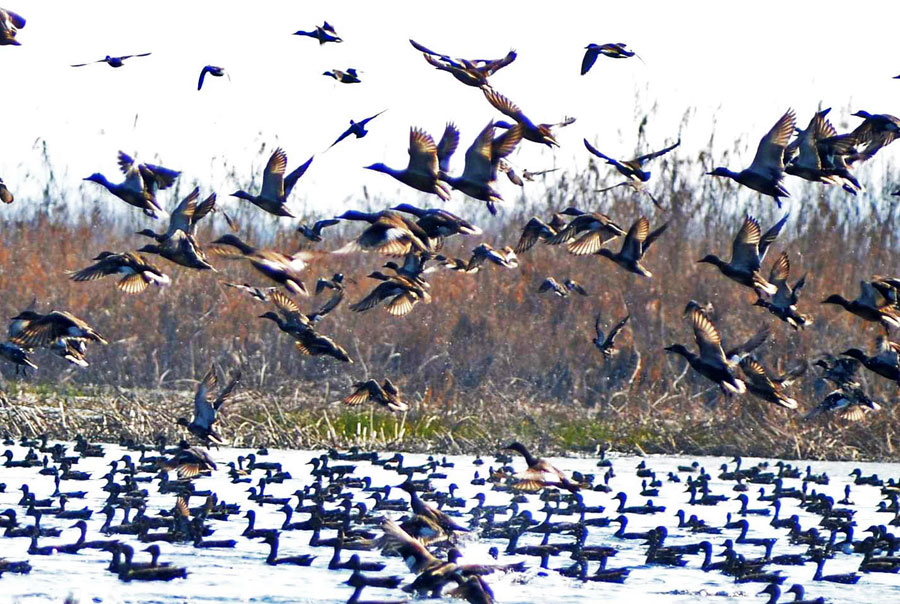
Hokersar is an important wetland in the Kashmir Valley, supporting resident and migratory waterbirds and providing habitat for aquatic plants, fish and other wildlife. The paper describes it as a key wintering ground along the Central Asian Flyway and notes its importance to communities whose livelihoods depend on resources associated with the wetland.
Its ecological functions extend beyond wildlife habitat. Wetlands can help regulate water flows, retain nutrients, store carbon and improve water quality. Their degradation can therefore affect biodiversity as well as the benefits people derive from these ecosystems.
The authors argue that the presence of pesticide residues, combined with high organic pollution and nutrient enrichment at some sampling sites, makes continued monitoring and improved management important for Hokersar’s protection.
The study also acknowledges limitations. Its pesticide assessment was restricted to organochlorine and organophosphate residues and did not cover other emerging contaminants, including pharmaceuticals, personal-care products and microplastics.
It did not include microbiological analyses either. Despite the elevated BOD, COD and ammoniacal nitrogen recorded at some locations, the absence of measurements for indicators such as total coliforms, faecal coliforms and Escherichia coli limits the study’s ability to assess microbial contamination and related public-health risks.
The researchers conclude that their findings provide baseline data for understanding the spatial and seasonal patterns of pollution in Hokersar. Further monitoring and ecological risk assessment would help establish how the detected contaminants behave over time and what their combined presence means for the wetland’s aquatic life.
The results underline a central concern- while Hokersar retains some capacity to improve water quality naturally, pollution entering through its catchment and the severe degradation recorded near built-up areas remain significant challenges for the long-term health of the wetland.