by Shabeer Ahmad Lone
Humanity’s enduring, timeless questions about existence, meaning, and morality are essential wellsprings that shape civilisations, cultivate vital public wisdom, and sustain authentic human flourishing
Bedil ba jalwa gah-e haqeeqat ke me rasad,
Ma ghafilan tasawwur-e imkani-e khudaim.
Khamoshi hum cheqadar nuskha-e-tahqeeq kashood
Ke man aaina-e-asraar maku gardeedam—Bedil
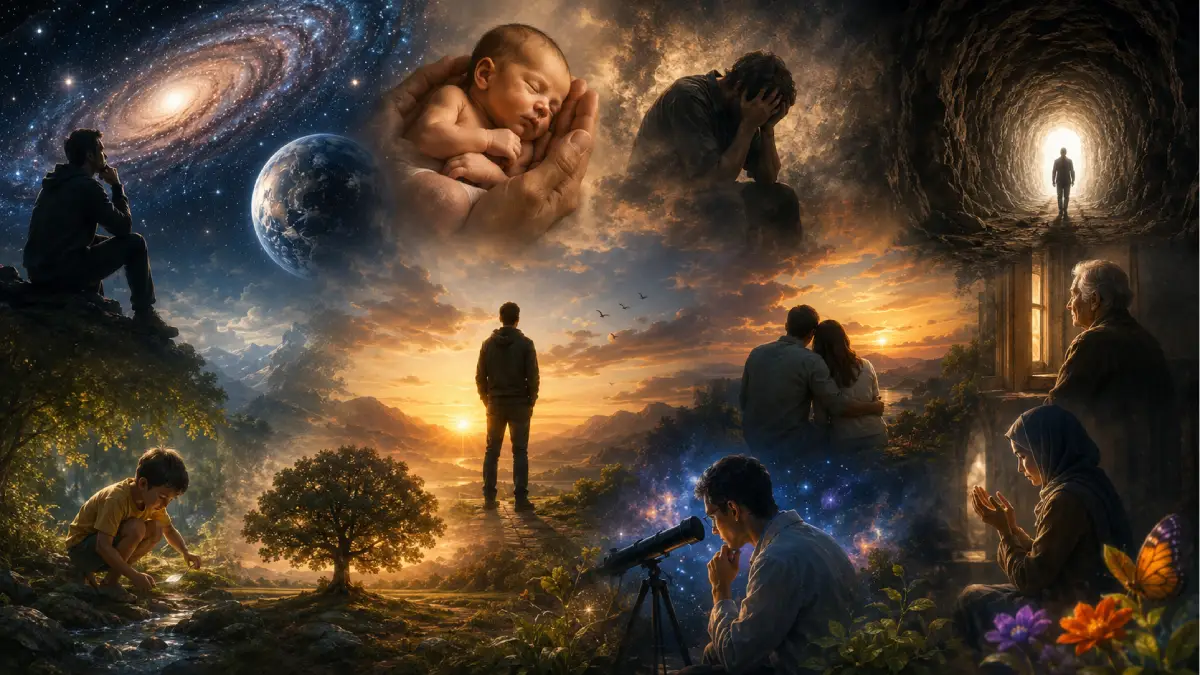
Every human being, sooner or later, stands before the same enduring mysteries: the wonder of existence, the birth of new life, the reality of suffering, the certainty of death, the longing for love, the silence of prayer, the joy of discovery, and the search for meaning. From these experiences arise humanity’s deepest questions: Why is there something rather than nothing? Who am I? What is ultimately real? What is consciousness? Are we truly free? What are truth, goodness, beauty, justice, love, and the meaning of life?
These are not merely philosophical or religious questions but humanity’s oldest and most enduring inheritance, inspiring the world’s greatest civilizations, religions, philosophies, sciences, literatures, and arts. Every enduring civilization has been shaped less by the answers it claimed than by the questions it courageously pursued. In an age of unprecedented technological power and profound moral uncertainty, these timeless questions remind us that knowledge without wisdom, power without purpose, and progress without moral vision cannot sustain authentic human flourishing. The future of humanity will be shaped not only by the brilliance of its discoveries but by the depth of its questions, the integrity of its seeking, and the wisdom with which it lives its answers.
These questions arise from capacities that appear uniquely human: wonder before the cosmos, awareness of mortality, moral conscience, symbolic imagination, self-reflection, and the longing to transcend immediate survival in pursuit of truth, beauty, and goodness. They are born not only in temples, classrooms, laboratories, and libraries but also at the bedside of the dying, in the embrace of love, amid grief and reconciliation, in solitude and community, in triumph and failure. They belong equally to the philosopher and the farmer, the scientist and the poet, the believer and the skeptic. To ask them is not a luxury of the learned but an expression of our common humanity.
Across cultures and centuries, these questions have inspired humanity’s greatest intellectual, moral, and spiritual achievements. Socrates accepted death rather than abandon the pursuit of truth. Siddhārtha Gautama renounced privilege in search of the end of suffering. Confucius sought harmony through moral cultivation, while the Hebrew prophets called societies to justice and compassion. Jesus proclaimed the transforming power of love, and the Qur’an repeatedly summons humanity to reflect upon creation, history, and the human soul. The Upanishadic sages explored the mystery of ultimate reality; Ibn Sīnā united reason and metaphysics; Al-Ghazālī examined the limits of certainty; Ibn ‘Arabī contemplated the unity of being; Rūmī transformed grief into love; Dante, Shakespeare, Dostoevsky, Tagore, Iqbal, Simone Weil, Hannah Arendt, and Viktor Frankl each illuminated dimensions of human existence that continue to speak across civilizations. Their answers often differ, sometimes profoundly, yet they converge in affirming that an examined life is richer, wiser, and more humane than one lived without reflection.
History likewise demonstrates that civilizations flourish when they cultivate wisdom alongside power. From Athens, Jerusalem, Baghdad, Nālandā, and Chang’an to the modern research university, humanity’s greatest centres of learning have been sustained by fearless inquiry into ultimate questions. Scientific revolutions, philosophical schools, religious traditions, literary masterpieces, and artistic achievements all emerged from humanity’s refusal to be satisfied with appearances alone. The deepest human questions have therefore served not as obstacles to progress but as its enduring wellspring.
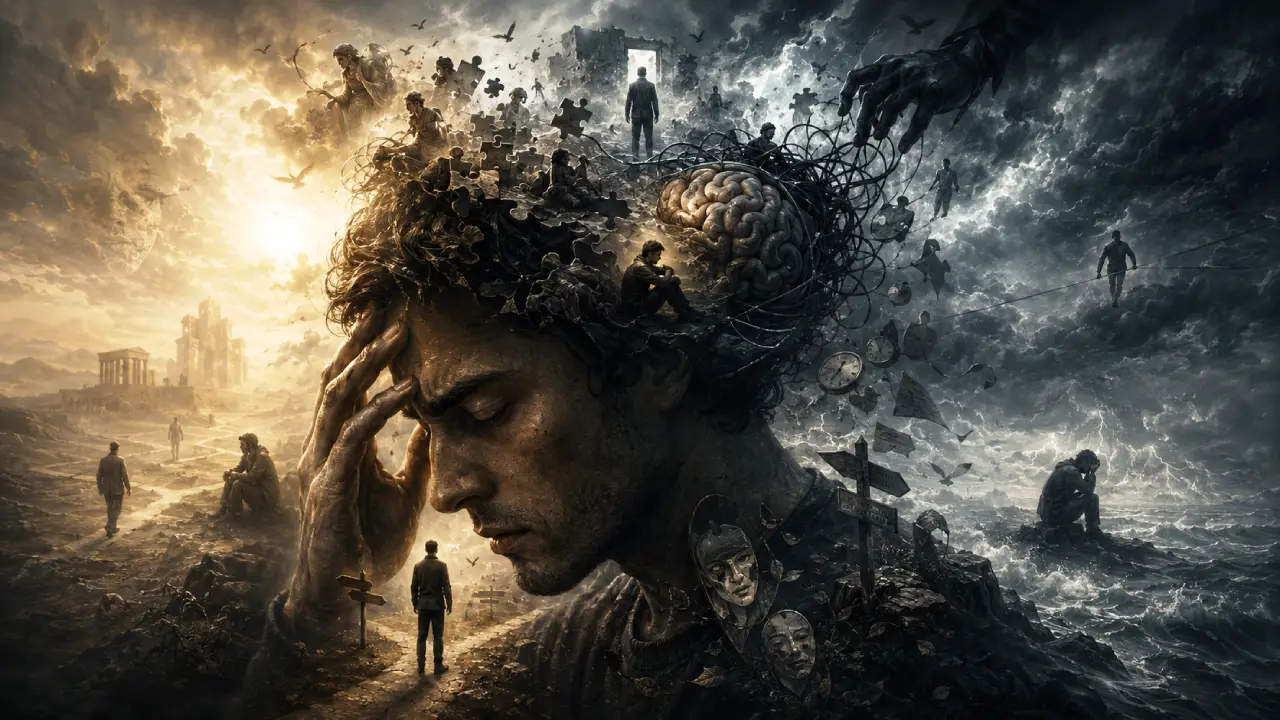
Modern science has transformed our understanding of the universe without exhausting its mystery. Cosmology investigates cosmic origins, evolutionary biology traces life’s unfolding, neuroscience explores the brain, and artificial intelligence challenges inherited assumptions about intelligence and personhood. Yet even the most remarkable scientific discoveries cannot finally determine why there is something rather than nothing, whether consciousness can be fully reduced to physical processes, whether moral values possess objective significance, or what ultimately makes life meaningful.
Science excels in explaining mechanisms; philosophy clarifies concepts; literature deepens imagination; ethics guides action; and religious and contemplative traditions explore questions of ultimate purpose and transcendence. Far from being adversaries, these diverse forms of inquiry are most fruitful when they engage one another with intellectual rigour, humility, and mutual respect.
These enduring questions have also provoked profound disagreement. Nietzsche challenged inherited moral and religious certainties. Marx viewed much of religion through the lens of social and economic power. Freud interpreted religious belief as rooted in the human psyche. Sartre argued that meaning must be created in a universe without predetermined purpose, while contemporary thinkers such as Daniel Dennett, Richard Dawkins, and Yuval Noah Harari have questioned traditional understandings of mind, religion, and human uniqueness.
Their critiques have sharpened rather than diminished humanity’s search for truth, compelling both religious and secular traditions to re-examine their assumptions. Yet no single worldview has resolved the deepest human questions conclusively. Their enduring vitality lies precisely in their capacity to invite rigorous debate, intellectual humility, and an ever-deepening dialogue among science, philosophy, religion, and the humanities.
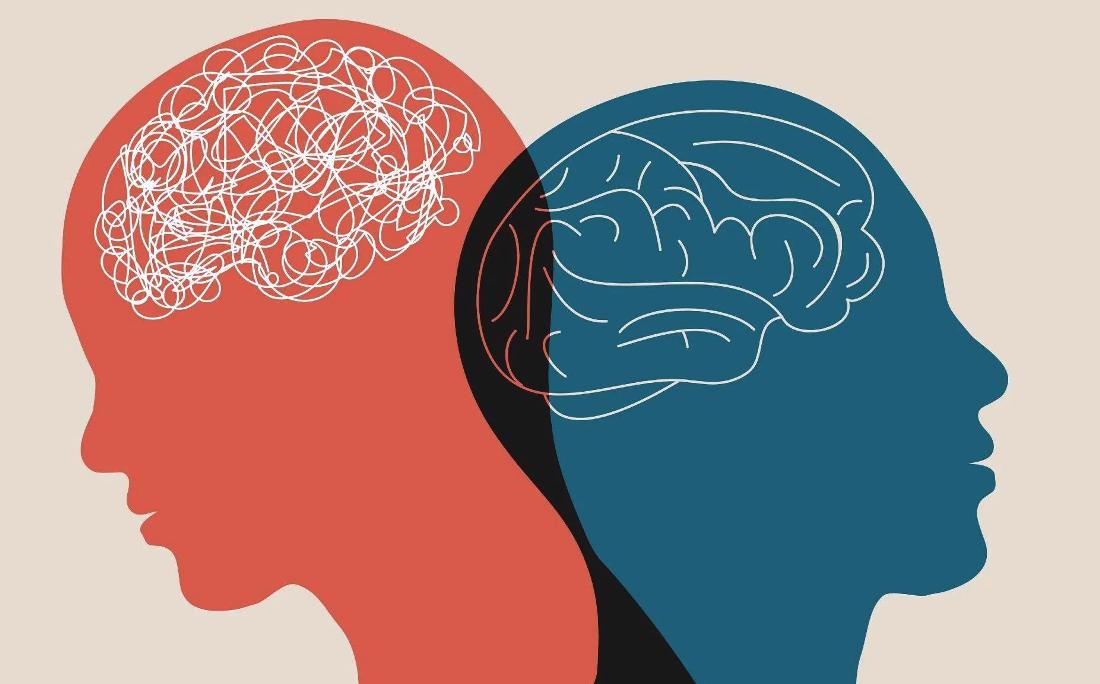
Contemporary research increasingly reinforces the enduring significance of these questions. Studies in psychology, neuroscience, education, and public health consistently suggest that lives marked by meaning, gratitude, purpose, compassion, hope, forgiveness, and awe are associated with greater resilience, psychological well-being, stronger relationships, and higher levels of civic trust. Conversely, chronic loneliness, nihilism, moral fragmentation, and purely material conceptions of success often accompany declining mental health, social polarization, and civic disengagement. Knowledge enlarges human power; wisdom directs that power toward the common good.
The deepest human questions therefore possess profound public significance. They shape education, leadership, economics, environmental stewardship, technological innovation, interfaith understanding, democratic citizenship, and global cooperation. A society that teaches its citizens how to produce, consume, and compete, yet neglects to ask why they exist or how they ought to live, may achieve extraordinary prosperity while suffering ethical and spiritual impoverishment.
The crises of our age, artificial intelligence, climate change, ecological degradation, widening inequality, violent conflict, digital isolation, and the erosion of shared moral horizons, cannot be resolved by technical expertise alone. They require wisdom equal to our power and character equal to our knowledge.
These questions also cultivate intellectual humility. Neither religious faith nor philosophical skepticism, neither scientific naturalism nor metaphysical reflection, possesses a monopoly on truth. Every authentic tradition acknowledges that reality ultimately exceeds the grasp of any single discipline, ideology, or culture. Genuine inquiry therefore demands both conviction and openness: the courage to seek truth wherever it may lead and the humility to revise our understanding in its light. Such dialogue transforms disagreement from a source of division into an opportunity for deeper understanding and shared flourishing.
The greatest works of literature remind us that these questions are lived before they are answered. The tragedies of Shakespeare, the spiritual ascent of Dante, the moral struggles of Dostoevsky, the poetry of Rūmī and Tagore, and Viktor Frankl’s witness amid Auschwitz reveal that wisdom is forged not only through abstract reasoning but also through suffering, imagination, memory, compassion, and hope. Their enduring power lies in showing that the search for meaning is inseparable from the formation of character.
The deepest human questions ultimately call not merely for contemplation but for transformation. They invite habits of attentive listening, disciplined inquiry, dialogue across differences, the study of humanity’s great texts, scientific curiosity, artistic creativity, compassionate service, ecological responsibility, and the lifelong cultivation of wisdom and virtue. Education itself finds its highest purpose not simply in preparing people to earn a living but in enabling them to live thoughtfully, responsibly, and meaningfully.
Every generation inherits these questions anew and must engage them within its own historical circumstances. Their enduring significance lies not in yielding simple or final answers but in enlarging understanding, deepening compassion, nurturing humility, and sustaining hope. They are humanity’s shared intellectual and spiritual inheritance, the common language through which civilizations, despite their differences, continue to seek truth, goodness, beauty, justice, and love. They are not problems to be solved once and for all but horizons that continually enlarge the human spirit.
A civilization may become wealthier without asking them, more powerful without answering them, and more technologically advanced while forgetting them. Yet no civilisation can remain truly humane once it ceases to wonder. The future of humanity will be shaped not only by the brilliance of its discoveries but by the depth of its questions, the integrity of its seeking, and the wisdom with which it lives its answers.
(The author is an educator, researcher and writer. Ideas are personal.)