by Khawar Khan Achakzai
Twentieth-century Kashmiri literature marked a modern revival, blending mysticism, nationalism, and progressive humanism, led by Mahjur and Azad, who modernised language, themes, and cultural self-consciousness.
The modern period in the development of Kashmiri started from 20th century. The attitude of inferiority towards Kashmiris in this era was still noticeable, but its markedness had reduced.
During the early twentieth century, three types of poetry were written. The first continued in the earlier mystical tradition, developing into a humanistic strain and displaying a marked yearning for what may be termed ‘inner peace’ and harmony. This development was partly the result of the post-World War II upheavals and the resultant human suffering, felt both in the Western and non-Western worlds. The post-partition mobilisation on the borders of Kashmir brought the whole drama of conflict nearer home.
Second, in poetry, the strain of Kashmiri identity became marked: attempts at self-discovery as a viable nation and self-introspection were initiated. This type of poetry displays an assessment of Kashmiriness, a contemplation about the state of Kashmiris, as people and as a nation. It is essentially a poetry of introspection, challenge, reawakening, and nationalism.
The main carriers of this message of awakening are Mahjur and Azad. In their poetry, for the first time, we find a bold message, yearning for self-realisation, and pride in native traditions and language.
Third, though this was a period of innovations, in stylistic terms, the lol tradition continued, and Mahjur made a very impressive and lasting contribution to it. Finally, new ideas, both political and social, came from other parts of the world, especially through the Progressive Writers’ Association, which was already well established in Kashmir.
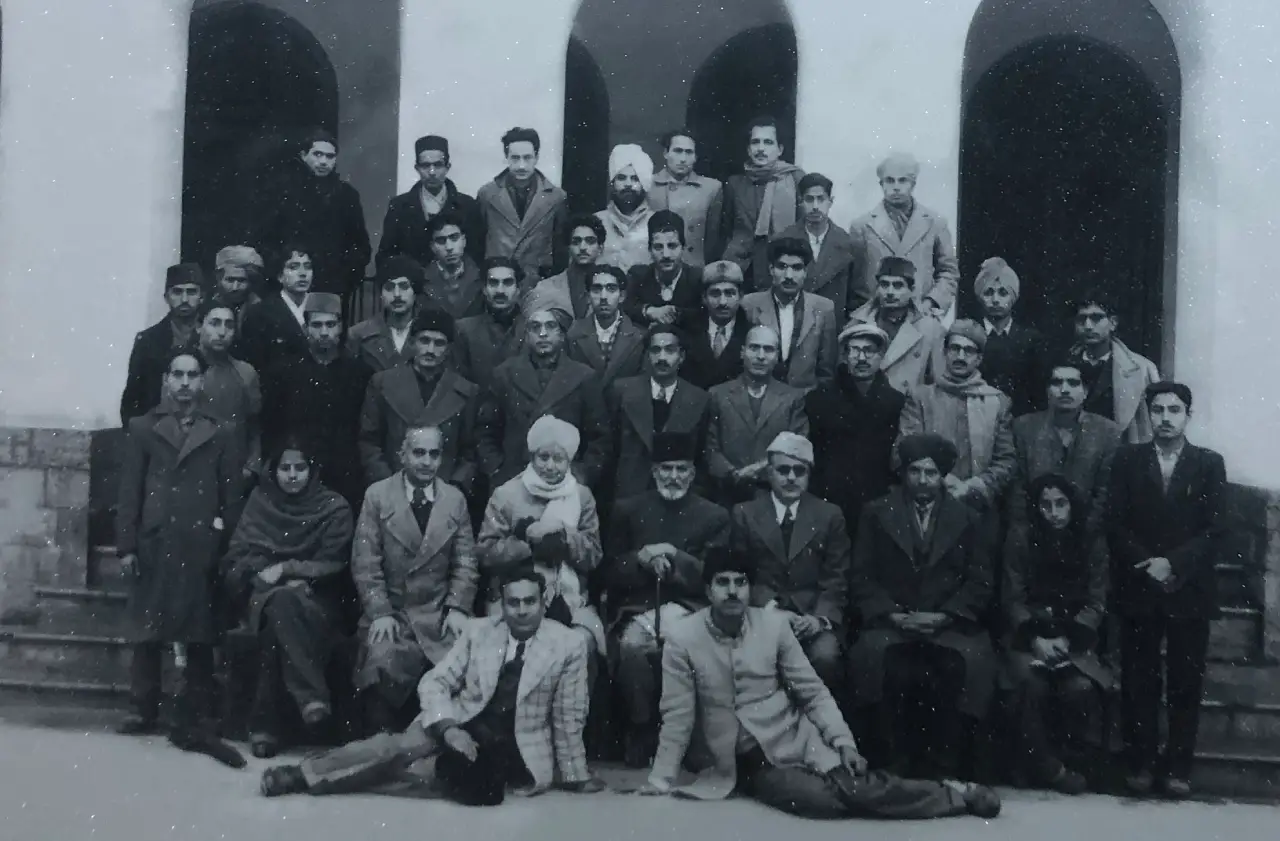
Shair-e-Kashmir
Ghulam Ahmad Mahjur is regarded as the most important figure in the revival of the Kashmiri language and culture. He played a decisive role in transforming Kashmiri poetry into a modern, respected, and popular literary medium. Born in the village of Mitragam near Srinagar, Mahjur initially wrote in Persian and Urdu, as was customary among Kashmiri poets of his time, but later consciously turned to Kashmiri. He became the first modern poet to elevate it to national and international notice, even attracting the admiration of Rabindranath Tagore. A humble and shy man who spent most of his life as a patwari, his close contact with rural Kashmir deeply shaped his poetic sensibility and rooted his work in the lives of ordinary people.
Mahjür introduced a new diction and technique, expanded the thematic scope of Kashmiri poetry, and blended innovation with tradition, particularly enriching the lol genre while reworking local myths and legends with remarkable skill. His poetry secularised Kashmiri verse and expressed subtle nationalism and cultural pride through accessible imagery that resonated across religious and social lines. The educated elites initially viewed him with scepticism due to their preference for Urdu and English. Influenced by broader social and political currents, including ideas circulating through the Progressive Writers’ Movement, Mahjur emerged as a foundational architect of Kashmiri literary modernism, providing at a crucial historical moment exactly the poetic voice and cultural confidence that Kashmiri society needed.
Mahjur’s senior contemporary, Zinda Kaul Masterji acquired the title masterji from his disciples. Zinda Kaul composed in Persian, Urdu and Hindi. Before his restirent he had written only one lyric in Kashmirii. However, in 1942, he recited Panin Kath at SP college. His poem Sumran was published in 1944, and it earned him a permanent position as an important Kashmiri poet. In tone and spirit, his poems possess a distinctly therapeutic quality, resembling the meditative musings of a bhakti and finding expression through forms such as ghazals, lila, bhajans, and rubaiyat. His poetic voice differed markedly from that of Mahjur, Azad and the dominant literary currents of the period. In both tone and thematic emphasis, he remained firmly rooted in earlier Kashmiri poetic traditions, particularly those associated with Paramananda. He never fully relinquished his attachment to mystic expression.
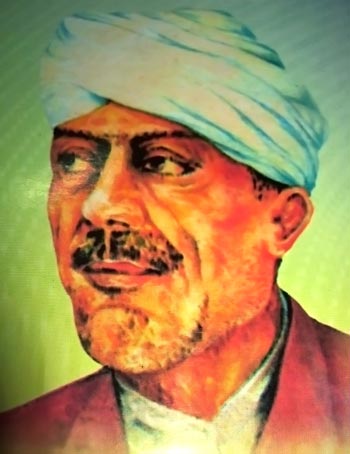
Abdul Ahad Dar Azad
Abdul Ahad Azad was a younger contemporary of Mahjur and Zinda Kaul. He blazed the trail of revolution and social change in Kashmiri poetry. He expanded the thematic and ideological horizons of Kashmiri poetry, as in Inqalab (Revolution) or Dariyav (The River). While themes of social transformation and change had Azad on a larger humanistic and universal basis, shaped by his commitment to scientific humanism.

As a stylistic experiment, his Dariyav is considered “one of the best poems so far written in Kashmiri.” Azad’s poetic career unfolded in three distinct phases, which are coincident with the nom de plume he adopted in each phase. The first included his rendition of love lyrics and devotional poems which were written under the name of Ahad (Unique), in second, he wrote poetry on nature under the name Janbaz (Daredev), the examples of poetry during this phase are Arival (The Wild Rose) and Vanicvar (Pine of the forest) and finally Azad (Free).
By 1942, his close association with PN Bazaz and socialist circles further deepened his ideological clarity. According to Bazaz, “While Mahjur was moving like a shuttle-cock between Religious Humanism and Modernism, Azad courageously preached Scientific Humanism.”
The restlessness of an anarchist is clearly expressed in the poetry of Azad, such as his well-known poem Dariyav. Azad introduced revolutionary themes and spirit in Kashmiri poetry.
There is no doubt that Mahjur and Azad, and to a lesser degree Masterji, dominated this period of Kashmiri poetry. But other poets also contributed, giving a new direction for the almost moribund Kashmiri literature. Among such poets, one must mention Mir Ghulam Hasan Beg Arif, Ahad Zargar, Mir Ghulãm Rasül Nazki, Dinanath Wali Almast, and Ghulâm Ahmad Fazil. They played important roles in steering Kashmiri literature away from stagnation and toward renewal.
This is the third part of the series on the evolution of modern Kashmiri poetry. Read the first part here, and the second part here.
(The author is a Kashmir-based cardiologist and writer. His areas of interest include Kashmiri history, philosophy, and literature, with a particular focus on cultural memory and interpretation. Ideas are personal.)