by Ruqaya Akhter
An analysis of Jammu and Kashmir’s improving sex ratio, healthcare gains, and the shifting realities of gender balance.
In many parts of India, the celebration of a son’s birth and the quiet resignation at a daughter’s arrival have long been an unspoken reality. This preference, passed down through generations, eventually shows up in census data as missing girls and surplus men. For Jammu & Kashmir, however, this old story is finally being rewritten.
The sex ratio, defined simply as the number of females for every 1,000 males, is a demographic mirror reflecting a society’s health, opportunities, and cultural priorities. While globally there are roughly 101 males for every 100 females, India’s complex story of gender balance stands out as a critical developmental challenge.
However, for Jammu & Kashmir, the latest data suggests a quiet yet significant turnaround. After years of lagging behind the national curve, the Valley appears to be turning the corner, redefining its demographic narrative with rising girls’ birth rates and unprecedented healthcare achievements.
India has recently reported a historic shift. According to the National Family Health Survey (NFHS-5), the country’s overall sex ratio is now 1,020 women per 1,000 men, meaning India technically has more women than men for the first time in recent history. However, this number can be misleading. The true test of gender bias is the Sex Ratio at Birth (SRB), which counts newborn girls for every 1,000 boys.
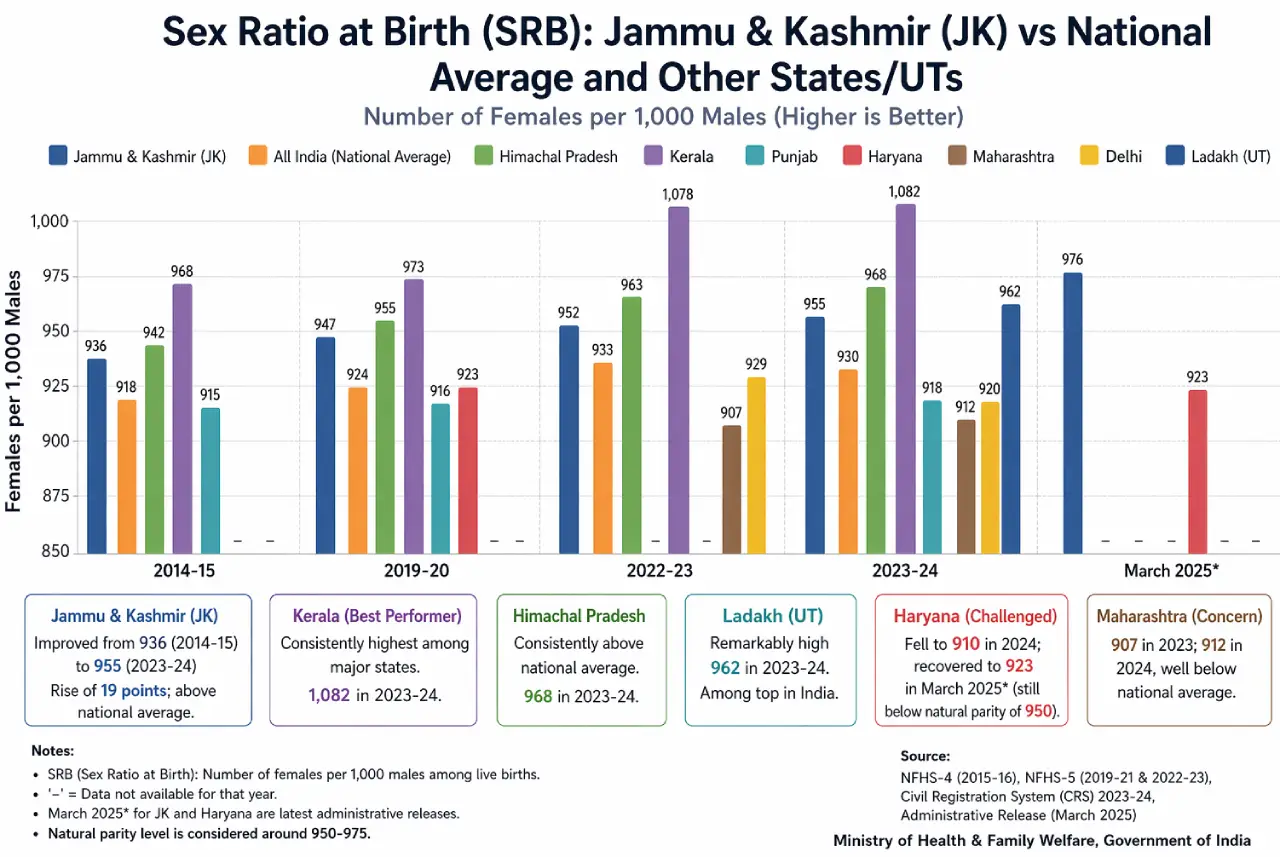
Here, the progress is steady but slower. The national Sex Ratio at Birth (SRB) has risen to 933 females per 1,000 males in 2022-23, up from 918 in 2014-15, with 12 states surpassing the national average. States like Kerala lead the way with a high overall sex ratio of 1,084 women per 1,000 men, followed closely by Tamil Nadu, Andhra Pradesh, Chhattisgarh, and Himachal Pradesh. On the other hand, Haryana, historically a state with severe deficits, saw its SRB plunge from 923 in 2019 to 910 in 2024 before clocking its highest figure in five years at 923 in 2025, still below the natural parity of 950. Punjab recorded an overall SRB of 918 in 2024, with districts like Pathankot hitting a shocking 864. Delhi too saw a decline, falling from 929 in 2022 to 920 in 2024. Meanwhile, Maharashtra has struggled to arrest a steady decline, with an SRB of 907 in 2023 and 912 in 2024, far below the national average.
For a region often in the news for conflict and political uncertainty, Jammu & Kashmir has emerged as a surprising success story in gender equity over the last decade.

The official data shows that SRB in J&K rose from 936 girls per 1,000 boys in 2014-15 to 955 in 2023-24, an impressive jump of 19 points. This transforms J&K from a laggard to a leader, now standing significantly above the national average of 930 (during the same 2023-24 period) and among the best-performing regions in North India.
Even more surprising are the figures released by the administration in March 2025, which recorded an SRB of 976 for the region. This specific metric, while sometimes calculated on a smaller sample size, represents a seismic improvement that puts J&K on par with socially progressive states in South India.
This isn’t just about numbers; it is reflected in broader health outcomes. The Union Territory’s Infant Mortality Rate (IMR) has dropped to 17 per 1,000 live births, comparable to Kerala and Goa, and it has already achieved the UN’s Sustainable Development Goal (SDG) target for child mortality years ahead of the 2030 deadline.
What drives such rapid change in a traditionally patriarchal society? The data points to strict law enforcement rather than just social awakening. Under the Pre-Conception and Pre-Natal Diagnostic Techniques (PC&PNDT) Act, which bans sex determination tests, J&K has made a concerted effort to crack down on offenders.
As of mid-2024, 841 diagnostic centres were registered across J&K, making the healthcare apparatus highly transparent. Experts note that this strict enforcement, combined with the Beti Bachao Beti Padhao (BBBP) scheme, has reduced the opportunities for illegal sex-selective abortions, forcing the natural order to reassert itself.
When J&K was bifurcated in 2019, it created two distinct demographic units. While J&K is making headlines for its rapid improvement, the newly separated Union Territory of Ladakh tells a different story.
For the first time, SRB statistics have been disaggregated for Ladakh. The cold desert region reported a remarkably high SRB of 962 in 2023-24, arguably making it one of the best-performing regions in the entire country. Its IMR stands at 16, beating even J&K’s impressive figures.
However, this success is accompanied by a stark disparity within the J&K region. District-wise projections show massive variations in overall population balance. While some areas like Kulgam and Shopian have historically had better sex ratios, remote districts like Leh have recorded extremely low ratios (690 females per 1,000 males in the 2011 Census), suggesting that the “girl child crisis” has not vanished but merely shifted locations.
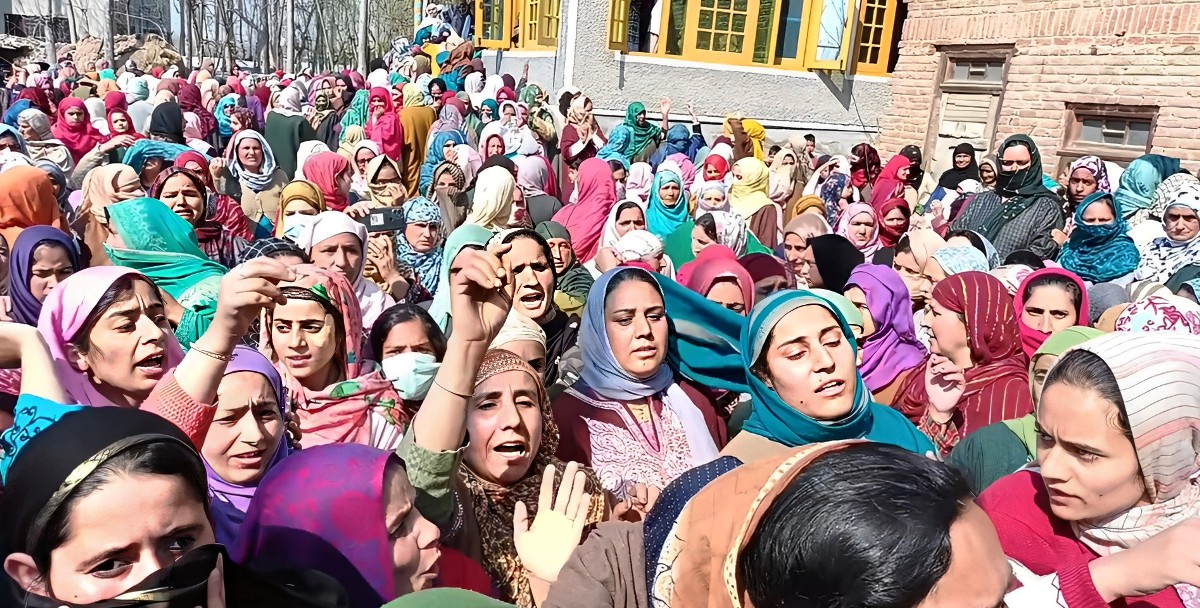
While J&K celebrates more daughters being born, demographers warn of an impending social challenge due to the “echo” of past discrimination. Jammu & Kashmir stands at a unique crossroads. It has proven that legal enforcement works. Unlike states like Punjab or Haryana, where sex selection remains a persistent black-market phenomenon despite economic wealth, J&K’s strict monitoring of diagnostic centres has yielded tangible results.
However, the story is far from over. The region must now move beyond survival and focus on empowerment. While the SRB has improved, the data remains incomplete on key metrics like the Maternal Mortality Ratio, which the Registrar General of India does not yet publish separately for J&K.
As India’s total fertility rate drops below the replacement level (currently at 1.9 children per woman), shrinking family sizes mean the pressure to have a son among one or two children actually increases. This fertility transition could, paradoxically, worsen sex ratios if not managed carefully.
(The author is an Economics research scholar at the University of Kashmir. Ideas are personal.)