SRINAGAR: India has reaffirmed its continued support for Afghanistan’s health sector and humanitarian needs during a meeting between Union Health and Family Welfare Minister Jagat Prakash Nadda and Afghanistan’s Minister of Public Health, Mawlawi Noor Jalal Jalali.
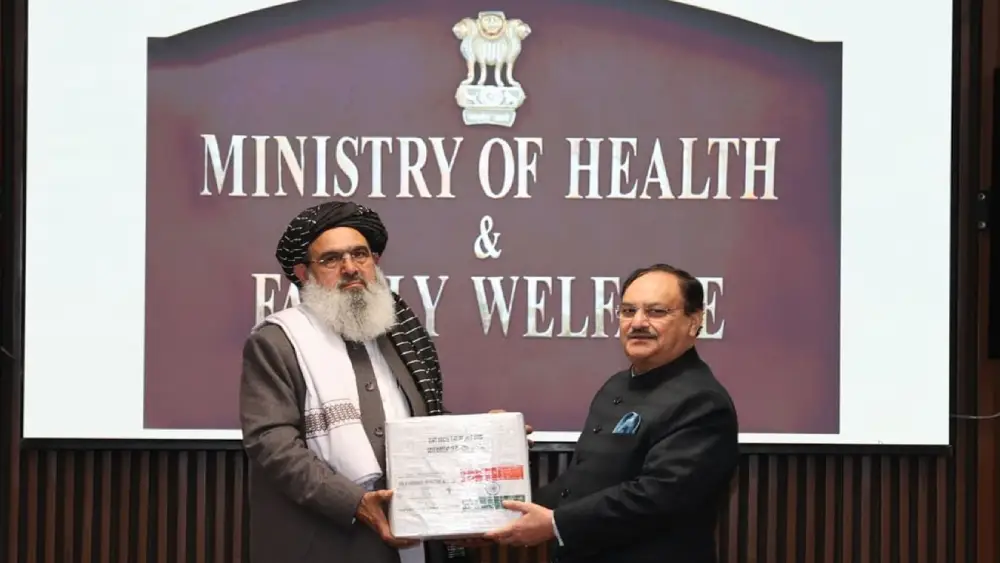
The discussions focused on ongoing health cooperation and explored avenues to further strengthen collaboration in healthcare infrastructure, medical supplies, and capacity building. Nadda emphasised that India’s engagement with Afghanistan, guided by Prime Minister Narendra Modi’s people-centric approach, remains focused on welfare, capacity building, and access to critical healthcare services. He added that India’s assistance is rooted in humanitarian considerations and the enduring bonds between the peoples of both countries.
India has implemented several key healthcare infrastructure projects in Afghanistan, including five maternity and health clinics in Paktia, Khost, and Paktika, a 30-bed hospital in Kabul, and the construction or upgradation of major facilities such as an Oncology Centre, Trauma Centre, Diagnostic Centre, and Thalassemia Centre in Kabul. Additional proposals for support are under active consideration.
Nadda noted that India has supplied 327 tonnes of medicines and vaccines to Afghanistan over the past four years. Cancer medicines and a CT scan machine requested by the Afghan Ministry of Public Health are ready for dispatch by the end of this month, while proposals for a radiotherapy machine and additional medical supplies are under processing.
Capacity-building initiatives were also discussed, including plans to send a team of senior Indian doctors to organise medical camps and training for Afghan doctors. The success of the Jaipur Foot Camp held in Kabul in June 2025, where 75 prosthetic limbs were fitted, was highlighted, with more camps planned in the coming year.
India reiterated its commitment to providing free treatment to Afghan patients with emergency or serious ailments and facilitating medical visas. Since the launch of a new Afghan visa module in April 2025, over 500 visas, including more than 200 medical visas, have been issued.
Nadda also recalled India’s broader humanitarian assistance, encompassing food grains, medicines, vaccines, emergency relief, and support for rehabilitation programmes in partnership with international organisations.
The meeting concluded with both sides expressing satisfaction over ongoing cooperation and reaffirming their shared commitment to strengthening healthcare support for the Afghan people.