SRINAGAR: Masoud Pezeshkian on Wednesday issued an open letter addressed to the people of the United States, asserting that Iran harbours “no enmity” toward ordinary Americans and warning that continued confrontation between the two countries is “more costly and futile than ever before.”
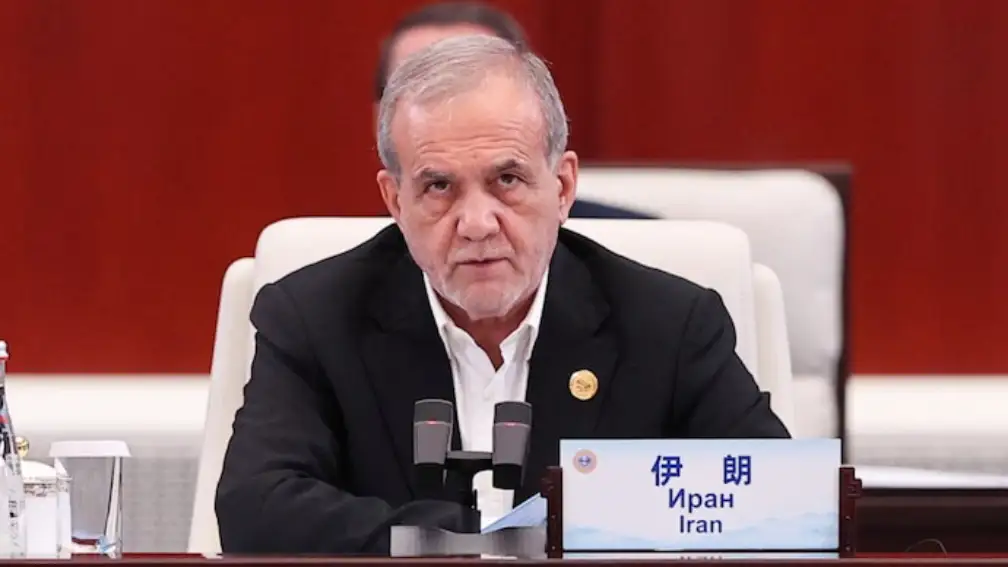
According to Press TV, the Iranian president said narratives portraying Iran as a threat are “neither consistent with historical reality nor with present-day observable facts,” and called for a reassessment of long-standing perceptions shaping bilateral tensions.
The letter was released hours before Donald Trump was scheduled to deliver what he described as an “important update” on the ongoing Iran conflict. Earlier in the day, Trump had stated on social media that Iran had sought a ceasefire, though no official confirmation was immediately available from Tehran.
Pezeshkian’s message struck a notably conciliatory tone, emphasising that the Iranian people distinguish between governments and citizens. “The Iranian people harbour no enmity toward other nations, including the people of America,” he wrote, framing hostility as a product of political decisions rather than public sentiment.
While the letter did not outline specific diplomatic steps, it underscored the possibility of engagement, stating that the global situation had reached a “crossroads” where the costs of continued confrontation outweigh potential gains.
The Iranian president traced tensions to historical events, particularly the 1953 Iranian coup d’état, which he described as a turning point that disrupted Iran’s democratic trajectory and fostered long-term distrust toward US policies.
He also cited subsequent developments—including U.S. support for the Shah, backing of Saddam Hussein during the Iran-Iraq War, and decades of sanctions—as factors deepening hostility between the two governments.
Addressing security concerns, Pezeshkian argued that Iran’s military posture is defensive, shaped by what he described as a significant U.S. military presence around the country. He maintained that Iran has not initiated wars in modern history and that its actions are “a measured response grounded in legitimate self-defense.”
The letter also criticised recent military actions targeting Iranian infrastructure, warning that such measures increase instability and have humanitarian consequences. He described attacks on energy and industrial facilities as actions that directly impact civilians and risk prolonging regional tensions.
In a pointed section, Pezeshkian questioned whether US involvement in the conflict aligns with American public interest, suggesting that Washington’s actions may be influenced by Israel and its regional security concerns.
He alleged that portraying Iran as a threat serves broader geopolitical and economic objectives, including sustaining military dominance and influencing global markets.
The Iranian president urged Americans to “look beyond the machinery of misinformation” and consider people-to-people interactions, citing the contributions of Iranian immigrants in academia and technology sectors globally.
He concluded by framing the current moment as a decisive juncture: “The choice between confrontation and engagement is both real and consequential; its outcome will shape the future for generations to come.”
No immediate response to the letter was issued by the White House.